A focused bibliometric exploration for developing Digital Official Document Passports in Mexico
1. Introduction
This second bibliometric analysis narrows the scope of the previous broad mapping on interoperability, data sharing, and digital public services. The first analysis established that digital government research is structured around concepts such as interoperability, e-government, public administration, public services, government data processing, data sharing, semantic interoperability, authentication, privacy, blockchain, artificial intelligence, digital transformation, and institutional governance.
This second analysis focuses more directly on the once-only principle, administrative data reuse, and the reduction of repeated information and document requests in digital government. This is highly relevant for your article idea:
Digital Official Document Passports as Data Governance Infrastructures for Administrative Simplification in Mexico
The once-only principle is important because it challenges one of the most inefficient practices in public administration: asking citizens and firms to repeatedly submit information or documents that the government has already collected, issued, validated, or stored. Under a once-only logic, public administrations should reuse existing authoritative data when legally permitted, instead of shifting the burden of interagency coordination onto citizens and businesses.
This connects directly with your proposed concept of Digital Official Document Passports. Official documents such as certificates, permits, licences, constancias, land-use authorisations, civil registry records, tax certificates, compliance certificates, and administrative resolutions should not remain static PDFs or paper-based outputs. They could instead be conceptualized as structured, verifiable, reusable, interoperable, and legally governed data objects.
In this sense, the once-only principle provides a stronger administrative and normative basis for your argument: if the state already has the data, or if it already issued the document, the citizen should not be forced to repeatedly prove the same thing.
2. Methodological note
This is a focused bibliometric analysis, not a full systematic literature review. Its purpose is to map the scientific landscape around the once-only principle and administrative data reuse, and to identify how this literature can support a conceptual article on Digital Official Document Passports in Mexico.
The analysis is based on a Scopus export file labelled:
scopus-export-20260506-Q4.csv
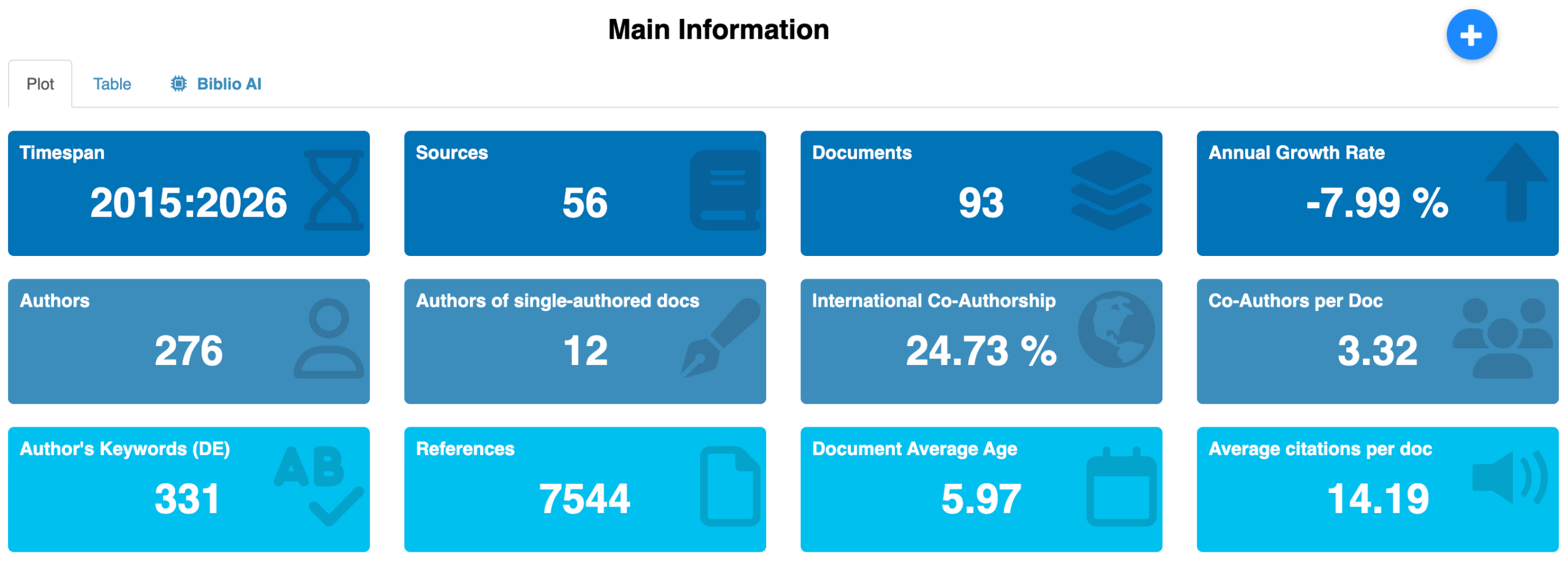
The export contains:
| Item | Result |
|---|---|
| Database | Scopus |
| Timespan | 2015–2026 |
| Documents | 93 |
| Sources | 56 |
| Authors | 276 |
| Author keywords | 331 |
| References | 7,544 |
| Average document age | 5.97 years |
| Average citations per document | 14.19 |
| International co-authorship | 24.73% |
| Co-authors per document | 3.32 |
| Authors of single-authored documents | 12 |
The intended refined Scopus query was:
TITLE-ABS-KEY(
  ("once-only principle" OR "once only principle" OR "once-only" OR "tell us once" OR "data reuse" OR "administrative data reuse")
  AND
  ("public administration" OR government OR "public sector" OR "digital government" OR "e-government" OR "public service*")
)
The CSV file itself does not embed the exact Scopus search history. Therefore, in the final academic article, the exact query should be copied directly from Scopus search history. Based on the filename and your description, I interpret this export as the focused Q4 query on once-only principle, data reuse, public administration, government, digital government, e-government, and public services.
The corpus contains:
| Document type | Number |
|---|---|
| Articles | 47 |
| Conference papers | 45 |
| Reviews | 1 |
Language coverage:
| Language | Number |
|---|---|
| English | 88 |
| Spanish | 5 |
Software/tools used:
Bibliometrix/Biblioshiny in RStudio, supported here by manual inspection of the Scopus CSV and the uploaded Bibliometrix screenshots.
Important limitation: because the query includes the broad term “data reuse”, the corpus also captures some documents that are not strictly about once-only government services. Some records relate to open data, data portals, health data, indigenous data governance, research data sharing, and even technically unrelated uses of “data reuse.” This is not a problem for exploratory mapping, but it means that a publishable article should include a manual relevance screening stage.
3. Descriptive overview of the corpus
The corpus is relatively small but analytically useful: 93 documents between 2015 and 2026. Its size confirms that this is a focused research niche compared with the broader interoperability and digital public services corpus.
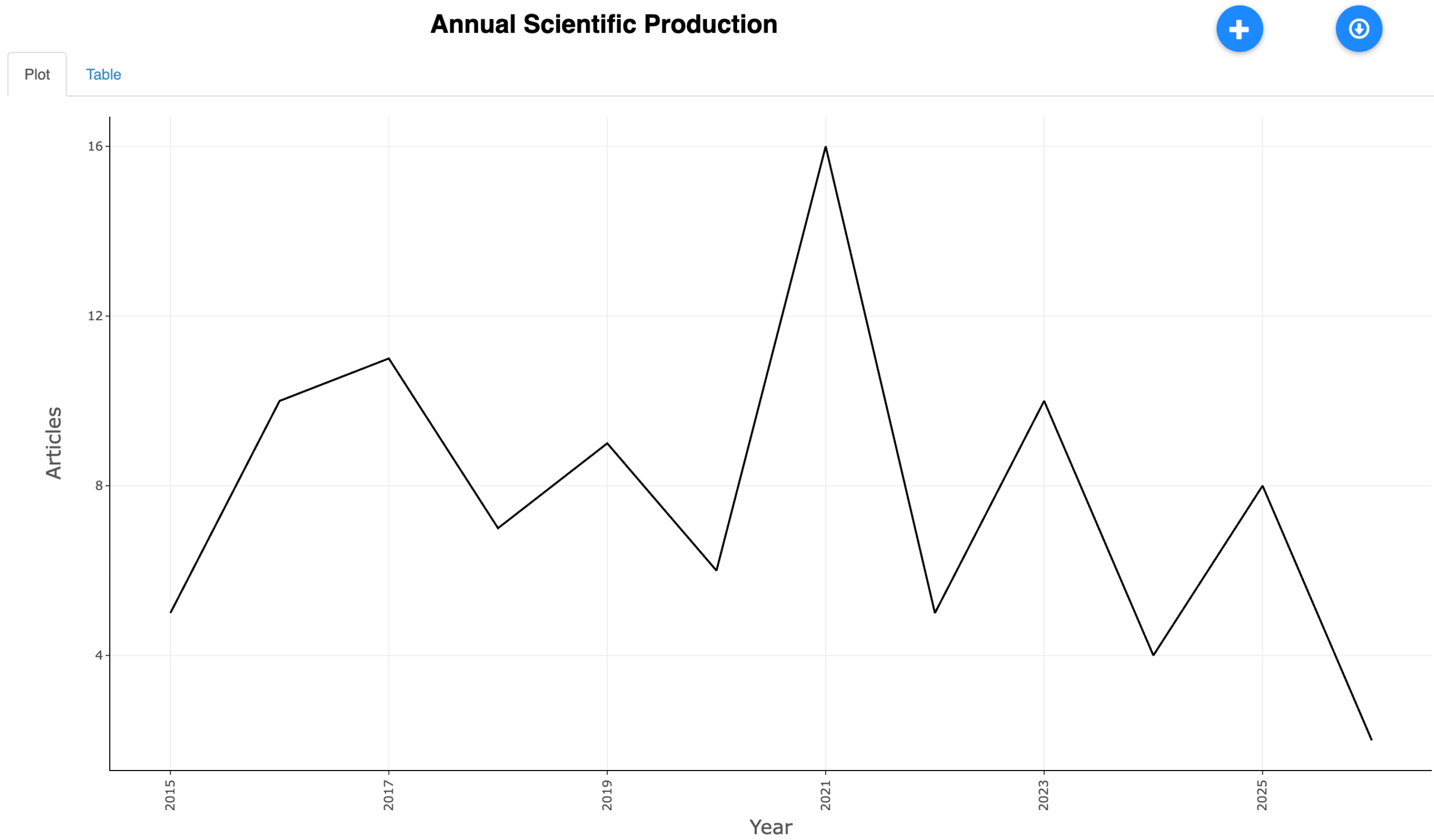
The annual production is uneven. The strongest year is 2021, with 16 documents. The years 2016, 2017, 2019, 2023, and 2025 also show visible activity. The apparent decline in 2026 should not be overinterpreted because 2026 is incomplete.
The annual growth rate shown in Bibliometrix is -7.99%, but this figure should be treated cautiously. In a small corpus with incomplete 2026 data, annual growth rates can be misleading.
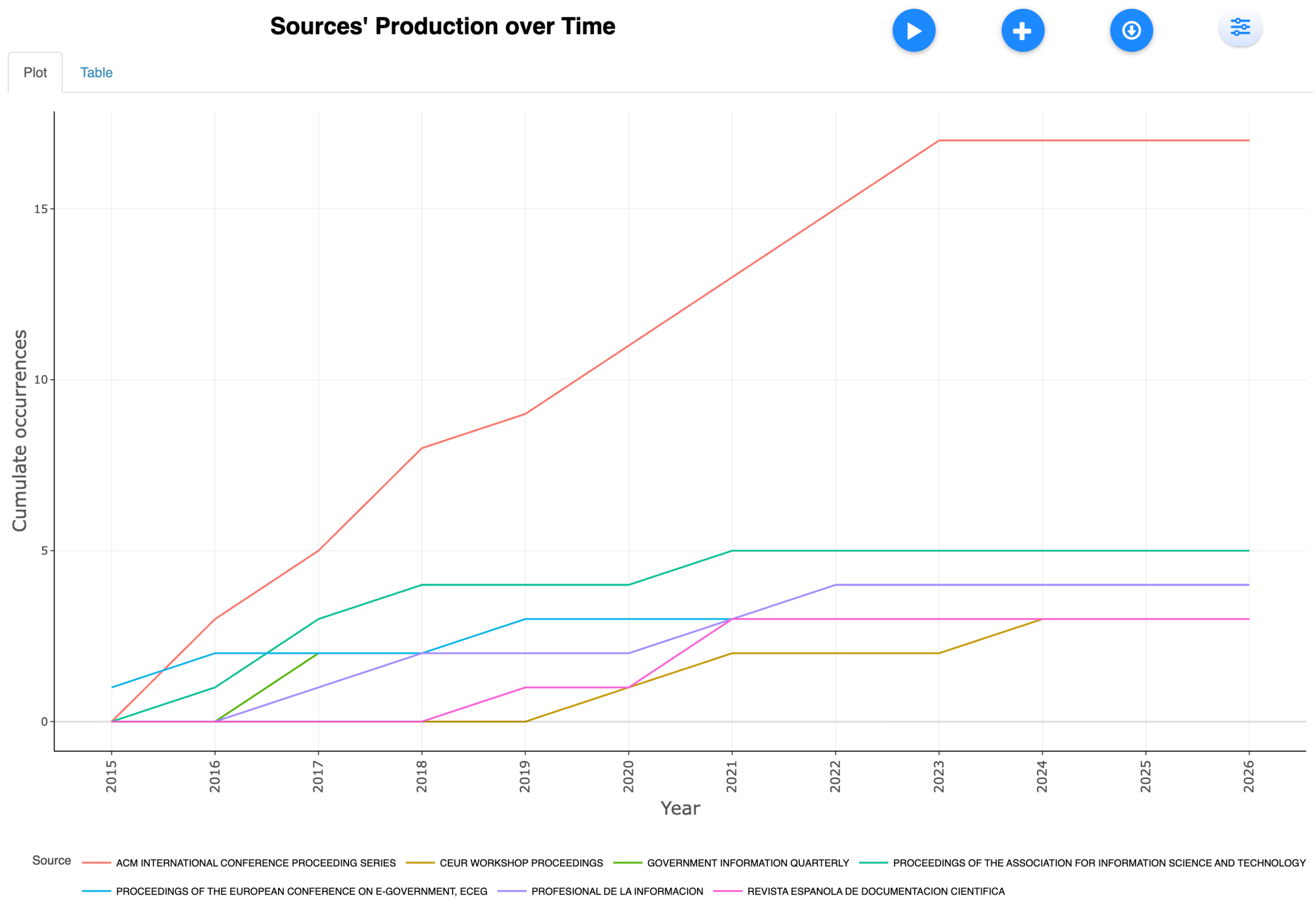
The most visible sources include:
| Source | Cumulative production pattern |
|---|---|
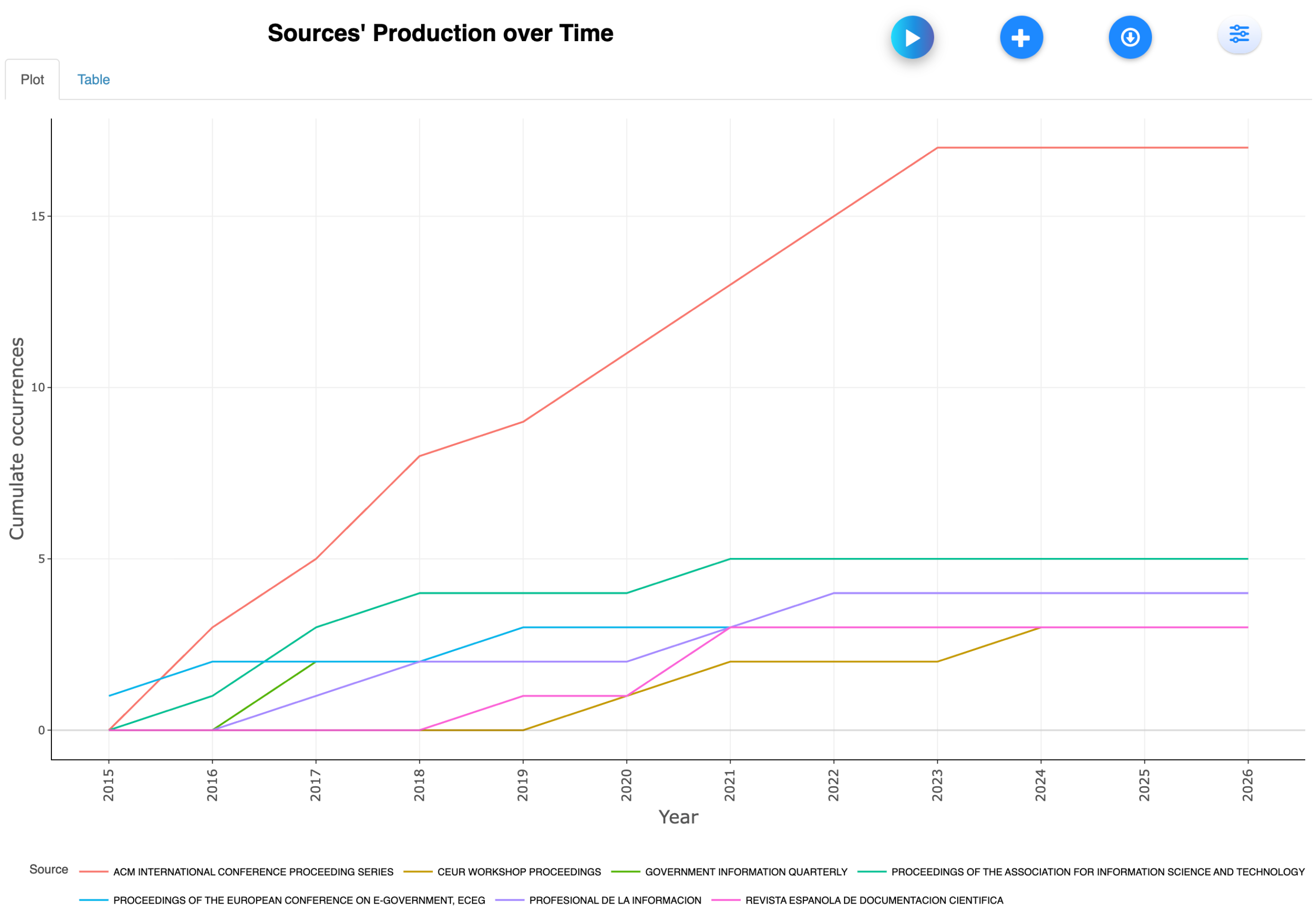
| ACM International Conference Proceeding Series | Dominant source, reaching 17 records |
| Proceedings of the Association for Information Science and Technology | 5 records |
| Government Information Quarterly | 4 records |
| Profesional de la Información | 4 records |
| Proceedings of the European Conference on e-Government | 3 records |
| CEUR Workshop Proceedings | 3 records |
| Revista Española de Documentación Científica | 3 records |
This confirms that the topic is located between digital government research, information systems, public administration, open data, and conference-based European e-government research.
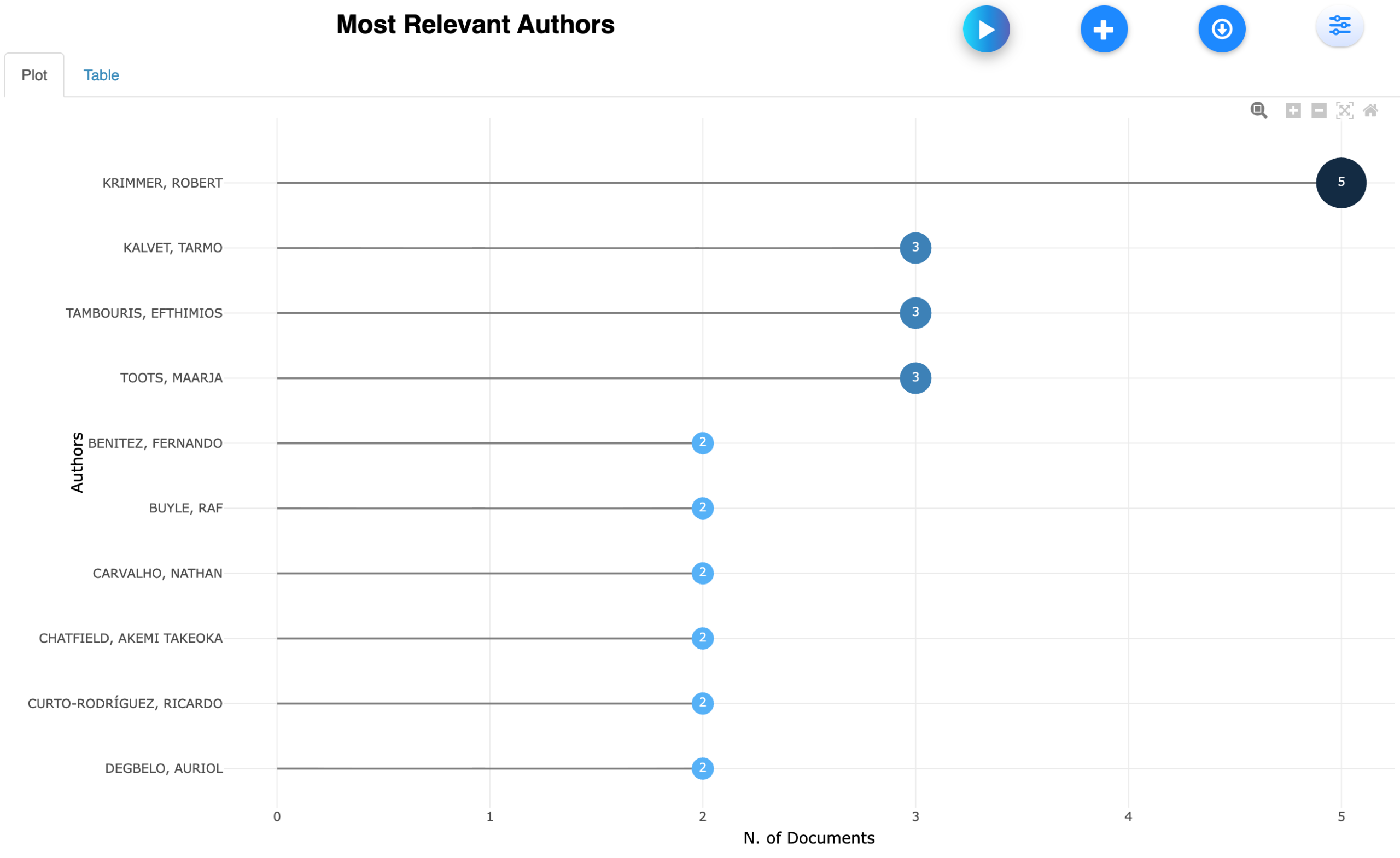
The most productive authors include:
| Author | Documents |
|---|---|
| Robert Krimmer | 5 |
| Tarmo Kalvet | 3 |
| Efthimios Tambouris | 3 |
| Maarja Toots | 3 |
| Fernando Benitez | 2 |
| Raf Buyle | 2 |
| Nathan Carvalho | 2 |
| Akemi Takeoka Chatfield | 2 |
| Ricardo Curto-Rodríguez | 2 |
| Auriol Degbelo | 2 |
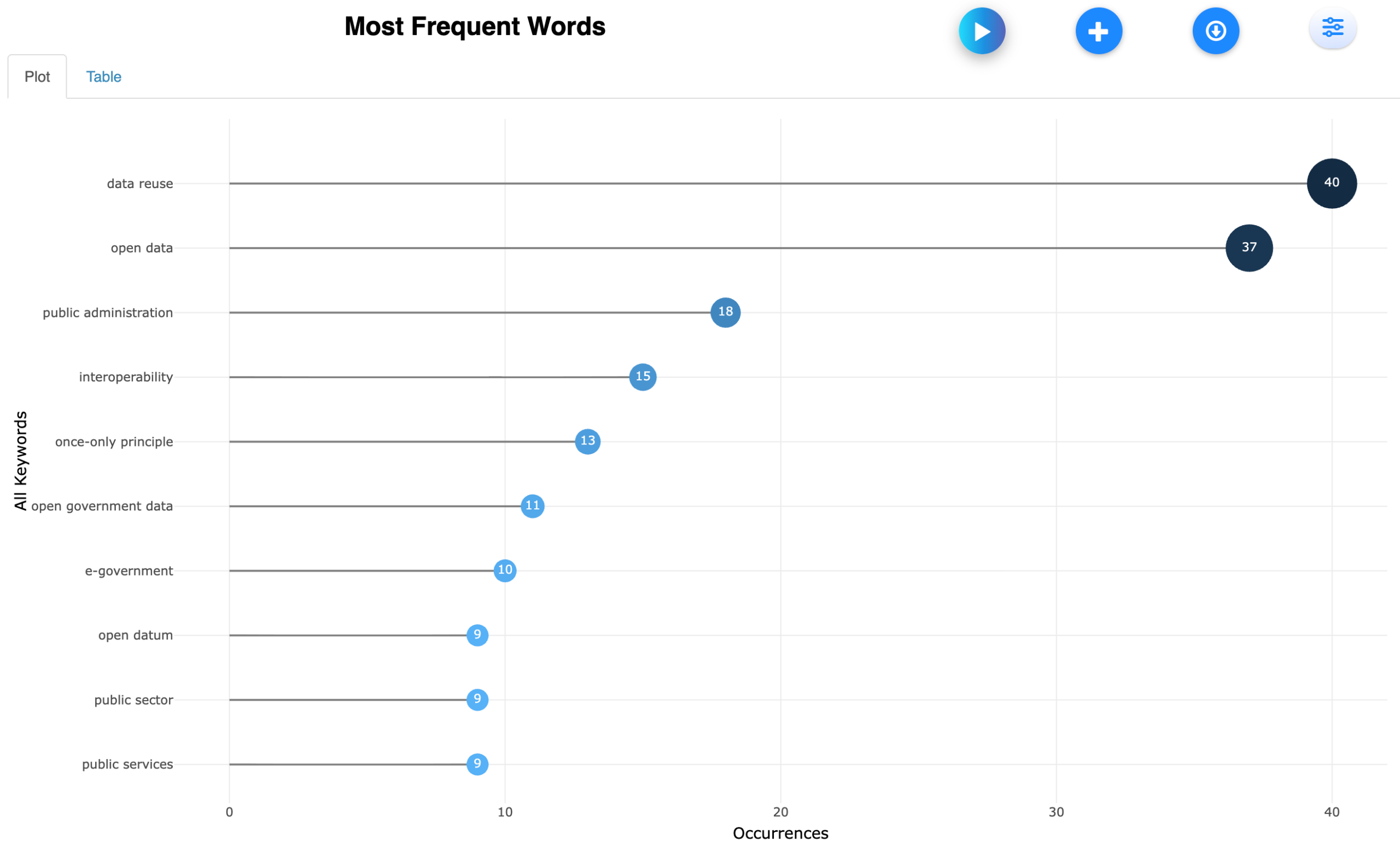
The most frequent keywords are highly relevant for your article:
| Keyword | Occurrences |
|---|---|
| Data reuse | 40 |
| Open data | 37 |
| Public administration | 18 |
| Interoperability | 15 |
| Once-only principle | 13 |
| Open government data | 11 |
| E-government | 10 |
| Open datum | 9 |
| Public sector | 9 |
| Public services | 9 |
This vocabulary shows that the corpus is structured around two related but not identical debates: open data/data reuse and once-only/interoperable public administration.
4. Annual scientific production
The annual production curve shows a small but persistent research field. The corpus starts in 2015 with 5 documents, rises in 2016 and 2017, fluctuates between 2018 and 2020, peaks in 2021, and then becomes uneven again.
This pattern suggests that the once-only/data reuse literature is not yet a fully consolidated mainstream field. It is better described as a specialized field with several peaks linked to European digital government initiatives, open government data research, and public-sector interoperability projects.
For your article, this is useful because it indicates that the topic is scientifically visible but still open for conceptual development. A paper on Digital Official Document Passports would not be entering an overcrowded field. It would be connecting an emerging policy principle — once-only government — with a new conceptual object: official documents as reusable, verifiable data containers.
5. Sources’ production over time
The sources’ production over time figure shows that ACM International Conference Proceeding Series is the main publication venue in the corpus. Its cumulative production rises strongly between 2016 and 2023 and then stabilizes. This suggests that much of the once-only and interoperability discussion has been developed in conference communities, especially those connected to e-government, digital public services, and information systems.
Government Information Quarterly appears with fewer documents but is important because of its disciplinary weight in digital government studies. Profesional de la Información and Revista Española de Documentación Científica point to an additional stream around open data, public-sector information, and Spanish-language or Spain-related research.
For your article, this means the literature is not located in a single disciplinary home. It is distributed across:
- digital government;
- public administration;
- information systems;
- open data;
- public-sector information management;
- European e-government conferences.
This interdisciplinary positioning supports your own approach, which combines public administration, data governance, interoperability, legal validity, and institutional analysis.
6. Author production over time
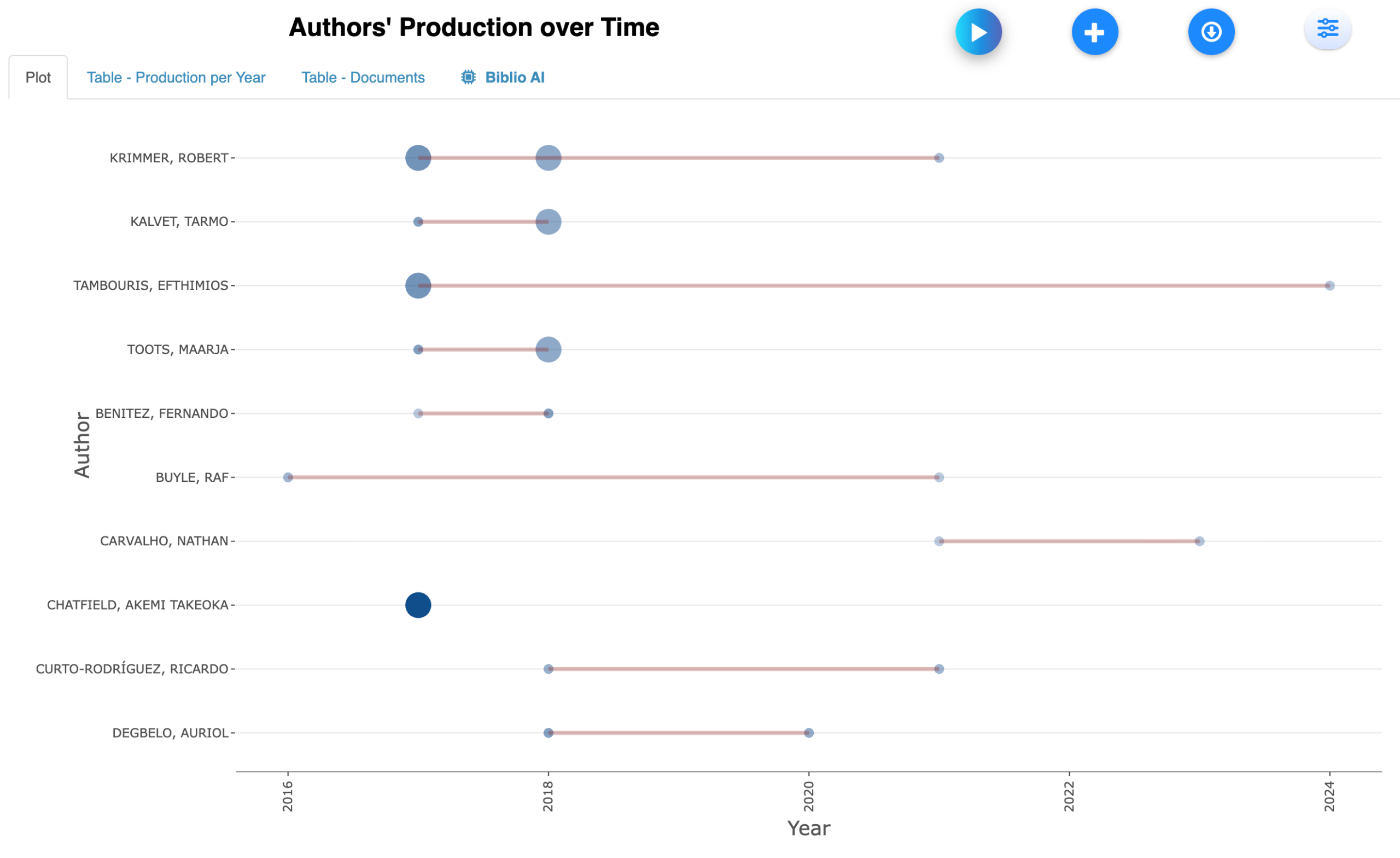
The author production figures show that the field is concentrated around a small number of recurring authors, but it is not dominated by a single scholar.
Robert Krimmer is the most productive author in this focused corpus, with five documents. His production is concentrated around 2017–2021 and is strongly associated with the once-only principle, cross-border e-government services, and the European Digital Single Market.
Tarmo Kalvet, Maarja Toots, and Efthimios Tambouris also appear as central contributors. Their work is connected to once-only implementation, expected benefits, barriers, drivers, public-sector interoperability, and European digital government infrastructures.
Other authors such as Buyle, Mannens, Carvalho, Degbelo, Benitez, Curto-Rodríguez, and Chatfield represent related streams on open data, linked data, data reuse, open government data portals, and public-sector information infrastructures.
The author pattern suggests that the once-only principle literature is specialized and partially concentrated in European digital government research, while the broader data reuse literature is more dispersed across open data and information systems communities.
For your article, this is useful because it shows that once-only is not just a generic administrative idea. It has a recognizable scholarly community, especially around European e-government, cross-border public services, and interoperability projects.
7. Country production and collaboration
The country analysis was reconstructed from the affiliation fields in the Scopus CSV. The strongest countries detected are:
| Country | Approximate document presence |
|---|---|
| Spain | 15 |
| United States | 14 |
| Greece | 11 |
| Germany | 10 |
| Estonia | 8 |
| Belgium | 6 |
| Taiwan | 5 |
| China | 5 |
| Sweden | 5 |
| Australia | 4 |
| Netherlands | 4 |
| Croatia | 4 |
| North Macedonia | 4 |
The strongest detected collaboration links include:
| Country pair | Joint records |
|---|---|
| Estonia–Greece | 3 |
| Greece–North Macedonia | 3 |
| Austria–Estonia | 2 |
| Australia–United States | 2 |
| Estonia–Netherlands | 2 |
| Germany–Spain | 2 |
| Belgium–Germany | 2 |
| Estonia–North Macedonia | 2 |
| Croatia–Netherlands | 2 |
| Estonia–Germany | 2 |
The country pattern reinforces the European character of the once-only principle literature. Estonia, Greece, Germany, Belgium, the Netherlands, Austria, Croatia, North Macedonia, Spain, and Sweden appear as important nodes. This is consistent with the policy relevance of the once-only principle in the European Union, especially for cross-border digital public services, the Single Digital Gateway, and once-only technical systems.
Mexico does not appear as an affiliated country in the detected records. Latin America is also marginal, although some open geodata reuse studies involve cases such as Colombia and Spain.
This absence is very important for your research. It suggests a clear opportunity: a Mexican contribution could extend the once-only/data reuse debate beyond the European context and apply it to administrative simplification, official documents, legal validity, and intergovernmental coordination in Latin America.
8. Most globally cited documents
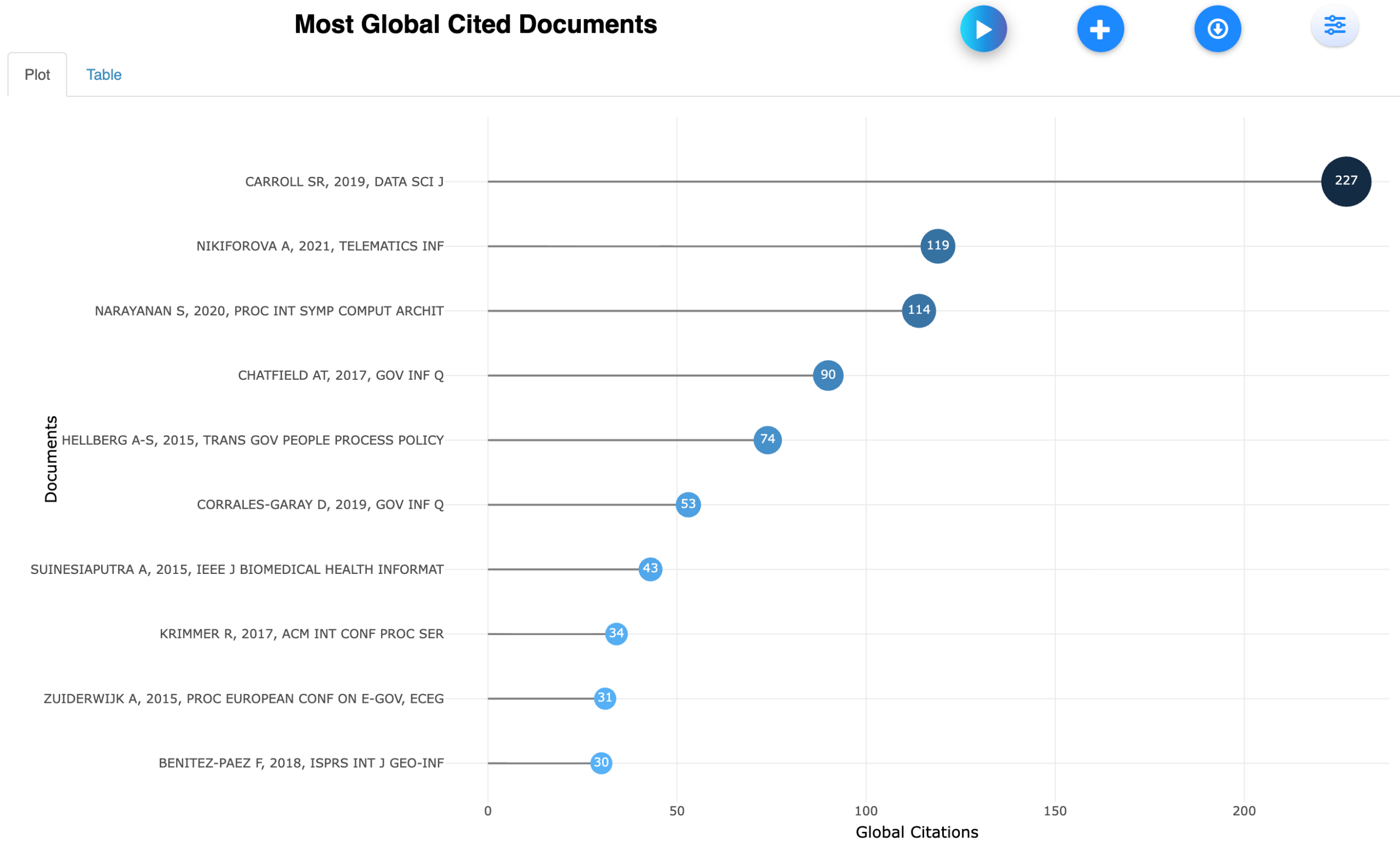
The most globally cited documents in this focused corpus include both directly relevant and indirectly relevant works.
The strongest globally cited document is Carroll et al. (2019) on Indigenous data governance, with 227 citations. This paper is not directly about the once-only principle, but it is highly relevant to the governance dimension of data reuse. It reminds us that data reuse is never neutral: it raises questions of sovereignty, control, ownership, legitimacy, and power.
The second major document is Nikiforova and McBride (2021) on open government data portal usability, with 119 citations. This is relevant because data reuse depends not only on availability but also on usability, discoverability, understandability, and user-centred design.
The corpus also includes Chatfield and Reddick (2017) on open data portal service capability, Hellberg and Hedström (2015) on the myth that the public automatically wants to use open data, and Corrales-Garay et al. (2019) on open data themes and future research. These documents show that data reuse requires institutional, technical, and social conditions.
The most directly relevant once-only document among the highly cited items is:
Krimmer, Kalvet, Toots, Cepilovs, and Tambouris (2017), “Exploring & demonstrating the once-only principle: A European perspective.”
Its abstract is directly aligned with your article. It describes a large-scale European project to implement the once-only principle, connect information systems across countries, and identify drivers and barriers such as data protection, data-sharing requirements, implementation costs, public-sector silos, and legal barriers.
Other directly relevant documents include:
- Wimmer et al. (2017), “Once only principle: Benefits, barriers & next steps.”
- Kalvet, Toots, and Krimmer (2018), “Contributing to a digital single market for Europe.”
- Kalvet et al. (2018), “Cross-border e-government services in Europe.”
- Schmidt, Krimmer, and Lampoltshammer (2021), on the Single Digital Gateway Regulation and the once-only principle.
- Mikiver and Tupay (2023), on the tension between GDPR and the once-only principle.
- Argyropoulou et al. (2024), on legal aspects of the once-only principle in the EU.
- Lenk and Ulrich (2024), on Swiss national data management and once-only implementation.
- Guzmán and Karunaratne (2025), on semantic elicitation of EU-wide evidence for public services.
For your article, the most important insight is that the globally cited list confirms two things: the data reuse literature provides the broader data-governance and usability foundation, while the once-only literature provides the specific administrative simplification argument.
9. Most locally cited references
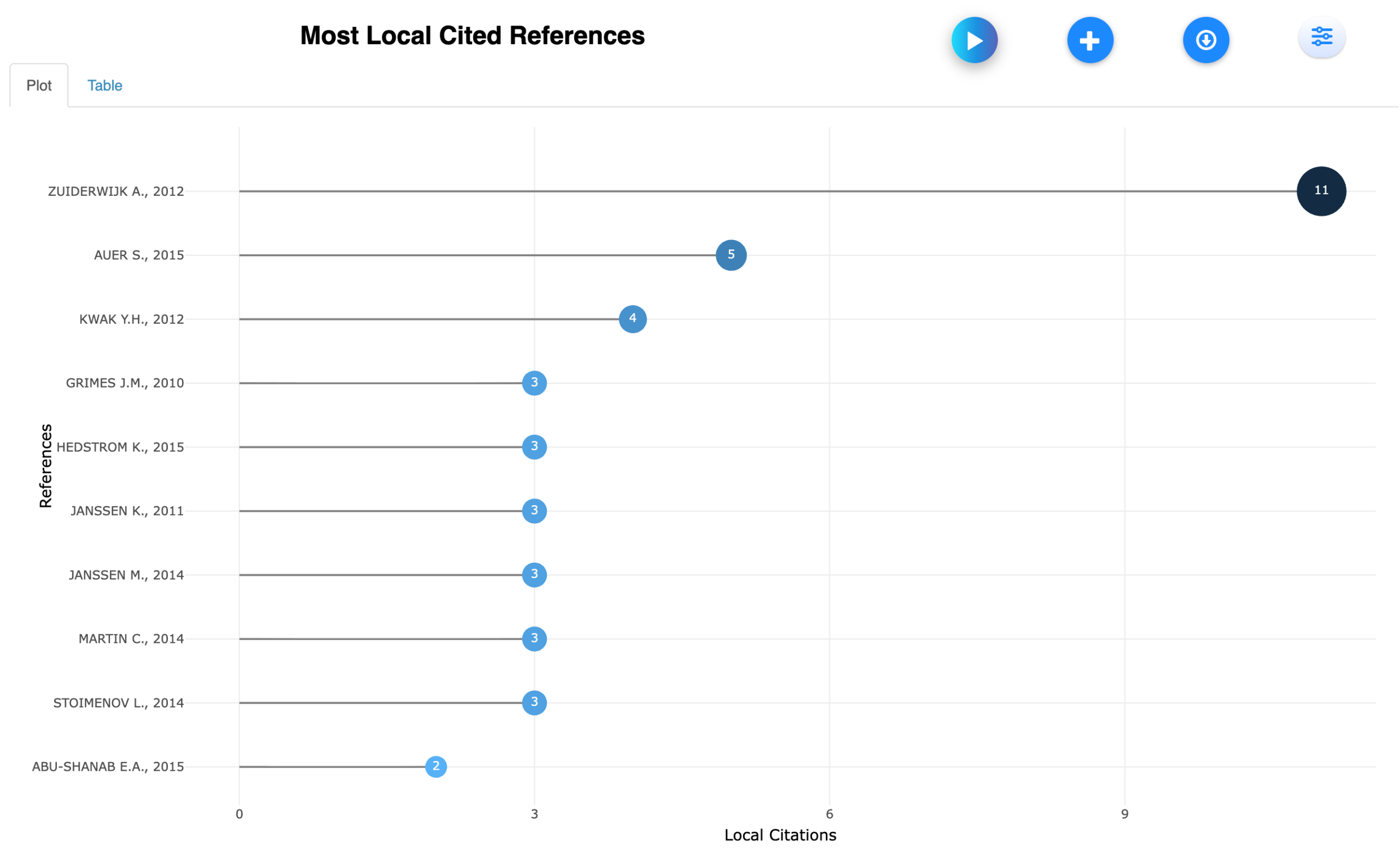
The local citation figure shows which references are most frequently cited inside this specific corpus.
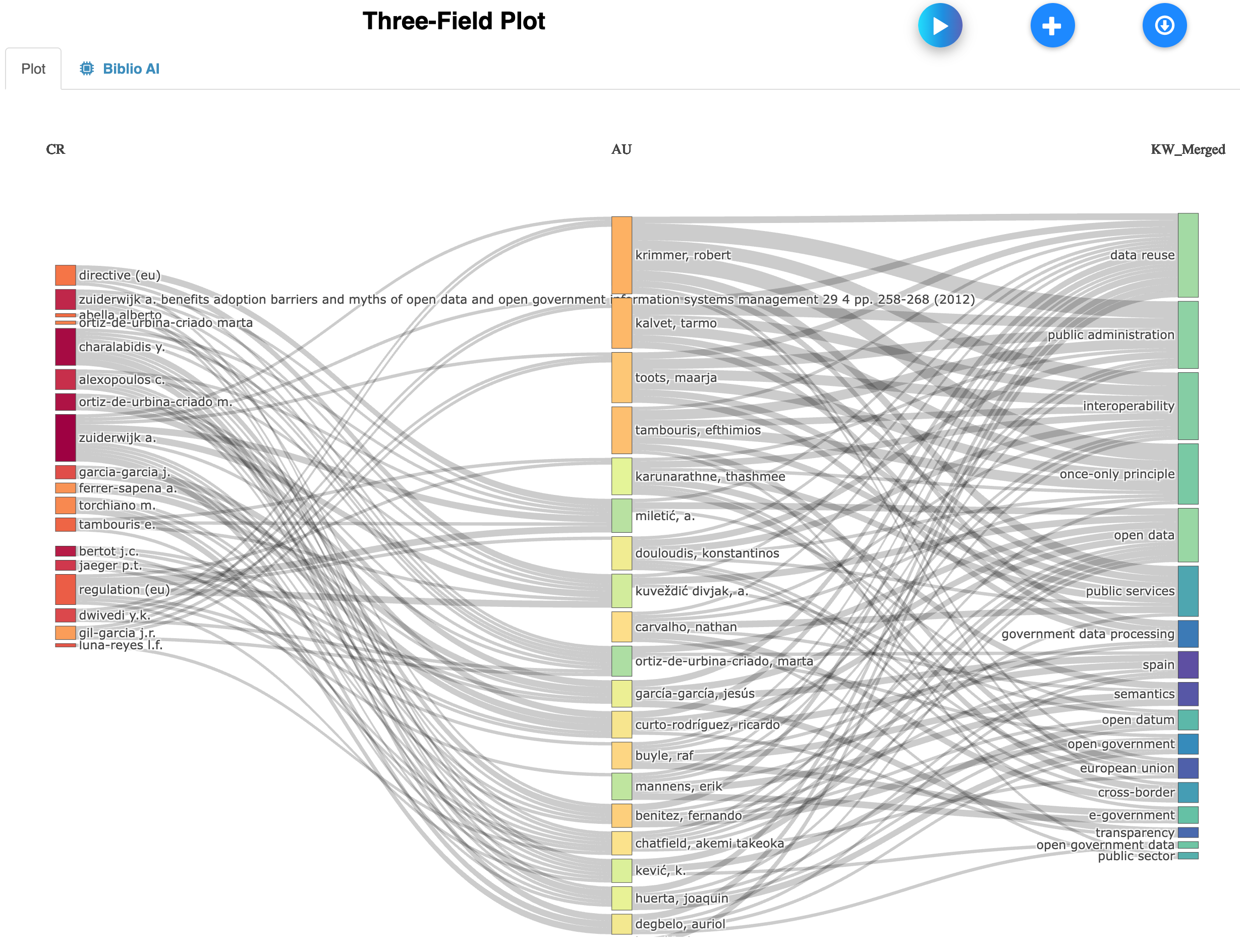
The most locally cited reference is Zuiderwijk et al. (2012), with 11 local citations. This confirms the importance of open data adoption, open government data barriers, and the practical conditions for data reuse.
Other locally cited references include Auer (2015), Kwak (2012), Grimes (2010), Hedström (2015), Janssen (2011), Janssen (2014), Martin (2014), Stoimenov (2014), and Abu-Shanab (2015).
This local citation structure suggests that the internal foundations of the corpus are closer to open data and public-sector data reuse than to a fully developed theory of official documents or legal validity. This is both a strength and a gap.
It is a strength because it provides a strong basis for arguing that data reuse is a recognized public-sector problem. It is a gap because the literature does not yet appear to fully conceptualize official documents as reusable data objects with legal validity, verification mechanisms, and institutional responsibilities.
That gap is precisely where your Digital Official Document Passport concept can contribute.
10. Most frequent words and keyword evolution
The most frequent words confirm that this corpus is not simply a duplicate of the broader interoperability mapping. Its dominant vocabulary is more focused:
- data reuse
- open data
- public administration
- interoperability
- once-only principle
- open government data
- e-government
- public sector
- public services
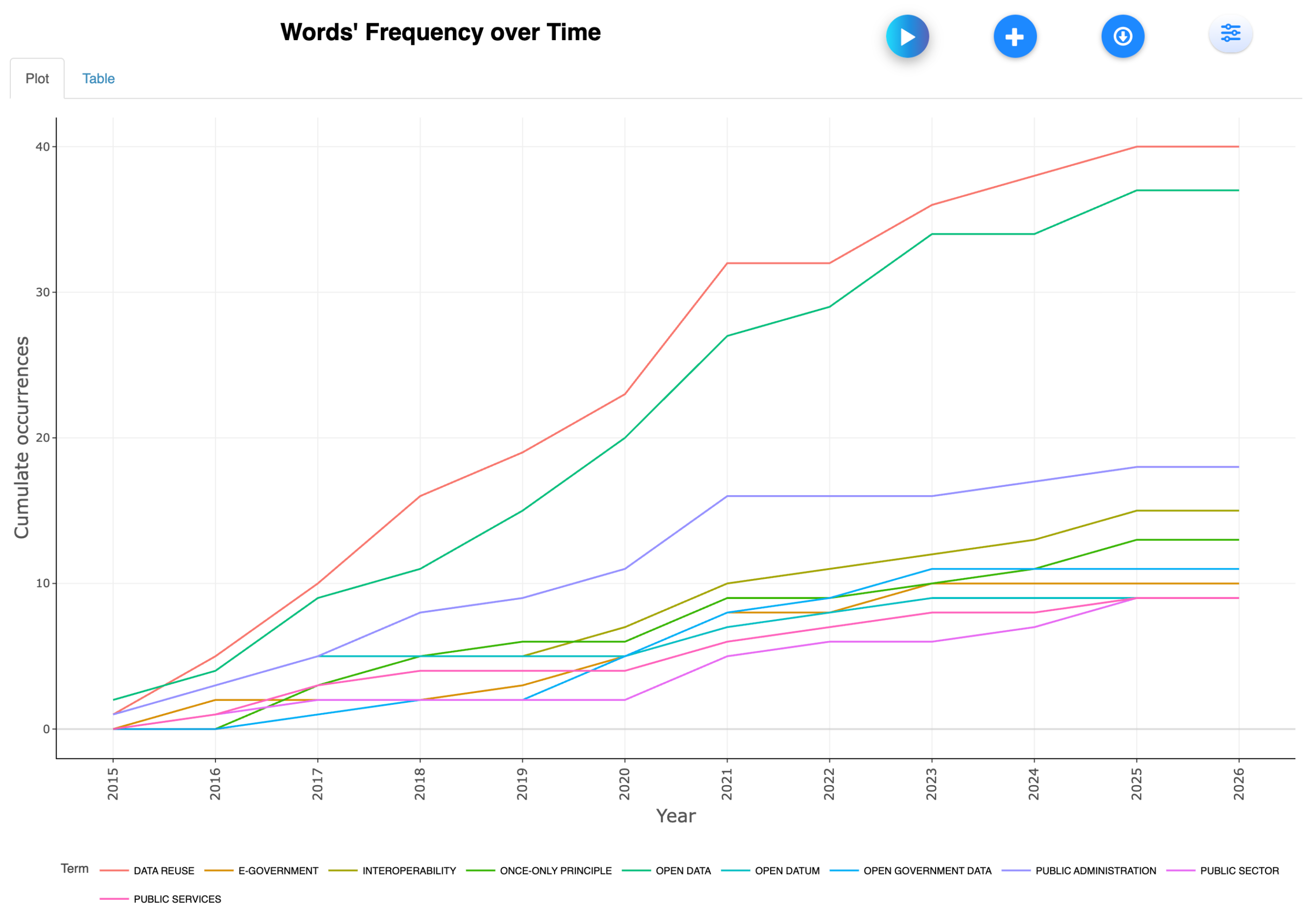
The words’ frequency over time figure shows that data reuse and open data are the dominant cumulative terms. Both grow steadily from 2015 onward and remain the strongest concepts by 2025–2026.
Public administration grows as a secondary but important theme. Interoperability and once-only principle appear with lower cumulative counts but are strategically important because they connect open data/data reuse with administrative simplification and public service delivery.
For your article, this means the corpus supports your argument in two ways.
First, the data reuse/open data vocabulary supports the idea that public-sector data should be reused, not repeatedly recollected.
Second, the once-only/interoperability/public administration vocabulary supports the idea that this reuse must happen through institutional, semantic, legal, and technical arrangements within government.
However, the vocabulary also shows a limitation: terms such as official documents, legal validity, document verification, digital identity, and document lifecycle are not dominant. This means your article should not claim that the current literature has already developed the Digital Official Document Passport concept. Instead, it should argue that the literature provides the building blocks, while your article contributes the missing conceptual integration.
11. Trend topics
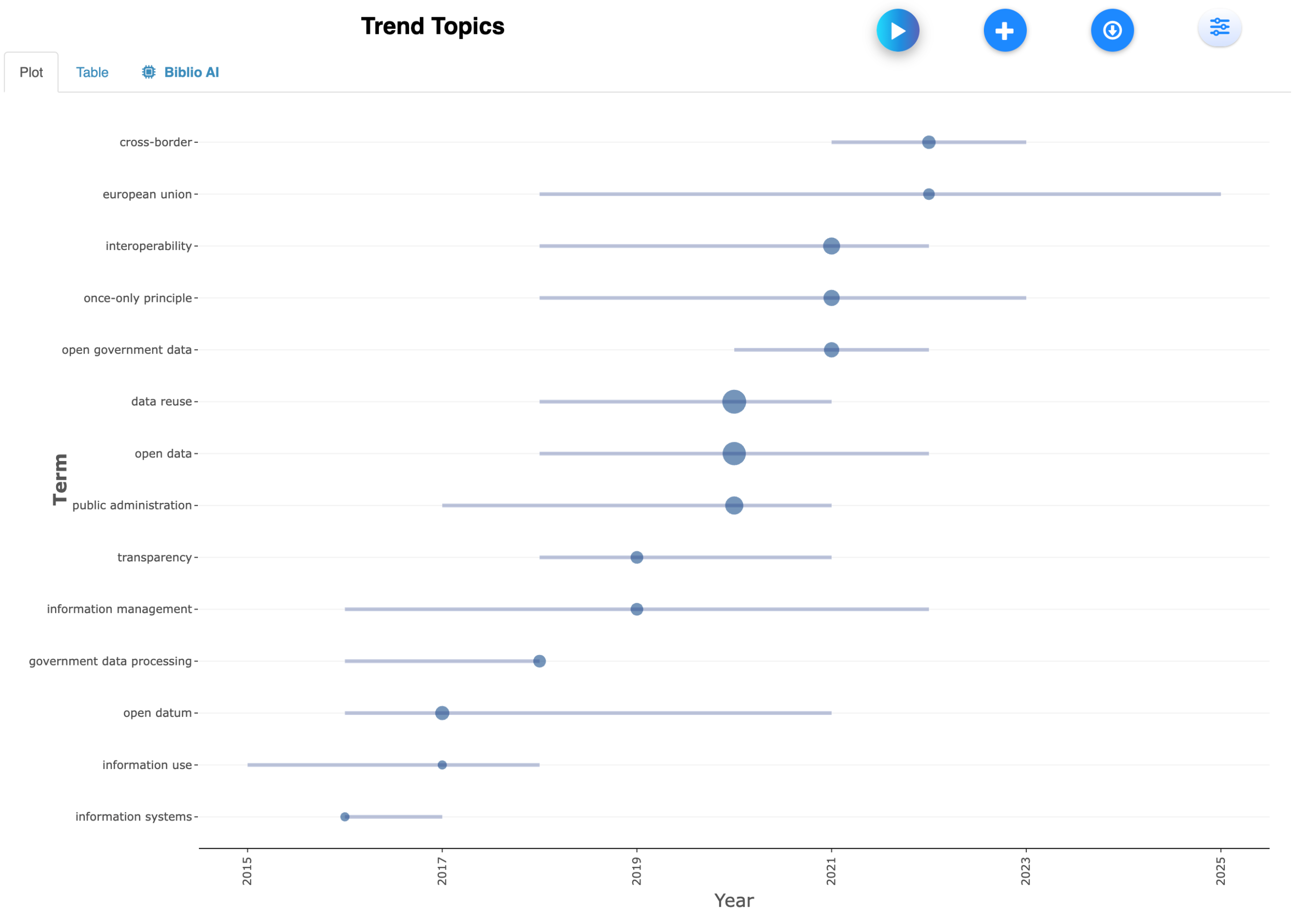
The trend topics figure shows an evolution from earlier information and open-data concepts toward interoperability, once-only, cross-border services, and European Union themes.
Earlier terms include:
- information systems
- information use
- open datum
- government data processing
- information management
These indicate that early contributions were concerned with data availability, information systems, and public-sector information processing.
The middle period shows the growth of:
- data reuse
- open data
- public administration
- transparency
- interoperability
- open government data
This reflects the consolidation of public-sector data reuse and open government data as major concerns.
More recent or strategically visible terms include:
- once-only principle
- European Union
- cross-border
- public administration
- interoperability
This indicates that the field is moving from general open data reuse toward administrative simplification, service integration, and cross-border public-service interoperability.
For your article, this supports an important argument: the once-only principle represents a shift from “open data for reuse by external users” toward “administrative data reuse inside and across public administrations.”
That shift is central to Digital Official Document Passports. The goal is not merely to publish data. The goal is to make legally relevant government-held information reusable for administrative purposes, with clear safeguards.
12. Co-occurrence network
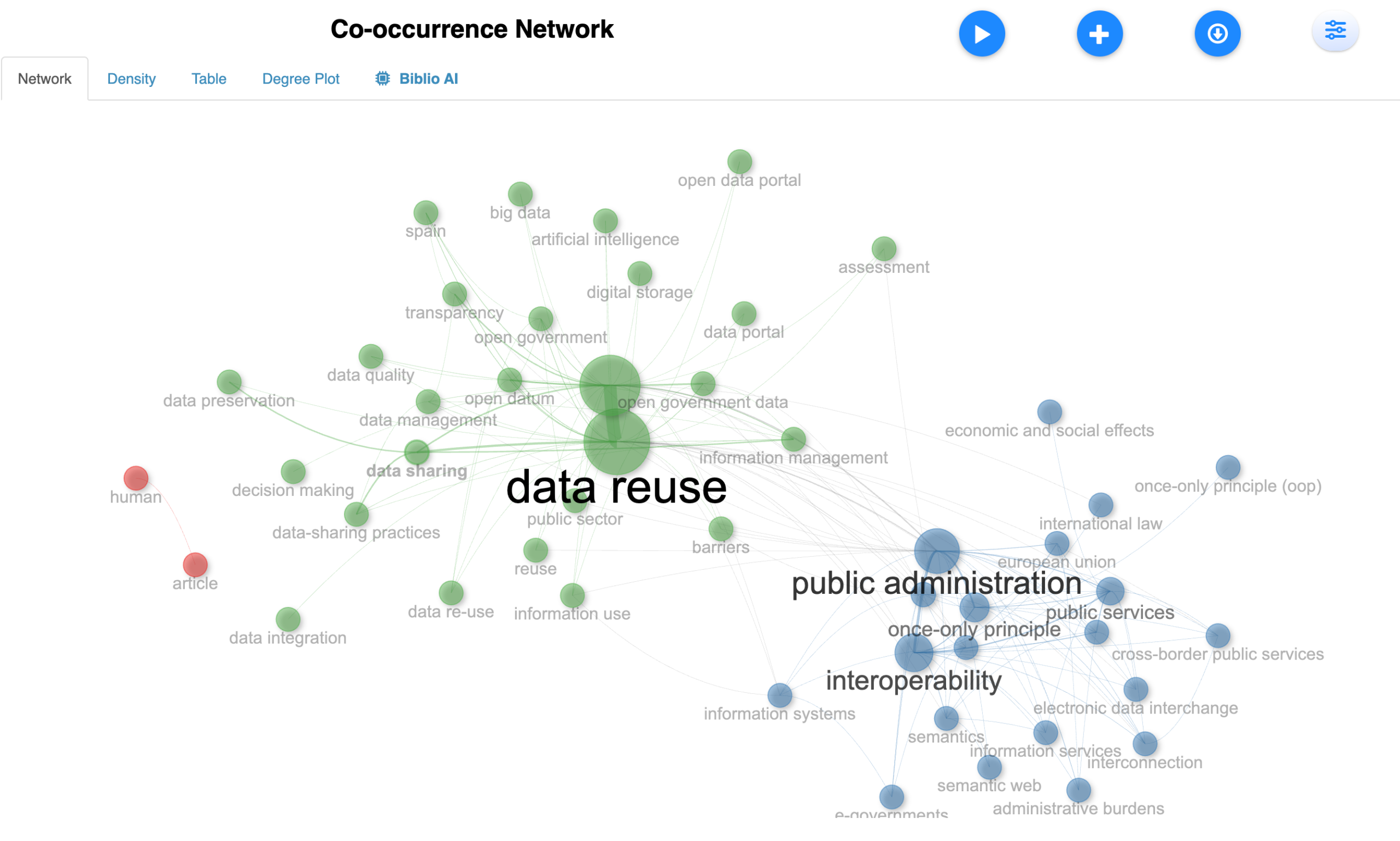
The co-occurrence network shows two major conceptual clusters.
Cluster 1: Data reuse and open data infrastructure
This cluster is organized around:
- data reuse
- open data
- open government data
- data sharing
- data management
- data quality
- transparency
- data portal
- open data portal
- information management
- public sector
- reuse
- data re-use
- data integration
- artificial intelligence
- big data
This cluster is about the conditions that make public-sector data reusable: availability, quality, portals, metadata, data management, user needs, and reuse practices.
For your article, this cluster contributes the data-governance foundation. It helps argue that official documents should not be seen only as legal artifacts; they are also public-sector data resources that require quality, metadata, management, discoverability, and reuse conditions.
Cluster 2: Public administration, interoperability, and once-only public services
This cluster is organized around:
- public administration
- interoperability
- once-only principle
- public services
- European Union
- cross-border
- cross-border public services
- electronic data interchange
- semantics
- semantic web
- administrative burdens
- interconnection
- information services
- e-government
This cluster is the most directly relevant to your Digital Official Document Passport concept. It links the once-only principle to interoperability, administrative burden reduction, semantic exchange, and cross-border public services.
For your article, this cluster supports the argument that repeated document requests are not only a citizen-service problem. They are symptoms of deeper institutional fragmentation: agencies cannot yet exchange, verify, or reuse official data in a legally and semantically reliable way.
Peripheral/noise cluster
A small peripheral cluster includes:
- human
- article
This appears to be a generic indexing artifact rather than a substantive research theme.
Gap revealed by the network
The co-occurrence network shows a clear gap. The corpus contains concepts such as metadata, semantics, interoperability, data reuse, once-only principle, administrative burdens, and public services, but it does not strongly foreground:
- official documents;
- legal validity of documents;
- document verification;
- digital identity;
- verifiable credentials;
- document lifecycle governance;
- documentary evidence;
- authoritative source registries.
This gap is highly valuable. It suggests that your article can make a contribution by explicitly connecting the once-only/data reuse literature with the institutional design of official document infrastructures.
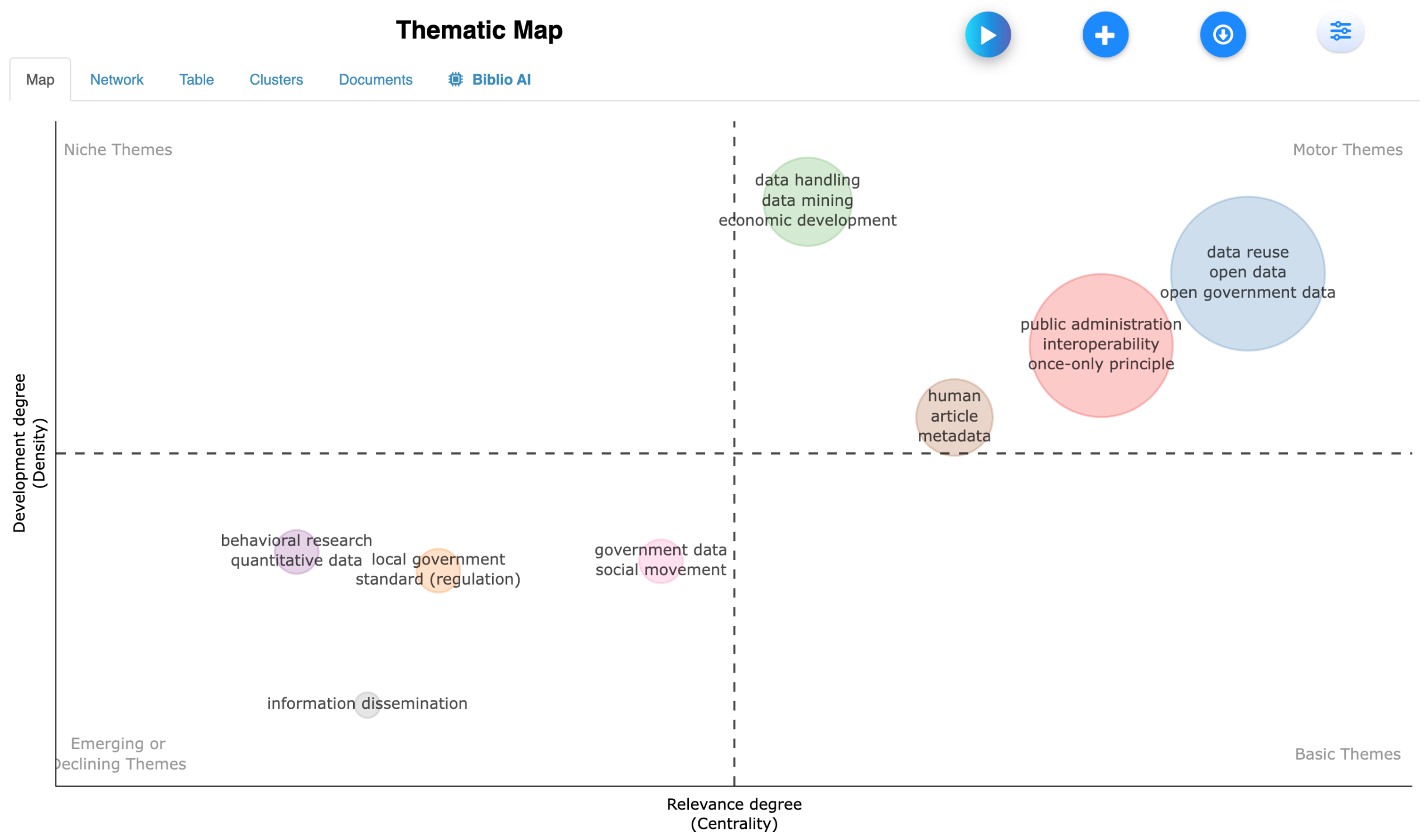
13. Thematic map
The thematic map provides a strategic view of the field.
Motor themes
The strongest motor theme is:
data reuse – open data – open government data
This theme is both central and well developed. It represents the mature part of the corpus: public-sector data reuse through open data infrastructures.
A second motor theme is:
public administration – interoperability – once-only principle
This is the most important theme for your article. It indicates that the once-only principle is not isolated. It is conceptually linked to public administration and interoperability.
A smaller motor or near-motor theme includes:
data handling – data mining – economic development
This suggests that some parts of the data reuse literature are connected to economic value, data analytics, and data exploitation.
Niche themes
Some specialized themes include:
- human – article – metadata
- behavioural research – quantitative data
- local government – standard regulation
These appear more specialized or methodologically specific.
Emerging or declining themes
Themes such as:
- information dissemination
- government data – social movement
appear less central and less developed. They may represent peripheral applications or older discussions.
Positioning Digital Official Document Passports
Your Digital Official Document Passport concept would sit between two motor themes:
- data reuse – open data – open government data
- public administration – interoperability – once-only principle
However, it would add a missing third layer:
legal validity – verification – authoritative documents – institutional responsibility
That is the key conceptual contribution. The thematic map shows the foundation, but your concept adds the documentary and legal-governance dimension.
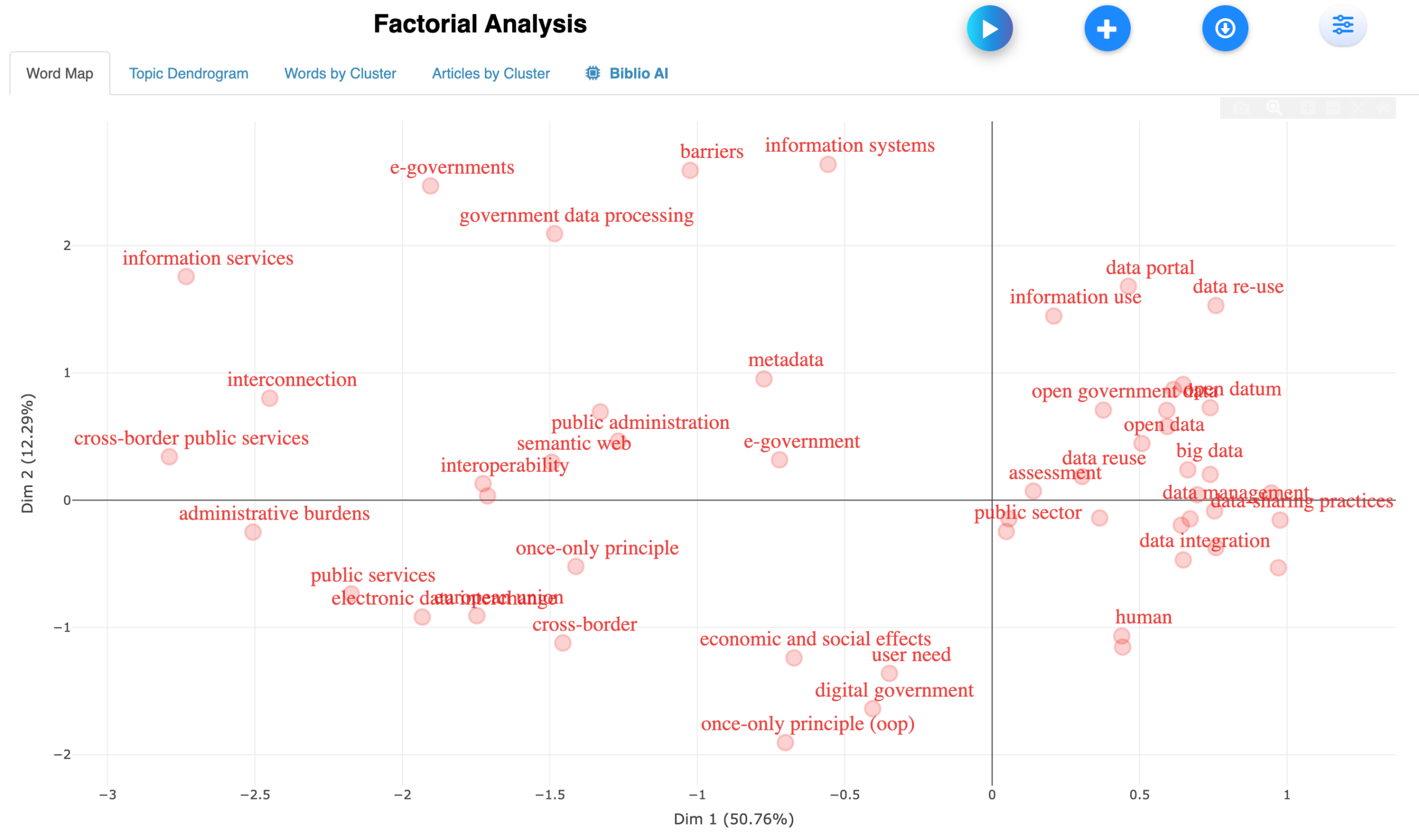
14. Factorial analysis / conceptual structure map
The factorial analysis is especially useful because it shows a clear separation between two logics.
Dimension 1 explains 50.76% of the conceptual structure. Dimension 2 explains 12.29%. Together, they explain a substantial share of the conceptual map.
The right side of the map includes:
- data reuse
- open data
- open government data
- open datum
- data portal
- data re-use
- data management
- data-sharing practices
- data integration
- information use
- public sector
This side represents a data reuse / open data / data management logic.
The left side includes:
- once-only principle
- once-only principle (OOP)
- interoperability
- public administration
- public services
- electronic data interchange
- cross-border
- administrative burdens
- semantic web
- government data processing
- e-government
- digital government
This side represents an administrative simplification / public service / interoperability logic.
This directly confirms your intuition. The corpus does separate into two conceptual orientations:
| Logic | Main concern | Relevance for your article |
|---|---|---|
| Administrative simplification / service delivery logic | Reducing burdens, integrating services, enabling once-only public administration | Supports the normative argument for not repeatedly asking citizens for documents |
| Data reuse / interoperability / governance logic | Reusing public-sector data through portals, data management, open data, metadata, and integration | Supports the operational data-governance architecture for Digital Official Document Passports |
Your article can contribute by integrating these two logics into one framework: official documents as reusable, verifiable, legally governed public-sector data objects.
15. Co-citation network
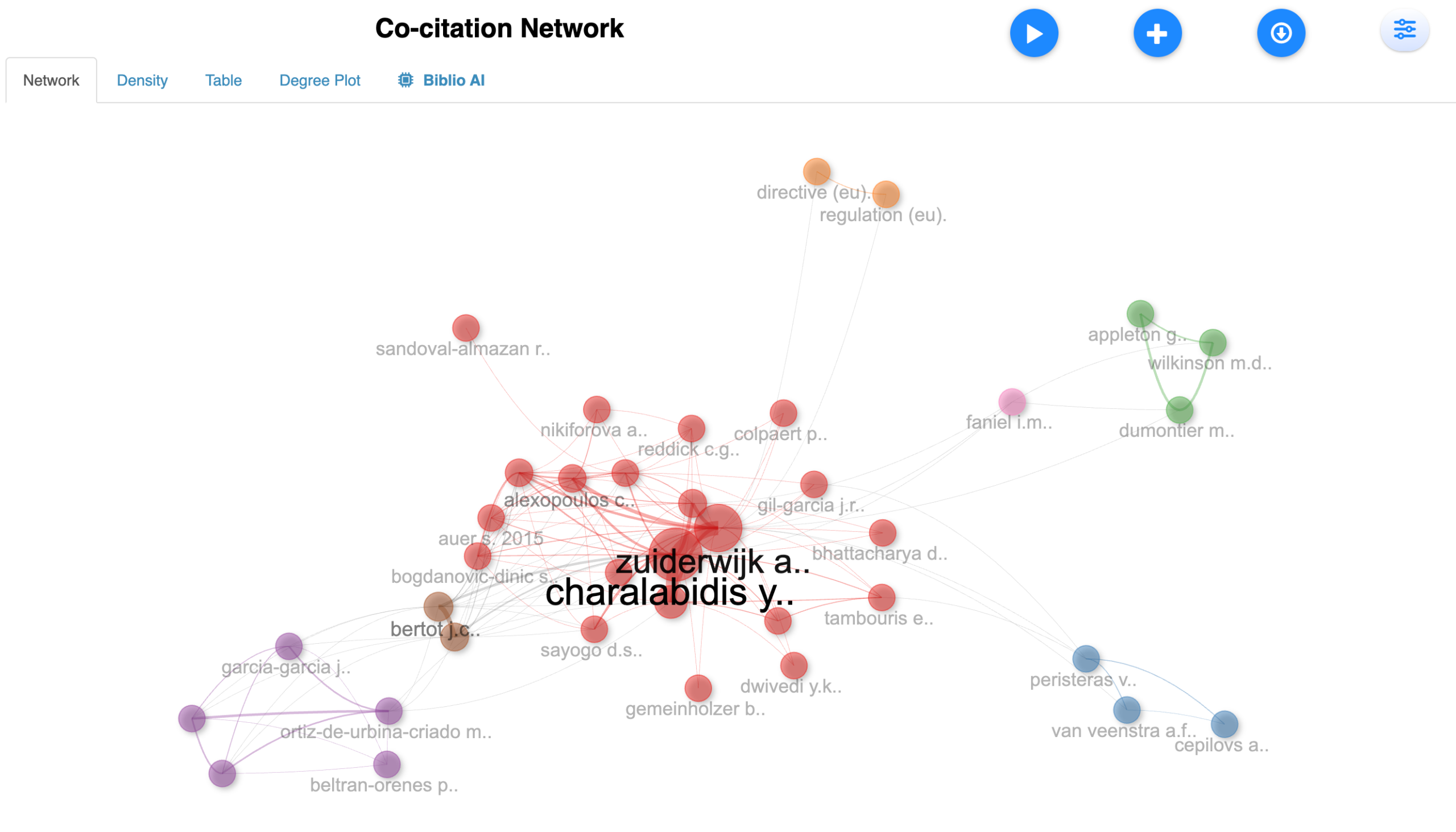
The co-citation network shows the intellectual traditions behind the corpus.
The most central cited authors are Zuiderwijk and Charalabidis. This confirms that the field is strongly grounded in open government data, public-sector data reuse, and European digital government/interoperability research.
The main co-citation cluster includes authors such as:
- Zuiderwijk
- Charalabidis
- Alexopoulos
- Auer
- Nikiforova
- Reddick
- Gil-Garcia
- Tambouris
- Sayogo
- Dwivedi
This cluster combines open data, e-government, digital government, public-sector information systems, public administration, and interoperability.
Another small cluster includes Directive (EU) and Regulation (EU) references. This is important because it shows that the once-only literature is partly anchored in legal and regulatory sources, especially European digital government regulation.
A third cluster around Peristeras, Van Veenstra, and related authors connects to interoperability and European public service delivery.
The co-citation network suggests that the field draws mainly from:
- e-government;
- digital government;
- open government data;
- public administration;
- public-sector interoperability;
- EU digital government;
- information systems;
- data governance.
It does not appear to be strongly grounded yet in documentary theory, legal informatics, verifiable credentials, or administrative document lifecycle governance. Again, this is a research gap your article can address.
16. Collaboration network
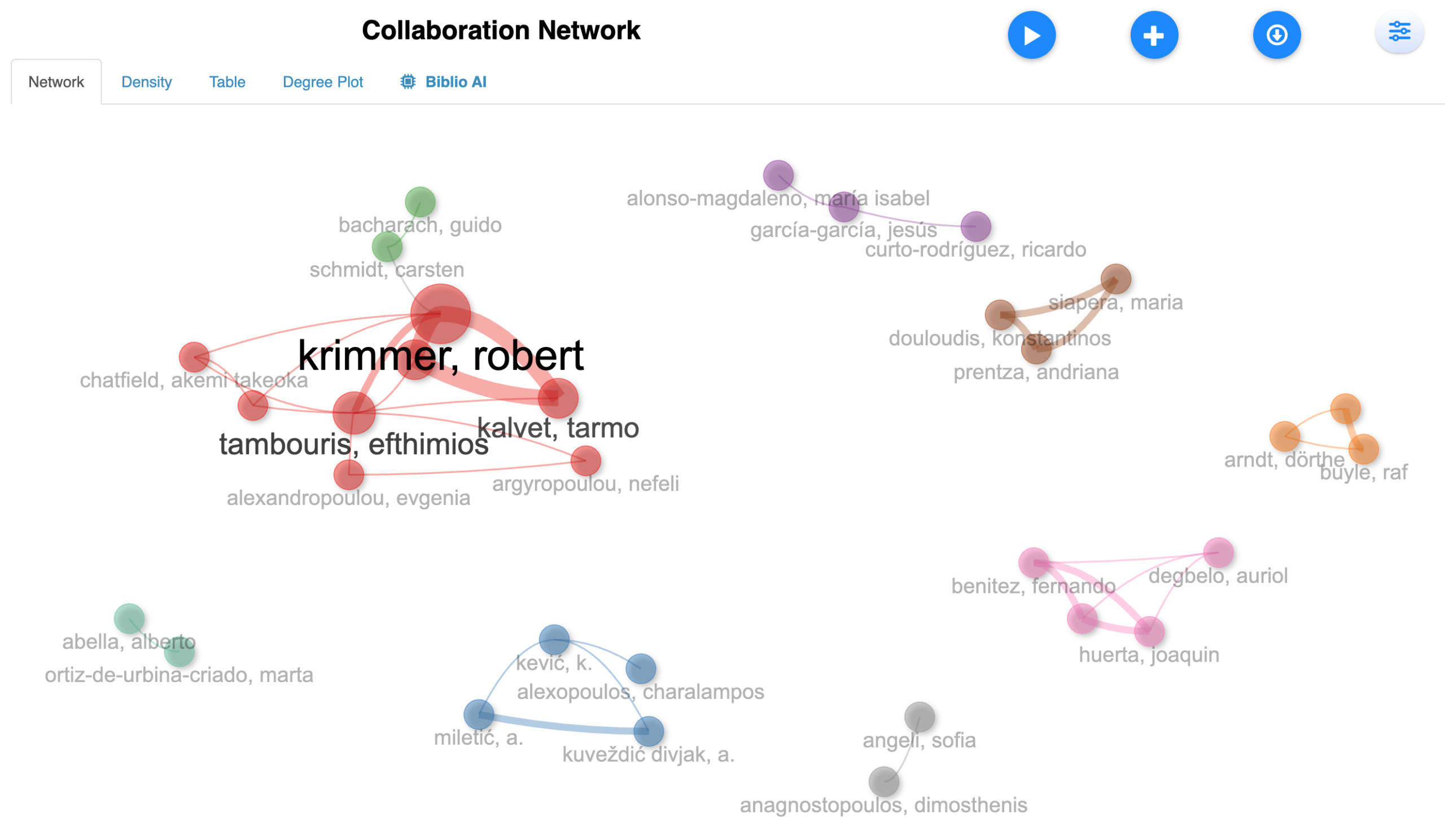
The collaboration network shows a fragmented but recognizable structure.
The most visible collaboration community is organized around:
- Robert Krimmer
- Efthimios Tambouris
- Tarmo Kalvet
- Maarja Toots
- Akemi Takeoka Chatfield
- Carsten Schmidt
- Guido Bacharach
This group is closely related to once-only principle research, European public services, digital government, and administrative burden reduction.
Other clusters include:
- a Spanish/open data group around García-García, Curto-Rodríguez, and related authors;
- a Greek/e-procurement and once-only group around Siapera, Douloudis, and Prentza;
- a semantic/open standards group involving Buyle, Mannens, and linked-data scholars;
- an open geodata/data reuse group around Benitez, Degbelo, and Huerta.
This suggests that the field is fragmented into specialized communities rather than organized as one integrated research network. That fragmentation mirrors the research problem itself: once-only implementation requires coordination across communities that often work separately — legal, semantic, technical, administrative, and service-delivery domains.
17. Synthesis: what this corpus adds to the previous broad interoperability mapping
The first broad mapping established the general scientific landscape of interoperability, data sharing, and digital public services. It showed that the field is structured around:
- interoperability;
- e-government;
- public administration;
- public services;
- government data processing;
- data sharing;
- semantic interoperability;
- data privacy;
- authentication;
- blockchain;
- AI;
- digital transformation;
- institutional governance.
That first mapping was useful because it showed that digital government interoperability is not merely a technical issue. It is a broader institutional data-governance challenge.
The focused once-only/data reuse mapping adds something more specific and more directly useful for your article.
It shows that there is a specialized literature around:
- once-only principle;
- administrative burden reduction;
- public-sector data reuse;
- open government data;
- cross-border public services;
- European Union digital government;
- semantic interoperability;
- electronic data interchange;
- public administration;
- data portals;
- open data usability;
- data management;
- legal and regulatory barriers.
The key difference is this:
The broad mapping tells us public administrations need interoperability.
The focused mapping tells us why interoperability matters for citizens and firms: because without it, governments repeatedly ask people to provide data or documents that the state already holds.
This is essential for your Digital Official Document Passport argument. The once-only principle provides the normative and administrative simplification logic: citizens and firms should not be used as messengers between government offices.
Your proposed concept then adds the missing design object:
If governments want once-only services, official documents must become reusable, verifiable, legally governed data objects.
That is the bridge from once-only principle to Digital Official Document Passports.
18. Implications for the article on Digital Official Document Passports
| Bibliometric finding | Meaning for the once-only/data reuse literature | Implication for Digital Official Document Passports |
|---|---|---|
| Data reuse is the most frequent keyword | The corpus is strongly centred on reusing existing public-sector data | Official documents should be designed as reusable data containers, not static files |
| Open data is highly central | The literature emphasizes availability, accessibility, and reuse of government data | DODPs should include metadata, accessibility rules, and controlled reuse conditions |
| Once-only principle appears as a core but smaller keyword | OOP is specialized but strategically important | The concept provides the administrative simplification rationale for DODPs |
| Public administration and interoperability form a motor theme | Data reuse depends on institutional coordination, not only technology | DODPs require interagency governance, not only software implementation |
| Cross-border and European Union terms are visible | Much of the literature is EU-driven and cross-border oriented | Mexico can adapt the logic to federal, state, and municipal interoperability |
| Administrative burdens appear in the conceptual map | The literature recognizes repeated data requests as a burden | DODPs can be framed as tools for reducing repeated document requests |
| Semantic web, semantics, and metadata are present | Reuse depends on common meanings and structured data | DODPs need semantic standards, document metadata, and common vocabularies |
| Legal/regulatory references appear but are not dominant | Legal interoperability is acknowledged but underdeveloped | DODPs can contribute by foregrounding legal validity, responsibility, and verification |
| Official documents are not a dominant keyword | The literature has not fully conceptualized documents as reusable data objects | This is the article’s main gap and originality |
| Mexico is absent from the corpus | The field is dominated by Europe and other regions | A Mexican case offers a valuable Latin American contribution |
19. Proposed use in your article
Introduction
Use the findings to justify the problem: governments continue to request documents and information repeatedly because public-sector data remains fragmented across agencies. Mention that the focused bibliometric corpus shows a growing literature on data reuse, open data, interoperability, once-only principle, and administrative burdens.
Section 2: Scientific landscape and conceptual background
Use the bibliometric results directly here. Present the broad mapping first, then the focused once-only/data reuse mapping. Use the most frequent words, trend topics, co-occurrence network, thematic map, and factorial analysis to explain the conceptual structure of the field.
Section 3: Mexican institutional context
Use the country analysis to argue that Mexico is absent or marginal in the once-only/data reuse literature. This justifies developing a Mexican contribution. Then connect the international discussion with Mexico’s administrative fragmentation, repeated document requests, federalism, municipal-state-federal data silos, and legal validity issues.
Section 4: Digital Official Document Passports
Use the gap identified in the co-occurrence and thematic maps: the literature discusses data reuse, once-only, interoperability, and public administration, but does not strongly conceptualize official documents as reusable legal data objects. This is where you introduce DODPs.
Section 5: IAD framework
Use the results to justify why an institutional framework is needed. The once-only principle depends on rules about actors, access, data sharing, verification, privacy, legal responsibilities, and interagency coordination. These fit naturally with IAD action situations.
Section 6: Illustrative document-family mapping
Use the data reuse and once-only findings to classify document families by reuse potential. For example: civil registry documents, tax certificates, licences, permits, land-use authorisations, business registration records, and compliance documents.
Section 7: Risks and safeguards
Use the corpus’s themes on barriers, privacy, data protection, metadata, data quality, data management, and legal aspects. This section should discuss safeguards such as consent, purpose limitation, access control, auditability, data minimization, legal validity, and appeal mechanisms.
20. Conclusion
The focused once-only/data reuse corpus strongly supports the argument that official public documents should be transformed from static PDFs, certificates, and paper-based records into reusable, verifiable, legally governed data objects.
However, the support is indirect and needs conceptual integration. The literature clearly discusses data reuse, open data, public administration, interoperability, once-only principle, cross-border services, administrative burdens, metadata, and semantic interoperability. Yet it does not fully develop the idea of official documents as a distinct class of public-sector data governance infrastructure.
That is the opportunity for your article.
The once-only principle provides the administrative simplification rationale. Data reuse provides the operational logic. Interoperability provides the technical and semantic condition. Public administration provides the institutional context. Your contribution is to connect these elements through the concept of Digital Official Document Passports.
21. General methodological limitations
This analysis has several limitations.
First, it depends only on Scopus. Relevant literature may also exist in Web of Science, Google Scholar, OECD documents, EU policy documents, legal databases, government reports, and grey literature.
Second, the query creates some bias. The term data reuse is broad and captures records outside the once-only/digital government core. Some documents are useful for understanding reuse, but others may need to be removed in a manual screening stage.
Third, Latin America is underrepresented. Mexico does not appear as an affiliated country in the detected records, which limits direct regional comparability but also creates a research opportunity.
Fourth, the corpus is strongly influenced by European cases, especially EU digital government, cross-border services, and once-only implementation.
Fifth, bibliometric mapping identifies patterns of association, not causality. Co-occurrence, co-citation, and collaboration maps should be interpreted as exploratory evidence.
Sixth, the bibliometric analysis must be complemented with manual reading of the most relevant papers, especially those on once-only implementation, data protection, legal interoperability, semantic interoperability, administrative burden reduction, and public-sector data governance.
22. Final methodological paragraph for your academic article
This study adopts a bibliometric-informed integrative conceptual synthesis to develop the concept of Digital Official Document Passports as data governance infrastructures for administrative simplification in Mexico. The synthesis is informed by two complementary bibliometric mappings. First, a broad exploratory mapping of Scopus literature on interoperability, data sharing, information exchange, digital government, public administration, and public service delivery was used to identify the general conceptual landscape of digital public-sector interoperability. Second, a focused bibliometric mapping of literature on the once-only principle, administrative data reuse, open government data, and public-sector data reuse was conducted to examine how repeated information requests, administrative burdens, and interagency data reuse are addressed in the digital government literature. These bibliometric analyses were not treated as a full systematic literature review, but as a structured basis for identifying dominant themes, intellectual anchors, conceptual gaps, and emerging research opportunities. The bibliometric evidence is complemented by targeted searches on official documents, legal validity, digital identity, public-sector data governance, and institutional analysis, as well as by a Mexican legal-institutional analysis of administrative document families. This combined approach supports the development of a conceptual framework in which official documents are analysed not as static files or isolated certificates, but as reusable, verifiable, interoperable, and legally governed public-sector data objects.