“TITLE-ABS-KEY(
(“”interoperability”” OR “”data sharing”” OR “”information sharing”” OR “”data exchange”” OR “”information exchange””)
AND
(“”public administration”” OR government OR “”public sector”” OR “”digital government”” OR “”e-government””)
AND
(“”public service*”” OR “”administrative procedure*”” OR “”government service*”” OR “”service delivery”” OR “”one-stop shop*”” OR “”single window””)
)”
Main Information
Annual Scientific Production
Average Citations Per Year
Three-Field Plot
Linking References, Authors, and Keywords
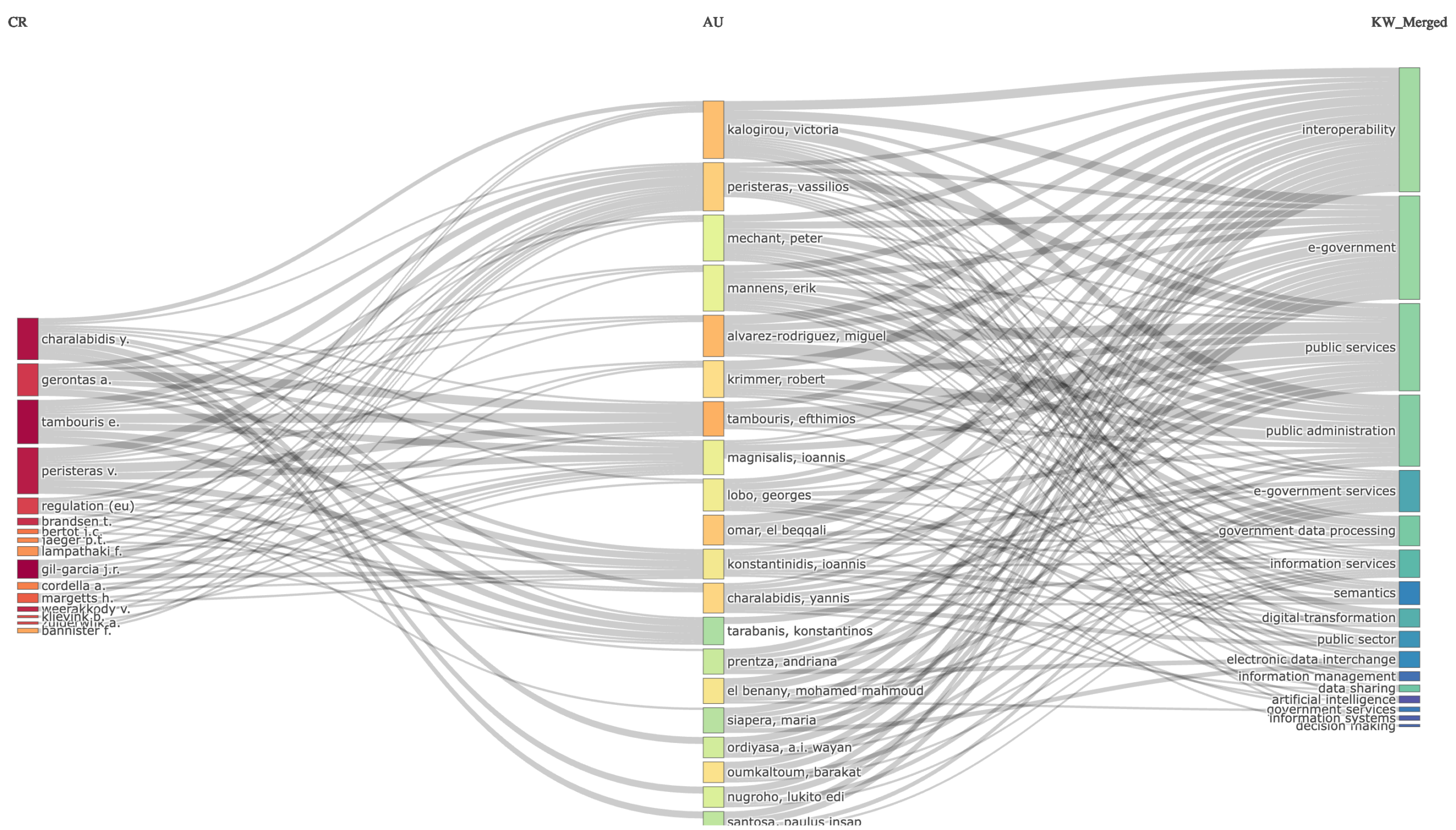
The Three-Field Plot provides an integrated view of the structure of the Scopus corpus on interoperability, data sharing, digital government, public administration, and public service delivery. Unlike the previous figures, which examined authors, keywords, or references separately, this plot connects all three dimensions in a single visualization.
On the left side (CR) are the most influential cited references. In the middle (AU) are the most visible authors in the corpus. On the right side (KW_Merge) are the main keywords associated with the literature. The flows between the columns show how these three elements are connected.
The figure confirms that the field is organized around a relatively coherent core of authors and references, strongly connected to a stable set of themes: interoperability, e-government, public services, and public administration.
Main Patterns in the Plot
A first important observation is that the most prominent keywords on the right side are clearly:
- interoperability
- e-government
- public services
- public administration
These are the largest and most central topics in the corpus, which is consistent with the previous keyword and thematic analyses. They form the conceptual backbone of the research field.
A second important observation is that several authors in the middle column act as major bridges between the cited references and these dominant topics. Among the most visible are:
- Victoria Kalogirou
- Vassilios Peristeras
- Efthimios Tambouris
- Miguel Alvarez-Rodriguez
- Robert Krimmer
- Omar El Beqqali
- Ioannis Konstantinidis
- Yannis Charalabidis
These authors are linked to the dominant topics of interoperability, e-government, public services, and public administration, suggesting that they are among the main contributors shaping the field.
A third important pattern is that the cited references on the left side include key names already visible in the co-citation and collaboration analyses, such as:
- Charalabidis
- Gerontas
- Tambouris
- Peristeras
- Regulation (EU)
- Brandsen
- Bertot
- Jaeger
- Lampathaki
- Gil-Garcia
- Cordella
- Margetts
- Weerakkody
- Bannister
This indicates that the literature combines several types of intellectual inputs:
- European interoperability and public-service research
- Digital government and public administration theory
- Policy and regulatory references, including EU-oriented work
- Studies on service delivery, governance, and public-sector digital transformation
- Interpretation of the Main Knowledge Flows
The strongest flows in the plot suggest that the field is built around a central chain of association:
foundational references → core authors → core themes
More specifically, authors such as Tambouris, Peristeras, Kalogirou, Charalabidis, and Alvarez-Rodriguez appear strongly connected to references associated with European interoperability and public digital service research, and they channel that intellectual base toward keywords such as interoperability, e-government, public services, and public administration.
This means that the field is not random or diffuse. It has a recognizable architecture in which a set of leading authors builds on a recurring body of cited work and contributes to a stable thematic core.
At the same time, the presence of secondary keywords such as:
- e-government services
- government data processing
- information services
- semantics
- digital transformation
- public sector
- electronic data interchange
- information sharing
- data sharing
- artificial intelligence
- government services
- information systems
- decision making
shows that the field is broadening beyond classic e-government debates toward issues of semantics, institutional coordination, digital transformation, data exchange, and more advanced forms of public-sector information management.
What This Figure Says About the Field
This figure suggests that the field has a strong European interoperability core, but it also connects to broader public administration and digital government debates.
In practical terms, the Three-Field Plot shows that:
- the literature is grounded in a recurring set of influential references;
- a relatively identifiable group of authors plays a central role in shaping the field;
- the dominant topics remain interoperability and e-government, but the field is expanding toward data sharing, semantics, digital transformation, and public-sector innovation.
This is a very useful finding because it shows that the field is not only about the existence of digital services. It is about the institutional and technical infrastructures that make those services possible.
Relevance for My Research
For my research on digital public documents in Mexico, this figure is especially important because it helps position the topic at the intersection of the three dimensions shown in the plot:
- Intellectual foundations: The cited references show that the field is supported by literature on interoperability, public administration, digital government, and service innovation.
- Research communities: The author column shows the scholars whose work is most directly linked to those themes.
- Core concepts: The keyword column shows that the field revolves around interoperability, e-government, public services, and public administration, with growing links to digital transformation, semantics, data sharing, and information systems.
This is exactly the conceptual space in which digital public documents can be analysed.
A public document such as a permit, license, certificate, constancia, authorization, or administrative resolution can be understood not simply as a file, but as an interoperable public-sector data object. To function well, such an object must be linked to:
- public administration rules,
- service delivery processes,
- interoperability standards,
- semantic data structures,
- verification and trust mechanisms,
- and institutional governance arrangements.
Relevance for a DPP-like Approach to Public Documents
The Three-Field Plot strongly supports the analogy with Digital Product Passports.
A Digital Product Passport is useful because it connects:
- structured information,
- governance rules, and
- interoperability across a value chain.
Similarly, a digital public document could connect:
- authoritative government data,
- public institutions,
- administrative procedures,
- interoperability frameworks, and
- service-delivery systems.
The plot shows that the core ingredients for this type of framework already exist in the literature. The main keywords and author communities are already working around the concepts needed for such an approach.
For Mexico, this means that digital public documents could be studied as verifiable, interoperable, reusable, and institutionally governed data containers, rather than as isolated PDFs or static administrative outputs.
Key Insight
The key insight from this figure is that the field is held together by a clear triad:
influential references + leading authors + core themes
And that triad is centered on:
interoperability + e-government + public services + public administration
This provides a strong intellectual basis for positioning a study of digital public documents within the broader debates on digital government interoperability and public-sector data governance.
Methodological Note
This figure should be interpreted as an exploratory relational map. It does not show causality, but rather patterns of association among cited references, active authors, and thematic keywords. Its value lies in showing how the intellectual foundations of the corpus are connected to the main contributors and to the dominant conceptual vocabulary of the field.
Most Relevant Sources
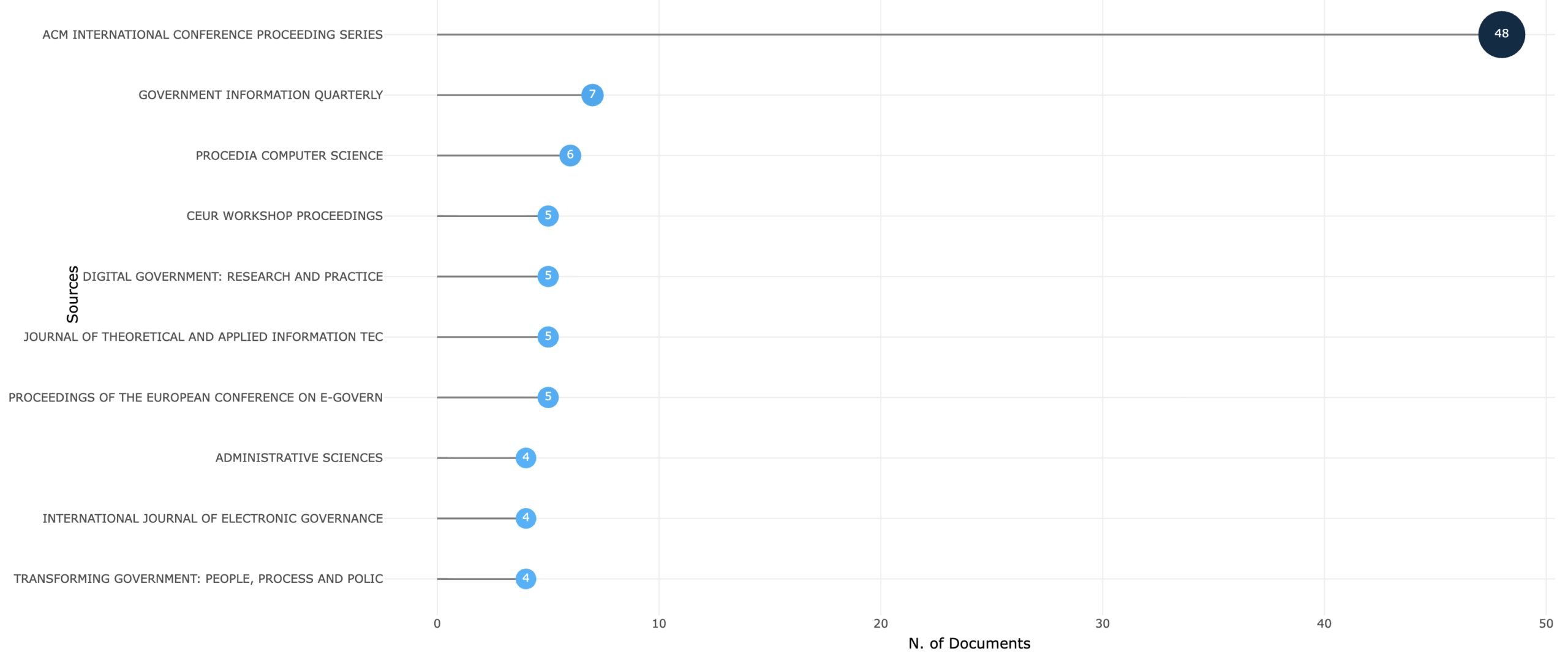
Core Sources by Bradford’s Law
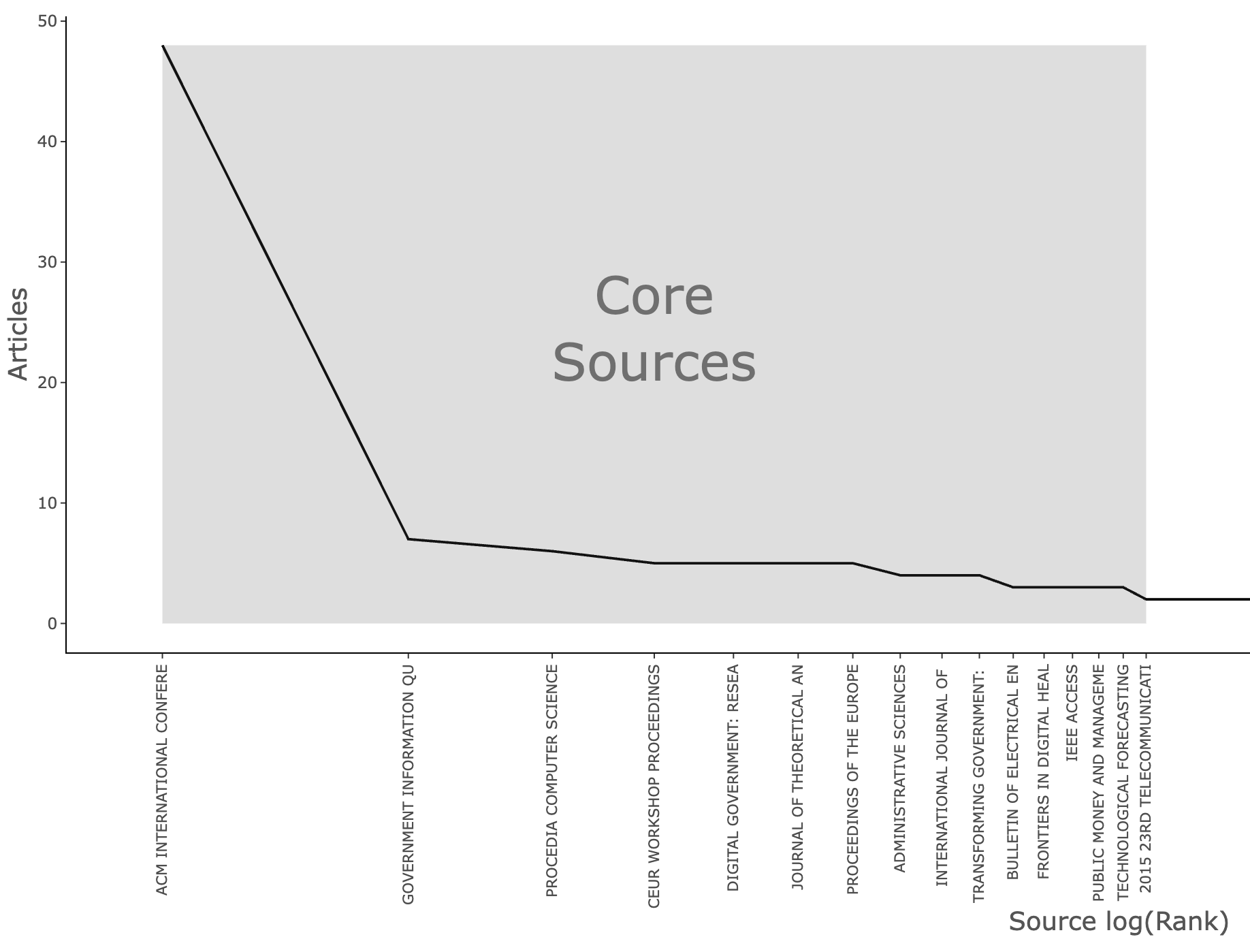
Sources’ Local Impact
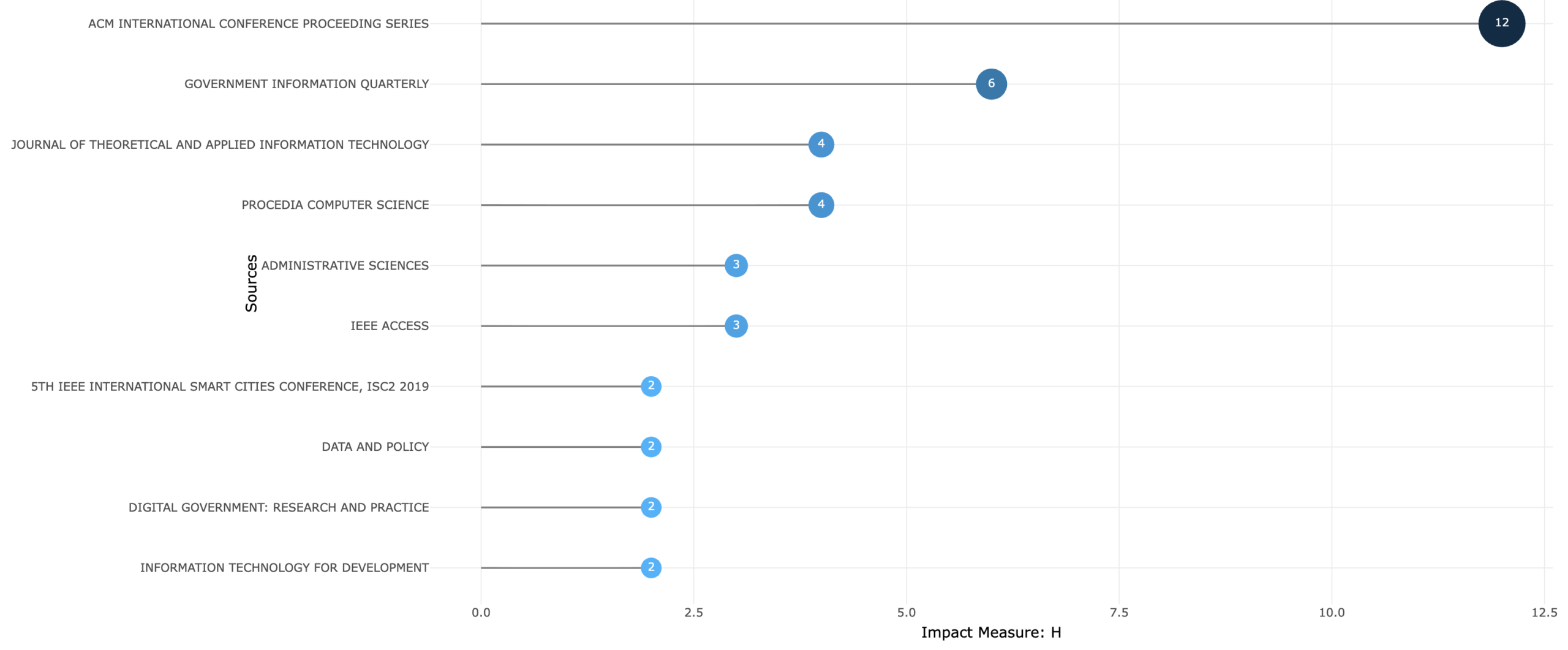
Sources’ Production over Time
Most Relevant Authors
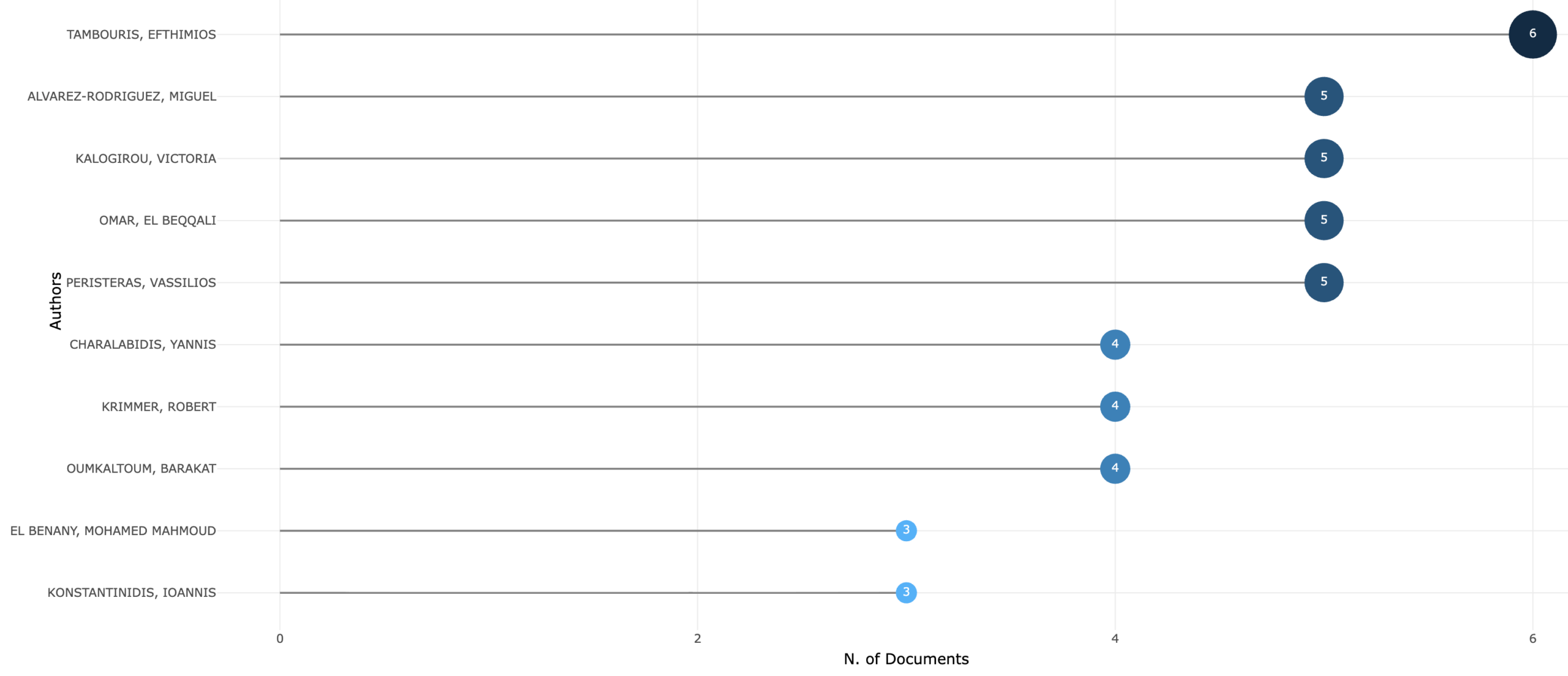
| TAMBOURIS, EFTHIMIOS | 6 | 2.07 |
| ALVAREZ-RODRIGUEZ, MIGUEL | 5 | 1.12 |
| KALOGIROU, VICTORIA | 5 | 1.29 |
| OMAR, EL BEQQALI | 5 | 1.67 |
| PERISTERAS, VASSILIOS | 5 | 1.09 |
| CHARALABIDIS, YANNIS | 4 | 1.00 |
| KRIMMER, ROBERT | 4 | 0.75 |
| OUMKALTOUM, BARAKAT | 4 | 1.17 |
| EL BENANY, MOHAMED MAHMOUD | 3 | 1.08 |
| KONSTANTINIDIS, IOANNIS | 3 | 0.73 |
| LOBO, GEORGES | 3 | 0.43 |
| MAGNISALIS, IOANNIS | 3 | 0.64 |
| MANNENS, ERIK | 3 | 0.37 |
| MECHANT, PETER | 3 | 0.37 |
| NUGROHO, LUKITO EDI | 3 | 0.70 |
| ORDIYASA, A.I. WAYAN | 3 | 0.70 |
| PRENTZA, ANDRIANA | 3 | 0.92 |
| SANTOSA, PAULUS INSAP | 3 | 0.70 |
| SIAPERA, MARIA | 3 | 0.92 |
| TARABANIS, KONSTANTINOS | 3 | 1.17 |
| VAN COMPERNOLLE, MATHIAS | 3 | 0.37 |
| WANG, FANG | 3 | 1.53 |
| ADADI, AMINA | 2 | 0.50 |
| AHMAD, KAMSURIAH | 2 | 0.83 |
| ALEXOPOULOS, CHARALAMPOS | 2 | 0.50 |
| AVGERINOS LOUTSARIS, MICHALIS | 2 | 0.50 |
| BAO, SHUMEI | 2 | 0.50 |
| BARTHELEMY, FLORIAN | 2 | 0.53 |
| BENADDI, HANANE | 2 | 0.75 |
| BERRADA, MOHAMMED | 2 | 0.50 |
| BOUNABAT, BOUCHAIB | 2 | 0.50 |
| BUNTAINE, MARK T | 2 | 0.67 |
| BUYLE, RAF | 2 | 0.25 |
| CHENOUNI, DRISS | 2 | 0.50 |
| CHIARELLI, FEDERICO | 2 | 0.42 |
| CRAHAY, ALLEGRA | 2 | 0.33 |
| CROMPVOETS, JOEP | 2 | 0.38 |
| CUSTERS, NOÉMIE | 2 | 0.42 |
| DE PAEPE, DIETER | 2 | 0.25 |
| DE VOCHT, LAURENS | 2 | 0.22 |
| DEDOVIC, STEFAN | 2 | 0.43 |
| DELIGIANNIS, ATHANASIOS | 2 | 0.48 |
| DOULOUDIS, KONSTANTINOS | 2 | 0.67 |
| EDELMANN, NOELLA | 2 | 0.83 |
| EMILIA, MISCENÀ | 2 | 0.42 |
| GERONTAS, ALEXANDROS | 2 | 1.17 |
| IDEM, UDOSEN J. | 2 | 0.40 |
| JANEV, VALENTINA | 2 | 0.67 |
| KALVET, TARMO | 2 | 0.45 |
| KARUNARATHNE, THASHMEE | 2 | 0.75 |
| KONG, INI | 2 | 1.33 |
| KOTSEV, ALEXANDER | 2 | 0.37 |
| KUMOROTOMO, WAHYUDI | 2 | 0.45 |
| LAAZ, NAZIHA | 2 | 0.75 |
| LACHANA, ZOI | 2 | 0.50 |
| LEE, JOOHO | 2 | 1.00 |
| MIJOVIC, VUK | 2 | 0.67 |
| PAPADOPOULOU, ELENI | 2 | 1.00 |
| PAPASTILIANOU, ANASTASIA | 2 | 0.70 |
| PAPPEL, INGRID | 2 | 0.83 |
| PIMENTEL, LUÍS | 2 | 0.67 |
| ROCHA, TÂNIA | 2 | 0.67 |
| SAKKOPOULOS, EVANGELOS | 2 | 1.00 |
| SARJITO, ARIS | 2 | 1.50 |
| STA, HATEM BEN | 2 | 2.00 |
| STASIS, ANTONIOS | 2 | 0.83 |
| TAN, EVRIM | 2 | 0.38 |
| TANG, SONG | 2 | 0.50 |
| TOOTS, MAARJA | 2 | 0.45 |
| VANLISHOUT, ZIGGY | 2 | 0.25 |
| VERBORGH, RUBEN | 2 | 0.22 |
| WIMMER, MARIA A. | 2 | 0.45 |
| ZHOU, LIHONG | 2 | 0.67 |
| ZHU, JUNYU | 2 | 0.50 |
| ZUO, ENGUANG | 2 | 0.50 |
Authors’ Production over Time
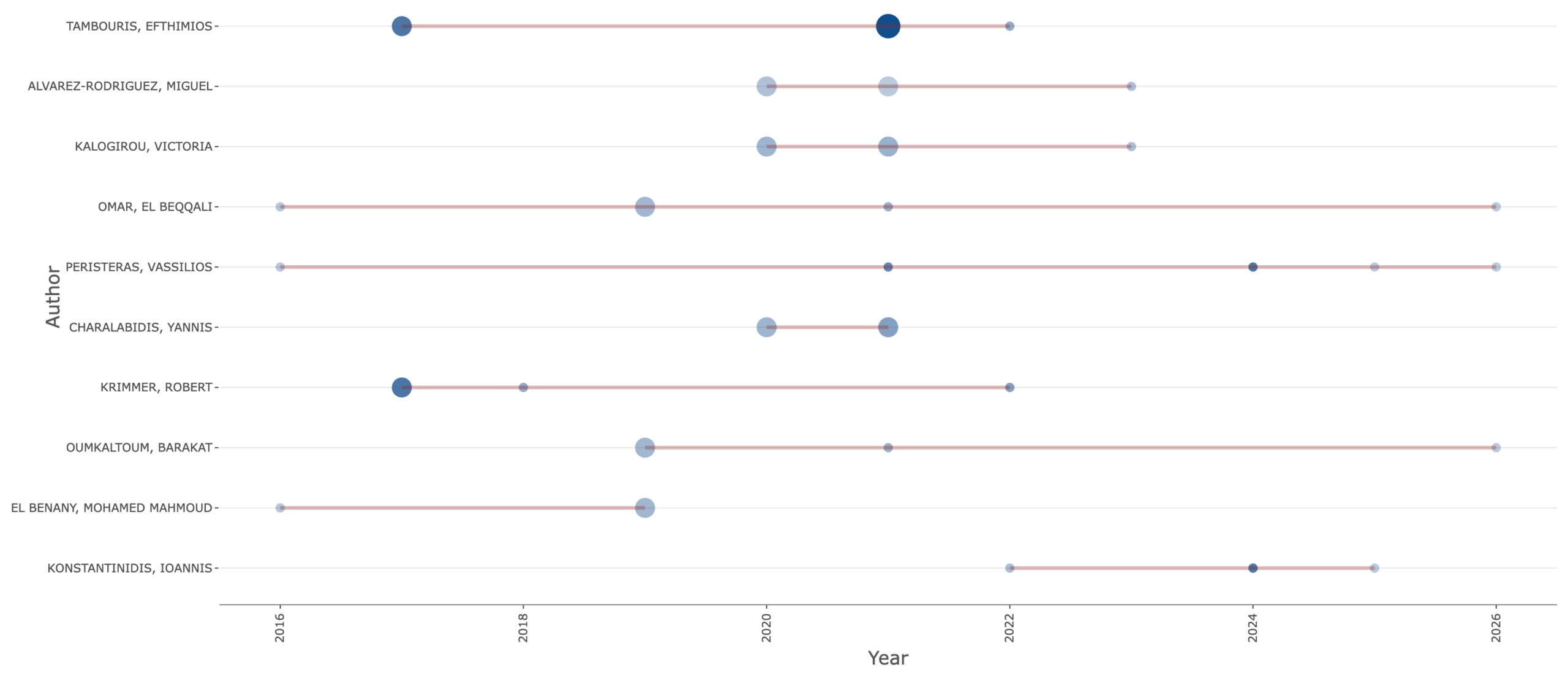
Author Production over Time: Interoperability, Data Exchange, and Digital Public Services
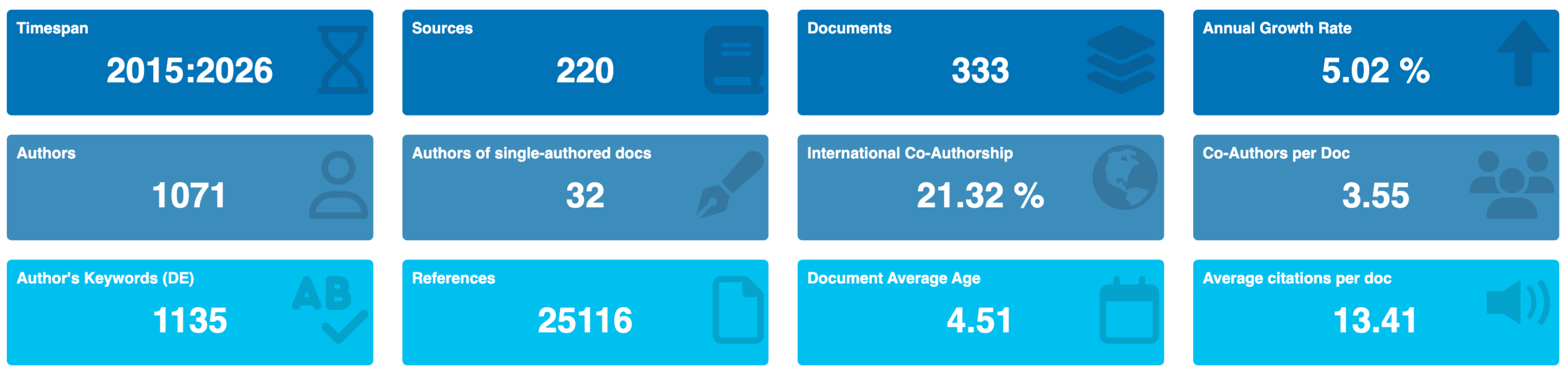
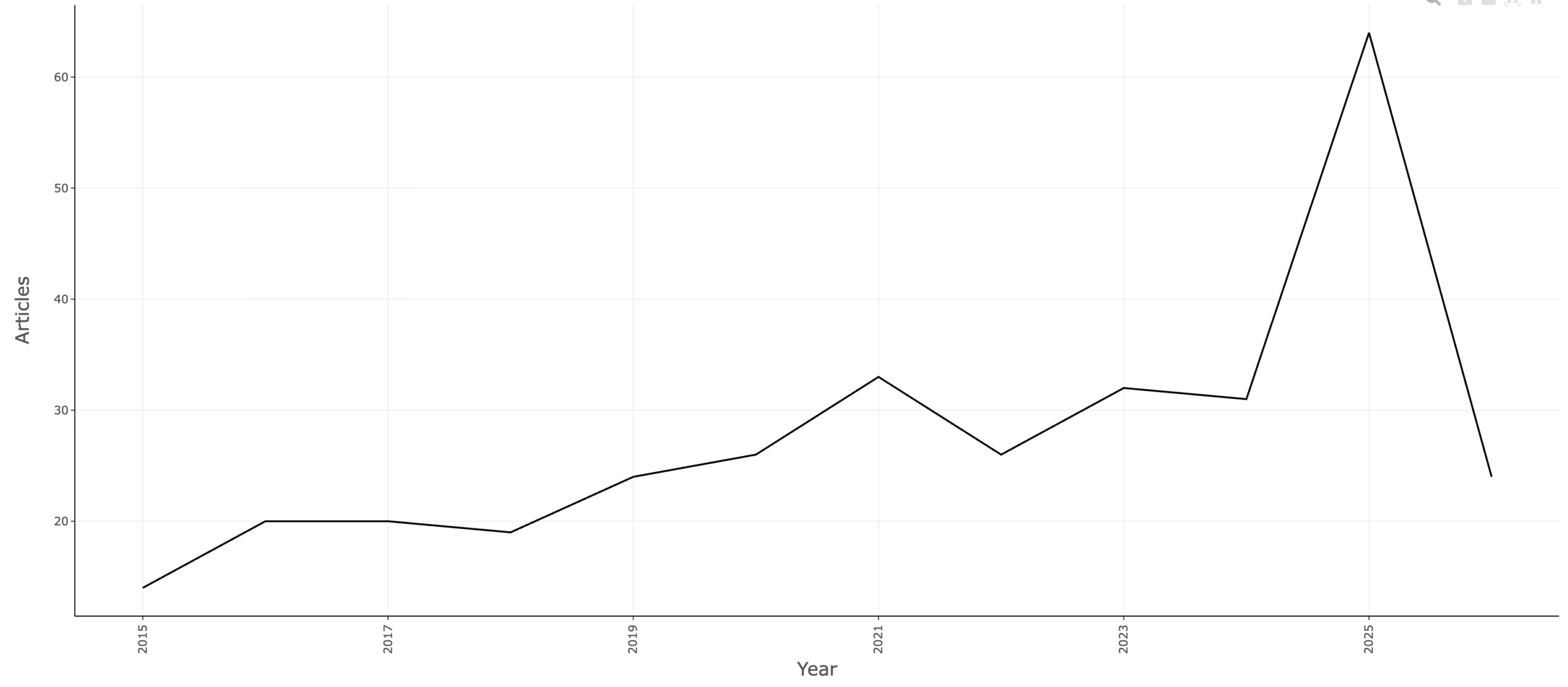
The figure shows the temporal evolution of the most productive authors within the Scopus corpus retrieved through a query focused on interoperability, data/information sharing, and public service delivery in digital government and public administration contexts. The dataset contains 333 documents published between 2015 and 2026, although the 2026 results should be interpreted as partial.
In the graph, the horizontal axis represents the year of publication, while the vertical axis displays the authors with the strongest presence in the corpus. The size of the bubbles indicates the intensity of production in a given year, while the horizontal line helps visualize each author’s period of activity within the dataset.
The general pattern suggests that this field is not dominated by a single author or school of thought, but rather by specialized research groups whose contributions are concentrated in specific periods. Authors such as Efthimios Tambouris, Vassilios Peristeras, Robert Krimmer, Victoria Kalogirou, Yannis Charalabidis, and Miguel Alvarez-Rodriguez stand out in relation to topics such as the once-only principle, European interoperability frameworks, public service models, common vocabularies, APIs, linked government data, and the transition toward more integrated and data-centered public services.
The graph also reveals a more technical research stream associated with authors such as Omar El Beqqali, Barakat Oumkaltoum, and Mohamed Mahmoud El Benany, whose work addresses SOA architectures, cloud computing, business intelligence, data warehousing, and data interoperability in e-government services. More recently, authors such as Ioannis Konstantinidis reflect a shift toward semantic interoperability, evidence-based public service provision, data-centric services, and systems supported by artificial intelligence.
An important reading of the graph is that the field appears to have evolved through three main stages. First, between 2016 and 2019, research was mainly concerned with technical interoperability, SOA, e-government services, and the once-only principle. Second, between 2020 and 2022, the discussion increasingly focused on interoperability frameworks, common vocabularies, APIs, digital skills, and integrated public service models. Finally, between 2023 and 2026, attention appears to be shifting toward data-centric public services, semantic interoperability, artificial intelligence, and institutional capabilities for public-sector innovation.
For my research, this visualization is useful because it confirms that government interoperability should not be understood only as a technological problem. Rather, it appears as an institutional, organizational, and semantic infrastructure required to enable different public agencies to exchange information, reduce duplication, automate administrative procedures, and produce official documents that are reliable, verifiable, and reusable. This perspective is especially relevant for developing an institutional governance proposal for digital public documents in Mexico, using a logic similar to that of Digital Product Passports, but applied to certificates, licenses, permits, official records, and other documents issued by government offices.
Author Productivity through Lotka’s Law
Authors’ Local Impact
Most Relevant Affiliations
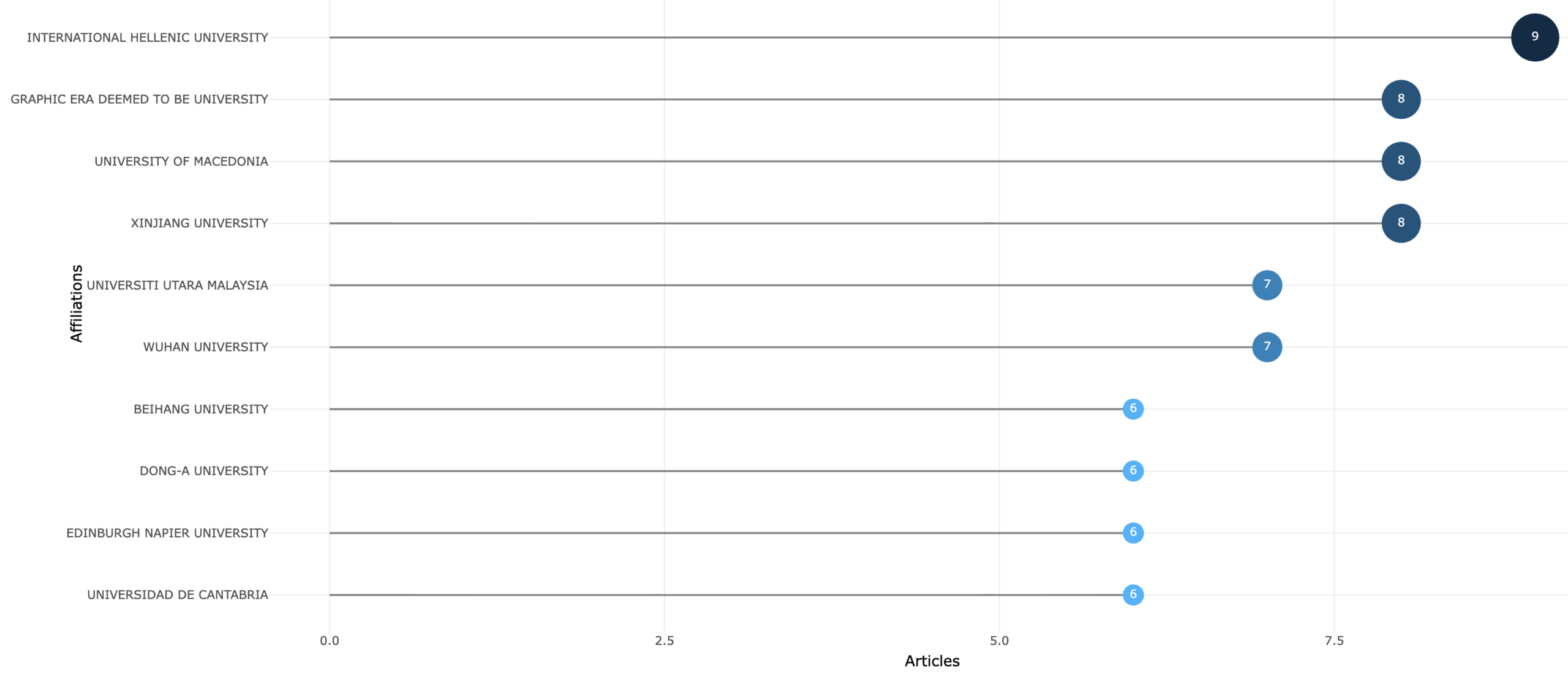
Affiliations’ Production over Time
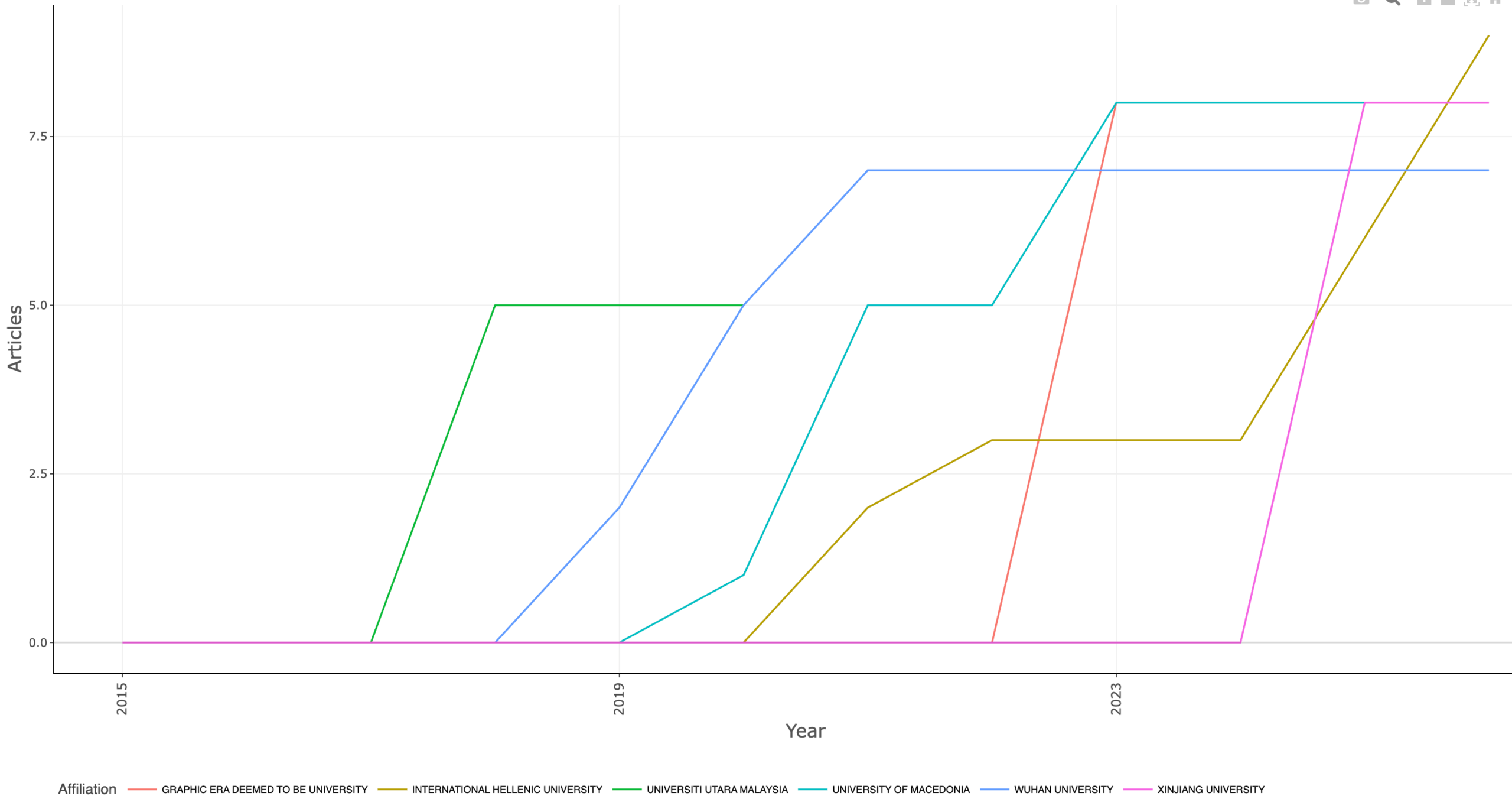
Corresponding Author’s Countries
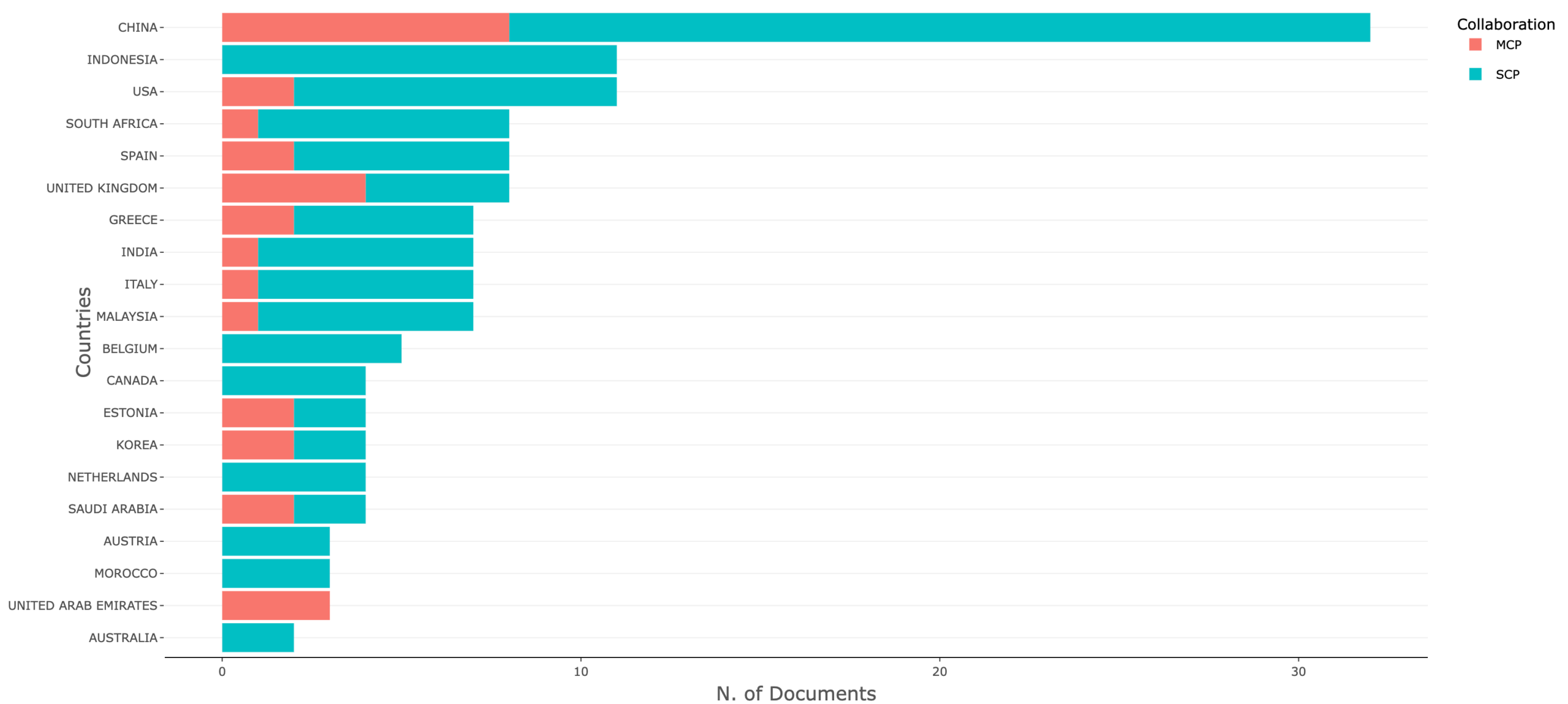
The figure shows the distribution of scientific production by country within the Scopus corpus on interoperability, data sharing, information exchange, digital government, public administration, and public service delivery. The bars distinguish between Single Country Publications (SCP) and Multiple Country Publications (MCP). SCP refers to documents authored by researchers from the same country, while MCP refers to publications involving international collaboration.
The results show that China is the dominant country in this corpus, with the highest number of documents overall. Its production is mainly concentrated in single-country publications, although it also shows some international collaboration. This suggests that China has developed a strong domestic research base around digital government, public service delivery, interoperability, and data exchange.
Other countries with visible production include Indonesia, the United States, South Africa, Spain, the United Kingdom, Greece, India, Italy, Malaysia, Belgium, Canada, Estonia, Korea, the Netherlands, Saudi Arabia, Austria, Morocco, the United Arab Emirates, and Australia. The presence of countries such as Estonia, Greece, Belgium, Spain, and the United Kingdom is particularly relevant because these countries are often associated with European discussions on digital government, interoperability frameworks, public-sector data exchange, and cross-border public services.
The collaboration pattern also reveals an important distinction. Some countries, such as China, Indonesia, India, Malaysia, Belgium, Canada, the Netherlands, Austria, Morocco, and Australia, show a stronger concentration of single-country publications. In contrast, countries such as the United Kingdom, Spain, Greece, Estonia, Korea, Saudi Arabia, the United Arab Emirates, and the United States show a more visible share of internationally co-authored publications. This suggests that part of the field is nationally embedded, while another part is shaped through international research networks.
Countries’ Scientific Production
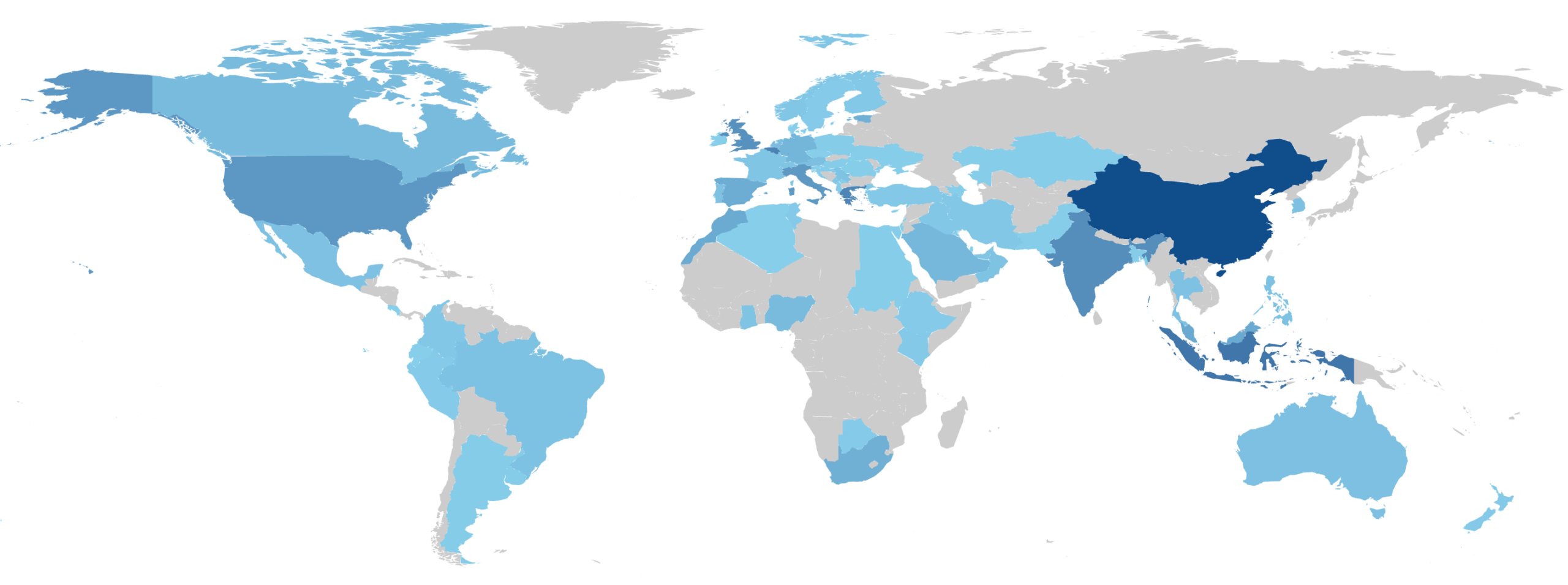
Countries’ Production over Time
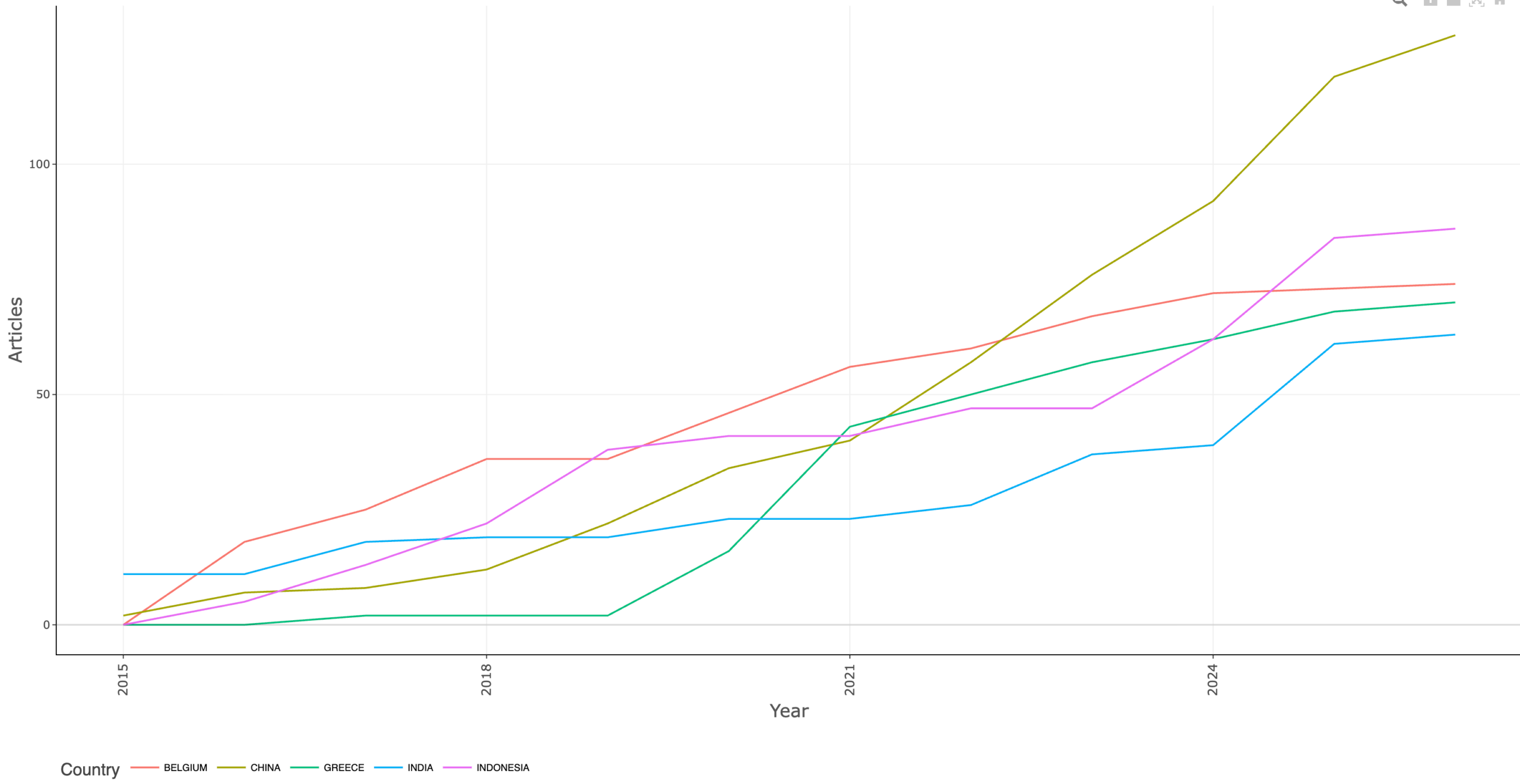
The country production table adds a temporal perspective. It shows that China’s contribution increased dramatically, from 2 records in 2015 to 128 by 2026. This confirms China’s growing role as a central producer of research on digital government, interoperability, data exchange, and public service innovation.
Indonesia also shows strong growth, moving from 0 records in 2015 to 86 by 2026. This indicates the increasing relevance of digital government and public service transformation in emerging economies, particularly in contexts where administrative modernization and digital service delivery are major policy priorities.
Belgium shows a different pattern. Its production starts strongly from 2016 and grows steadily to 74 by 2026. This may reflect its role within European digital government research, especially around interoperability, public-sector information systems, and EU-related governance frameworks.
Greece presents one of the most interesting trajectories. Its production remains low until 2019, but grows sharply after 2020, reaching 70 by 2026. This increase may be connected to the visibility of Greek and European research groups working on semantic interoperability, public service models, digital transformation, and once-only government services.
India also shows consistent growth, increasing from 11 records in 2015 to 63 by 2026. Its trajectory suggests a sustained interest in digital public services, e-government platforms, data exchange, and administrative modernization.
Interpretation for My Research
For my research, this figure is important because it shows that the study of interoperability and data exchange in digital public services is not limited to one geographical region. Instead, it is a global research field, with strong contributions from Asia, Europe, North America, Africa, and the Middle East.
The results also suggest that digital government interoperability is both a national policy challenge and an international governance issue. On one hand, many countries develop their own domestic models for data exchange, digital identity, administrative procedures, and service delivery. On the other hand, international collaboration becomes increasingly important when public services require common standards, semantic interoperability, shared vocabularies, cross-border data exchange, and institutional coordination.
This is directly relevant to my research on digital public documents in Mexico. If official documents issued by government offices are understood as DPP-like digital objects — that is, structured, verifiable, reusable, and interoperable data containers — then the Mexican case can be connected to an international research agenda on public-sector interoperability, institutional data governance, and digital service transformation.
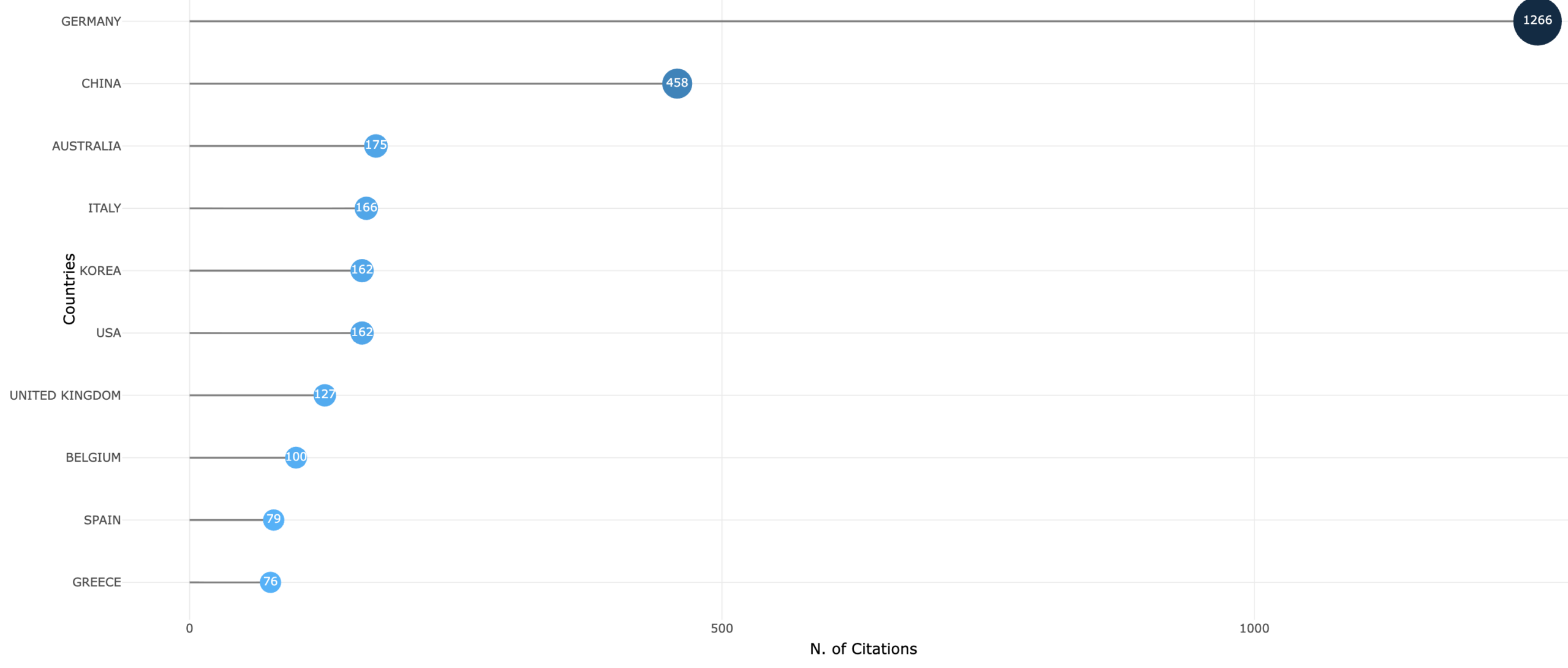
Most Cited Countries
Most Global Cited Documents
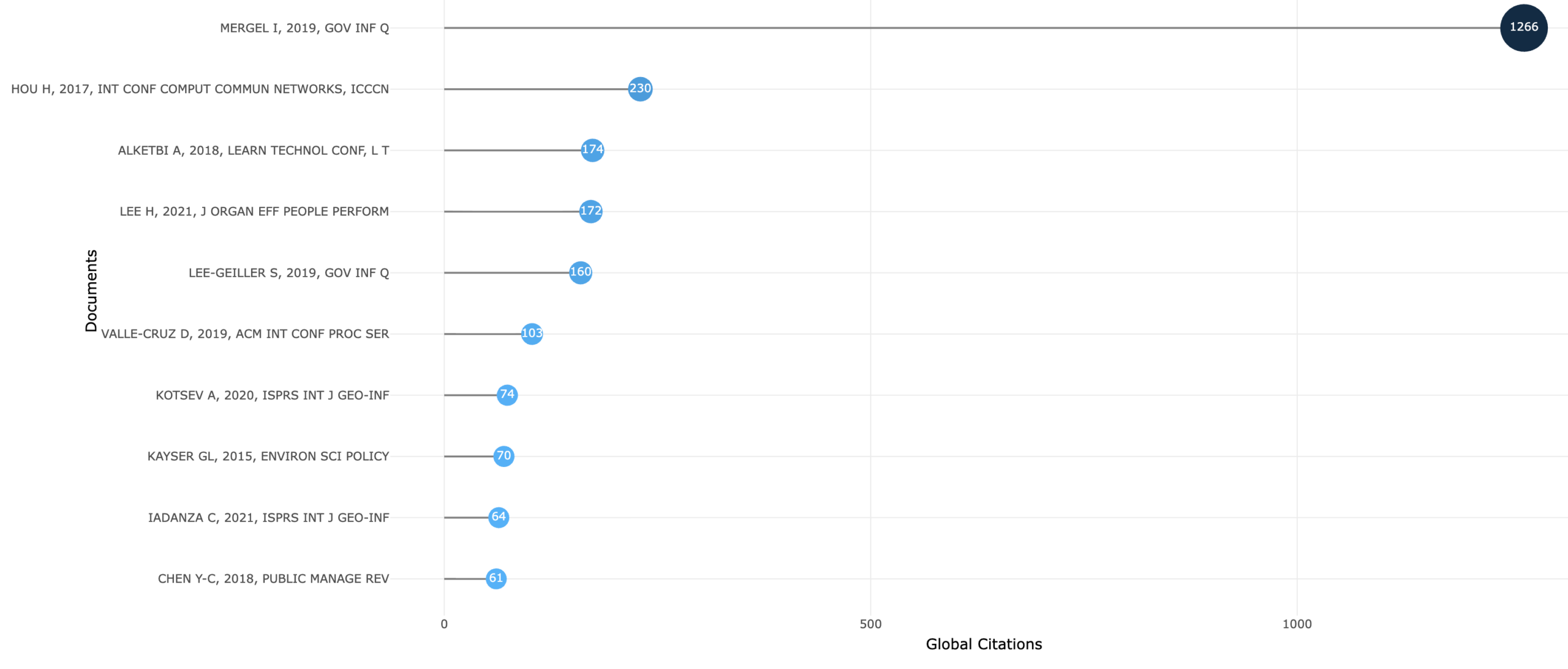
The “Most Global Cited Documents” figure identifies the documents in the corpus that have received the highest number of citations in Scopus. These papers are important because they show the broader intellectual foundations of the research field around digital government, interoperability, data sharing, information exchange, public service delivery, and public administration transformation.
The most influential document by far is Mergel, Edelmann, and Haug (2019), “Defining digital transformation: Results from expert interviews,” published in Government Information Quarterly, with 1,266 global citations. This article is central because it provides an empirically grounded definition of digital transformation in the public sector. Its abstract highlights that governments are under pressure to improve public service delivery, become more efficient, increase transparency, improve interoperability, and respond to rising citizen expectations. For my research, this article is especially relevant because it frames digital transformation not simply as the adoption of technology, but as a deeper change in how public administrations operate, design services, and produce public value.
A second important cluster is formed by highly cited works on blockchain and government services. Hou (2017) analyses the application of blockchain in Chinese e-government, using the Chancheng District project in Foshan, Guangdong, as a case study. The abstract emphasizes potential benefits such as improved government service quality, greater transparency, better accessibility of government information, and stronger information sharing across organizations. However, the article also identifies information security, cost, reliability, standards, and management systems as major challenges. Similarly, Alketbi, Nasir, and Talib (2018) review blockchain use cases for government services, emphasizing secure data sharing, data integrity, trust, and the possibility of reducing dependence on centralized authorities. Together, these two documents show that blockchain entered the digital government literature as a possible infrastructure for trust, verification, and inter-organizational data exchange.
Another relevant document is Lee-Geiller and Lee (2019), “Using government websites to enhance democratic e-governance,” also published in Government Information Quarterly. Its abstract argues that government websites should not only be evaluated as information portals or service-delivery tools, but also as platforms for democratic participation and citizen engagement. This is useful for my research because it connects digital public services with broader questions of transparency, participation, accountability, and democratic governance.
The corpus also includes an influential article on artificial intelligence in government: Valle-Cruz, Sandoval-Almazan, Ruvalcaba-Gomez, and Criado (2019). The abstract describes AI as an emerging trend in the public sector with potential applications in public health, climate change, public management, decision-making, disaster response, citizen interaction, service personalization, interoperability, large-scale data analysis, and real-time simulation. However, it also warns about challenges such as algorithmic bias and uncertain implementation outcomes. This article is important because it shows how the digital government literature is moving from basic digitization and interoperability toward intelligent, data-driven public administration.
A further group of highly cited papers focuses on data infrastructures, open data, APIs, and data spaces. Kotsev, Minghini, Tomas, Cetl, and Lutz (2020) examine the evolution from European spatial data infrastructures to broader data spaces. Their abstract emphasizes the importance of timely, accessible, well-documented, interoperable data for digital transformation and data-driven innovation. Similarly, Iadanza et al. (2021) present IdroGEO, an Italian collaborative web-mapping platform based on REST APIs, open data, open standards, and public-sector data reuse. These articles are important because they show that interoperability is not only a legal or administrative issue; it also requires technical architectures, standards, APIs, workflows, and data governance mechanisms.
The figure also includes documents that expand the field beyond narrow e-government systems. Kayser et al. (2015) analyse drinking water quality governance in Brazil, Ecuador, and Malawi. Although this article is not strictly about digital government, its abstract highlights coordination, data sharing between ministries, monitoring, enforcement, and technical capacity as key governance challenges. This is relevant because it shows that data sharing is also a public-sector governance problem in areas such as water, health, environment, and infrastructure.
Finally, Chen and Lee (2018), “Collaborative data networks for public service,” is especially relevant for my research. Its abstract brings together collaborative governance, network management, cross-boundary information sharing, technology, and performance. This article directly supports the idea that public service delivery increasingly depends on collaborative data networks that cut across organizational boundaries. For a study of digital public documents in Mexico, this is highly relevant because official documents often require data exchange among several agencies, levels of government, registries, and administrative units.
Interpretation for My Research
The most cited documents suggest that this research field is built around several connected themes.
First, digital transformation in government is broader than digitization. The leading article by Mergel et al. shows that public-sector digital transformation involves changes in administrative processes, organizational routines, service design, transparency, interoperability, and citizen expectations.
Second, interoperability is a core condition for digital public services. The abstracts repeatedly mention information sharing, cross-boundary data exchange, APIs, standards, data spaces, open data, and collaborative data networks. This confirms that interoperability is not a secondary technical feature; it is one of the foundations of modern digital government.
Third, trust and verification are becoming central concerns. The blockchain-oriented papers show that governments are exploring technologies that can support secure data sharing, data integrity, transparency, and traceability. This is directly relevant for thinking about official government documents as verifiable digital objects.
Fourth, public service delivery is increasingly data-centric. The papers on AI, spatial data infrastructures, APIs, and collaborative data networks suggest that the next stage of digital government depends on the ability to organize, govern, exchange, and reuse public-sector data across institutions.
Fifth, institutional governance remains essential. Even when the papers discuss advanced technologies such as blockchain or AI, the abstracts emphasize standards, management systems, coordination, organizational capacity, legal frameworks, and public value. This supports the argument that digital public documents cannot be studied only as technical artifacts; they must also be understood as institutional and governance infrastructures.
Relevance for a DPP-like Approach to Mexican Public Documents
For my own research, these highly cited documents help justify the idea of analysing official public documents as DPP-like digital objects. In the same way that Digital Product Passports structure, verify, and circulate product-related data across value chains, digital public documents could structure, verify, and circulate citizen-, firm-, land-, license-, permit-, or certificate-related data across government agencies.
This perspective opens a promising research path for Mexico. Public documents such as licenses, permits, certificates, constancias, registrations, and administrative resolutions could be studied as interoperable data containers that require institutional rules, technical standards, semantic agreements, governance mechanisms, and trusted verification infrastructures.
In this sense, the most cited documents in this corpus provide a useful intellectual bridge between digital government, interoperability, data governance, blockchain, AI, public value, and cross-agency service delivery.
Methodological Note
This figure should be interpreted carefully because global citations measure the overall influence of a document in Scopus, not only its influence within this specific corpus. For example, some highly cited documents are broad digital transformation or organizational studies rather than narrowly focused interoperability papers. Therefore, this analysis is useful for identifying influential intellectual anchors, but it should be complemented with local citation analysis, co-citation analysis, bibliographic coupling, keyword co-occurrence, and manual reading of the most relevant abstracts.
Most Local Cited References
The Intellectual Foundations of the Corpus
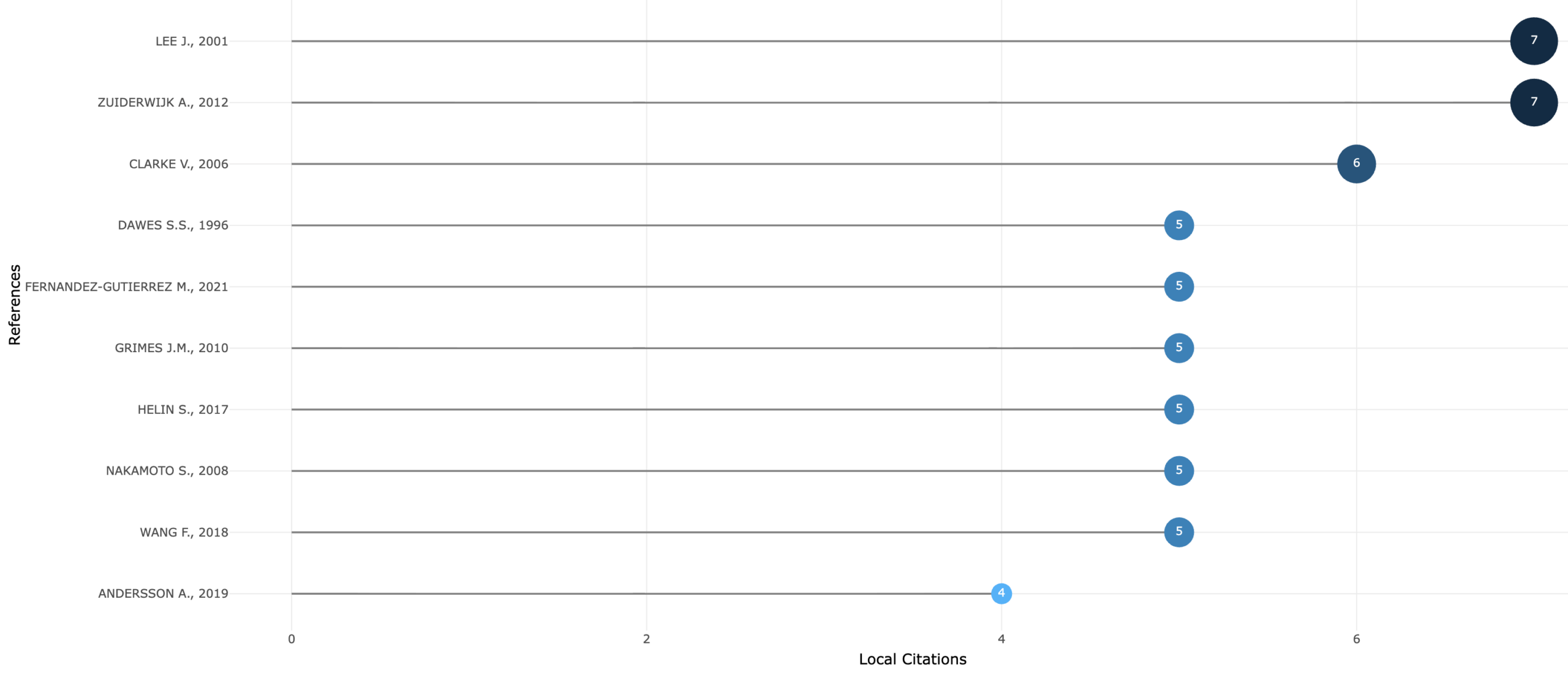
The “Most Local Cited References” figure identifies the works that are most frequently cited by the documents included in this Scopus corpus. Unlike global citations, which measure the overall influence of a document across Scopus, local citations show which references are most important within this specific research field: interoperability, data sharing, information exchange, digital government, public administration, and public service delivery.
An important first observation is that the local citation counts are relatively low. The most locally cited references appear only seven times within the corpus. This suggests that the field is fragmented and interdisciplinary, rather than organized around a single dominant theory or canonical body of literature. The corpus draws from e-government, public administration, information systems, open data, blockchain, transparency, public value, and qualitative research methods.
The most locally cited works point to several foundational themes.
First, Lee (2001) represents one of the classic references on the evolution of e-government. Its presence suggests that many studies still rely on staged models of digital government development, moving from basic online presence toward more integrated, transactional, and service-oriented forms of government. For my research, this is relevant because digital public documents can also be understood as part of a broader maturation process: from paper-based certificates and permits, to downloadable PDFs, to verifiable, interoperable, machine-readable digital records.
Second, Zuiderwijk et al. (2012) connects the corpus to the literature on open data and open government. This reference is important because it highlights that making data available is not enough. Public-sector data reuse depends on institutional conditions, technical standards, incentives, usability, trust, and the capacity of public organizations and users to work with data. This is directly relevant to the study of digital public documents because official documents are not only administrative outputs; they are also structured information resources that could be reused across agencies and services.
Third, Dawes (1996) is one of the key foundational references on interagency information sharing. This work is central to the corpus because it frames information sharing as both beneficial and risky. On the one hand, interagency data exchange can reduce duplication, improve coordination, and enhance public service delivery. On the other hand, it creates risks related to privacy, data quality, accountability, institutional control, and misuse of information. This is highly relevant for Mexico, where the digitalization of public documents would require strong institutional rules about who can access, verify, update, and reuse official data.
Fourth, Wang (2018) provides a more recent and dynamic view of interagency government data sharing. The abstract of this document, included in the Scopus export, emphasizes that interagency data sharing improves the coordination of government departments and public services. It also develops a dynamic mechanism model based on forces that shape government data sharing over time. For my research, this is especially useful because it supports the idea that interoperability is not a one-time technical integration, but an evolving institutional process involving incentives, constraints, organizational routines, and coordination mechanisms.
Fifth, Helin (2017) adds a longitudinal perspective on inter-organizational information sharing in the public sector. Its relevance lies in showing that the conditions for successful information sharing change over time. This matters because digital public document systems cannot be designed only as technical platforms. They must also consider how legal responsibilities, organizational incentives, political priorities, and administrative routines evolve during implementation.
A different but increasingly important cluster is associated with blockchain and verification technologies. Nakamoto (2008) appears as a foundational reference because many digital government papers discussing blockchain, trust, traceability, and secure data exchange cite the original Bitcoin white paper. Fernandez-Gutierrez et al. (2021), in turn, represents the more applied public-sector discussion through its systematic literature review on blockchain for public services. Together, these references indicate that part of the corpus is concerned with how governments can create trusted, tamper-resistant, and verifiable digital records.
The presence of Grimes (2010) shows another important dimension: transparency and anti-corruption. This reference links digital government and ICTs with openness, public accountability, and the reduction of corruption risks. This is very important for the study of official public documents, because certificates, licenses, permits, and administrative records are often areas where authenticity, verification, traceability, and institutional trust are critical.
Finally, Andersson et al. (2019) introduces the public value perspective. This reference is important because it reminds us that digital government should not be evaluated only by efficiency or technological sophistication. It should also be assessed in terms of public value: better services, transparency, inclusion, trust, accountability, and improved relationships between citizens and the state.
Interpretation for My Research
Taken together, these locally cited references suggest that the corpus is built around five main intellectual foundations:
- E-government maturity and service integration: Digital government is understood as a process of institutional and technological evolution, not merely as the digitization of existing procedures.
- Open data and public-sector data reuse: Data must be accessible, usable, reliable, and governed through appropriate rules and standards.
- Interagency information sharing: Public service delivery increasingly depends on the ability of different government offices to exchange data securely and meaningfully.
- Trust, verification, and blockchain-inspired infrastructures: The literature is increasingly concerned with how governments can guarantee authenticity, integrity, and traceability in digital records.
- Transparency, anti-corruption, and public value: Digital public services must generate institutional trust and public value, not only operational efficiency.
Relevance for a DPP-like Approach to Mexican Public Documents
For my own research, this figure is very useful because it confirms that digital public documents can be analysed as more than administrative files. They can be conceptualized as interoperable, verifiable, and reusable data objects embedded in institutional governance systems.
This is where the analogy with Digital Product Passports becomes useful. A Digital Product Passport organizes product-related data so that it can be accessed, verified, reused, and exchanged across a value chain. Similarly, a digital public document could organize government-issued data so that it can be verified and reused across agencies, administrative procedures, and public services.
For Mexico, this perspective opens an important research agenda. Official documents such as permits, licenses, certificates, constancias, land-use authorizations, civil registry documents, and administrative resolutions could be studied as public-sector data infrastructures. Their value would depend not only on digital signatures or QR codes, but also on interoperability rules, semantic standards, access rights, institutional responsibilities, verification mechanisms, and public value outcomes.
Methodological Note
This figure should be interpreted as an indicator of the internal intellectual structure of the corpus. Since local citation counts are relatively low, the field appears dispersed across multiple traditions rather than concentrated around a single dominant theory. Therefore, this analysis should be complemented with co-citation analysis, keyword co-occurrence, bibliographic coupling, and manual reading of the most relevant documents.
Reference Spectroscopy
Most Frequent Words
The Core Vocabulary of the Corpus
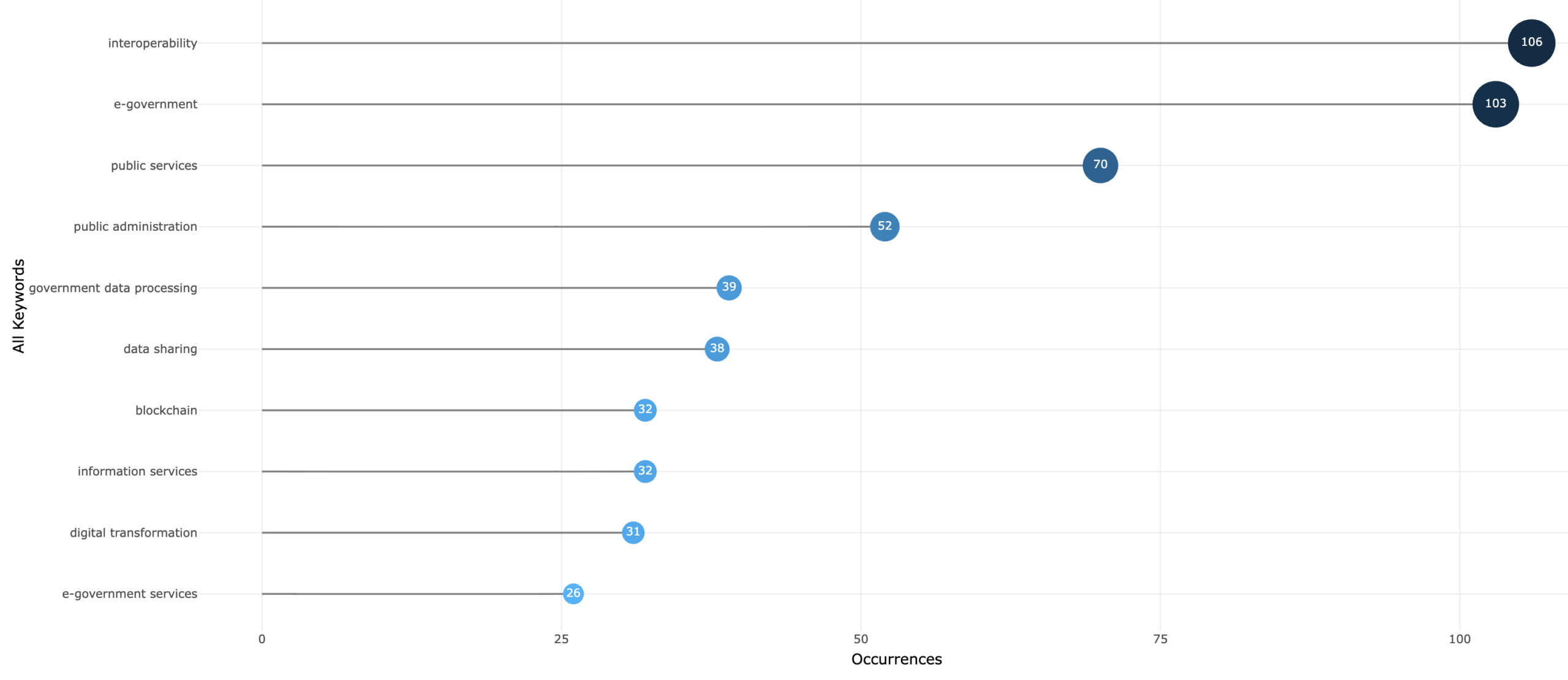
The “Most Frequent Words” figure shows the keywords that appear most often in the Scopus corpus retrieved through the query on interoperability, data sharing, information exchange, public administration, digital government, and public service delivery.
The dominant term is interoperability, with 106 occurrences, followed closely by e-government, with 103 occurrences. This confirms that the corpus is strongly aligned with the main objective of the search strategy: to identify literature dealing with the technical, organizational, and institutional conditions that allow public-sector information systems to exchange and reuse data.
The next most frequent term is public services, with 70 occurrences, followed by public administration, with 52 occurrences. This is important because it shows that the literature is not only concerned with technical data exchange, but also with the transformation of public-sector organizations and service delivery models. In other words, interoperability appears as a means to improve how governments provide services to citizens, firms, and other institutions.
A second group of terms includes government data processing and data sharing, with 39 and 38 occurrences respectively. These terms point to the operational layer of the field: how public data is collected, processed, exchanged, governed, and reused across agencies. For my research, this is particularly relevant because official public documents can be understood as structured outputs of government data processing. If these documents are designed as interoperable and verifiable data objects, they can become reusable inputs for other administrative procedures.
The presence of blockchain, with 32 occurrences, shows that part of the literature is concerned with trust, traceability, verification, and tamper-resistant records. This is relevant for the idea of digital public documents because certificates, licenses, permits, and official records require authenticity, integrity, and institutional trust. However, the presence of blockchain should not be interpreted as meaning that blockchain is the only solution. Rather, it indicates that the literature is exploring different technological mechanisms for ensuring trusted data exchange.
The terms information services, digital transformation, and e-government services also appear among the most frequent keywords. Together, they suggest that the field has moved beyond the simple digitization of administrative procedures. The focus is increasingly on integrated, data-driven, user-oriented, and service-based models of government.
Interpretation for My Research
This figure confirms that the corpus is structured around three main conceptual layers.
First, there is a technical and semantic layer, represented by terms such as interoperability, data sharing, government data processing, and information services. This layer refers to the standards, architectures, vocabularies, systems, and data models required for public institutions to exchange information.
Second, there is an organizational and administrative layer, represented by public administration, public services, and e-government services. This layer highlights that interoperability is not only a technological issue. It also requires coordination among agencies, redesign of procedures, institutional responsibilities, and changes in administrative routines.
Third, there is a governance and trust layer, represented by blockchain, digital transformation, and e-government. This layer points to questions of authenticity, verification, accountability, transparency, and public value.
For my research on digital public documents in Mexico, this is highly relevant. The keywords suggest that official documents should not be analysed only as files or PDFs. They can be understood as institutional data objects that connect public administration, interoperability, data governance, and service delivery.
Relevance for a DPP-like Approach to Public Documents
The figure supports the idea that public documents could be studied through a logic similar to Digital Product Passports. In the same way that a Digital Product Passport organizes and verifies product-related information across a value chain, a digital public document could organize and verify government-issued information across administrative procedures.
For example, a permit, license, certificate, land-use authorization, or civil registry document could function as a structured data object containing verified information, metadata, issuing authority, validity period, access rights, and machine-readable data fields. This would allow the document to be reused across agencies, reduce duplication, improve service delivery, and strengthen institutional trust.
From this perspective, interoperability becomes the central concept. Without interoperability, digital public documents remain isolated files. With interoperability, they can become part of a broader public-sector data infrastructure.
Methodological Note
This figure should be interpreted with caution because several of the most frequent words also appear in the original Scopus query. Therefore, terms such as interoperability, e-government, public services, and public administration partly confirm the search strategy itself. The more interesting analytical value comes from the combination of these terms with related concepts such as government data processing, data sharing, blockchain, information services, and digital transformation, which help reveal the thematic structure of the corpus.
WordCloud
TreeMap
Words’ Frequency over Time
How the Field Has Evolved
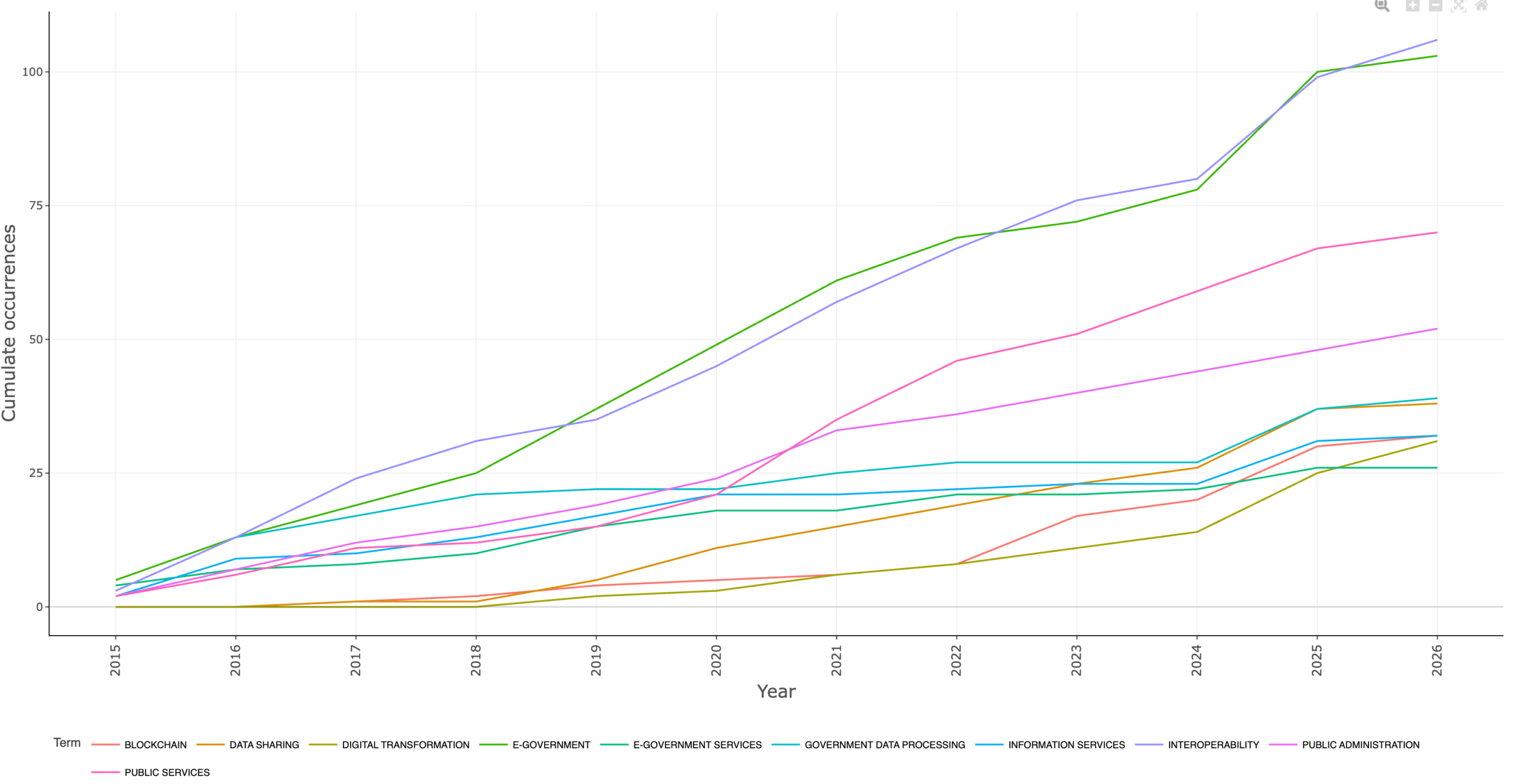
The “Words’ Frequency over Time” figure shows the cumulative evolution of the main keywords in the Scopus corpus on interoperability, data sharing, information exchange, public administration, digital government, and public service delivery between 2015 and 2026.
The first and most important observation is that interoperability and e-government clearly dominate the evolution of the field. Both terms grow steadily throughout the period and emerge as the two strongest conceptual anchors of the corpus. By 2026, interoperability reaches the highest cumulative frequency, slightly above e-government, which suggests that the field is increasingly structured around the problem of how public organizations connect systems, exchange data, and enable coordinated digital services.
A second major trend is the strong rise of public services and public administration. These terms grow more gradually than interoperability and e-government, but they become increasingly central after 2020. This indicates that the literature is not limited to technical system integration. Rather, it is increasingly concerned with the transformation of administrative processes and the improvement of service delivery. In other words, interoperability is being discussed not only as a technical capability, but as a means to redesign how government works.
The figure also shows the growing relevance of government data processing and data sharing. These terms reflect the operational and infrastructural dimension of the field. Their growth suggests that research is paying increasing attention to the management, reuse, and exchange of data across public institutions. This is highly relevant for my research, because official public documents can be understood as outputs of government data processing that may later become reusable inputs for other procedures, registries, or administrative decisions.
Another interesting pattern is the rise of digital transformation and blockchain, especially from the later years of the period. These terms start from a much lower base, but their cumulative growth becomes more visible after 2019 and especially after 2021. This suggests that the field has progressively expanded beyond traditional e-government discussions toward broader questions of institutional change, innovation, trust, verification, and technological infrastructures for secure data exchange.
The term information services remains relatively stable in the middle range, while e-government services also grows, but at a slower pace. These patterns suggest that the literature increasingly emphasizes broader public-sector data and governance issues rather than focusing only on service portals or front-end delivery channels.
A Possible Reading of the Evolution of the Field
Taken together, the figure suggests that the field has evolved in at least three broad stages.
1. Foundational stage: 2015–2018
In the earlier years, the strongest growth appears in e-government, interoperability, and, to a lesser extent, government data processing and information services. This reflects a phase in which the literature was mainly concerned with building the foundations of digital government: connecting systems, digitizing services, and improving administrative information flows.
2. Expansion stage: 2019–2022
From 2019 onward, the field broadens noticeably. Public services, public administration, and data sharing gain momentum, while interoperability continues to rise strongly. This suggests a shift from purely technical concerns toward a more integrated vision linking digital systems, organizational change, and public service delivery.
3. Emerging innovation stage: 2023–2026
In the most recent years, interoperability consolidates its leading position, while digital transformation and blockchain accelerate more visibly. This indicates that the literature is increasingly incorporating themes related to trusted digital infrastructures, organizational innovation, institutional redesign, and the strategic use of data in government.
Interpretation for My Research
For my own research, this figure is very important because it confirms that the study of digital government interoperability has moved from a narrow technical focus toward a broader institutional and governance perspective.
The long-term rise of interoperability, together with the parallel growth of public administration, public services, data sharing, and digital transformation, suggests that government interoperability should be understood as a public-sector data infrastructure rather than simply as a software integration issue.
This is directly relevant to my research on digital public documents in Mexico. If official government documents are analysed as structured digital data objects — similar in logic to Digital Product Passports — then they can be studied as part of a broader ecosystem of interoperability, data governance, institutional coordination, and service delivery. In this sense, the figure supports the argument that digital public documents should not remain isolated PDFs or static records. They should evolve into interoperable, verifiable, machine-readable, and reusable information objects.
Relevance for a DPP-like Approach
The rise of keywords such as interoperability, data sharing, government data processing, digital transformation, and blockchain supports the idea that public documents can be reimagined through a DPP-like logic.
A DPP-like digital public document would not be just a file issued by an office. It would be a structured data container with metadata, issuing authority, validity rules, verification mechanisms, and machine-readable content that could be exchanged across agencies. This could improve administrative efficiency, reduce duplication, increase traceability, and strengthen trust in official records.
From this perspective, the figure shows that the conceptual building blocks for such an approach are already present in the literature.
Brief Methodological Note
This figure represents cumulative keyword occurrences, so the lines naturally move upward over time rather than fluctuating year by year. The chart is useful for identifying long-term thematic growth, but it should be interpreted together with the “Most Frequent Words” figure and the underlying article abstracts. It is also important to remember that some keywords, such as interoperability and e-government, are partly reinforced by the original search query itself. The greatest analytical value therefore lies in observing how these core terms evolve alongside related concepts such as data sharing, government data processing, digital transformation, blockchain, and public administration.
Trend Topics
From E-Government Infrastructure to Data-Centric Public Transformation
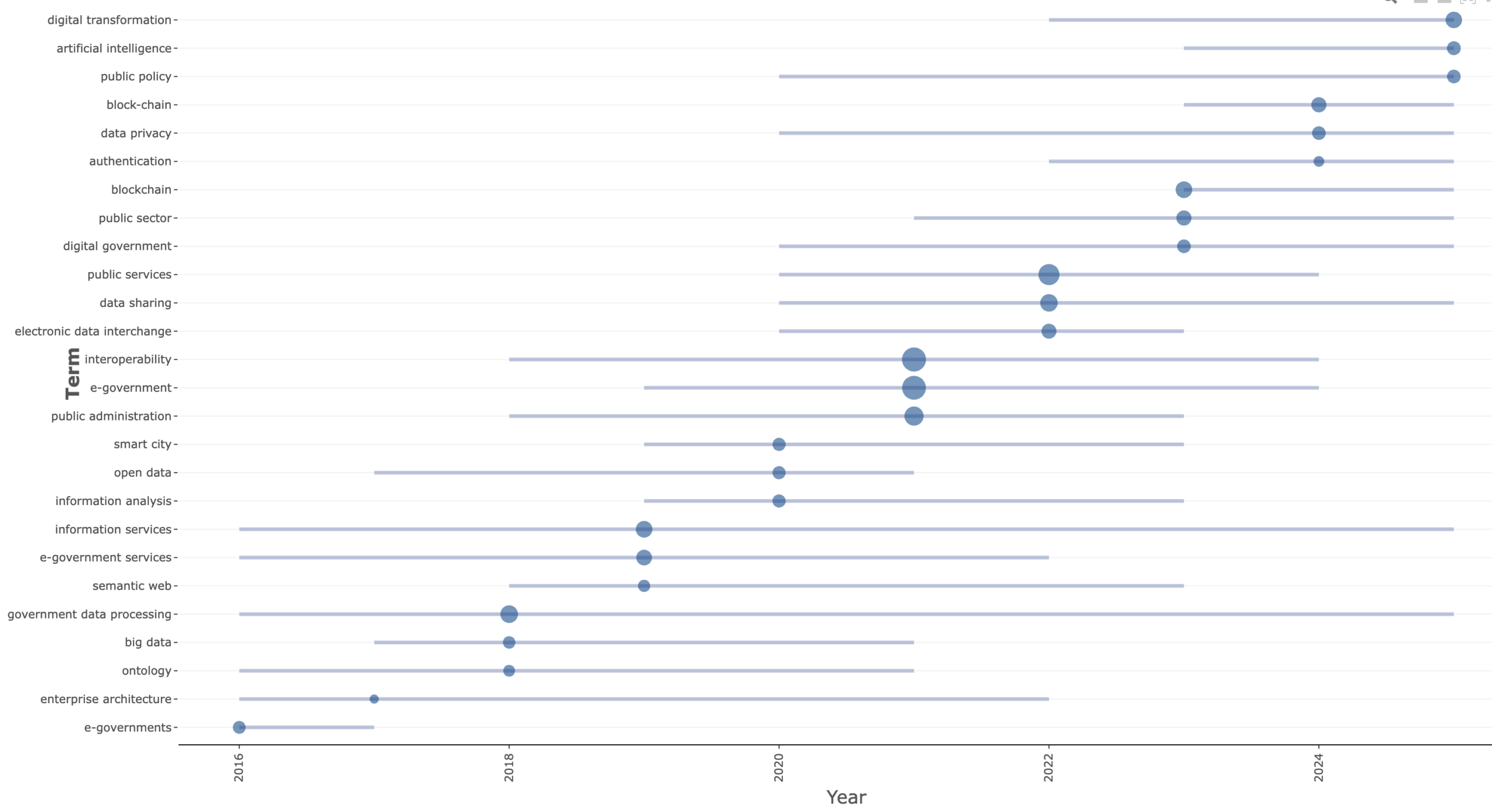
The “Trend Topics” figure shows the temporal evolution of the main concepts appearing in the Scopus corpus on interoperability, data sharing, information exchange, public administration, digital government, and public service delivery. In Bibliometrix/Biblioshiny, this type of visualization helps identify which terms become more visible in different periods of the literature.
The figure suggests that the field has moved through several thematic stages.
Early foundations: e-government, information services, and technical architectures
In the earlier years, especially around 2016–2018, the dominant terms are related to classic e-government infrastructure: e-governments, enterprise architecture, government data processing, ontology, big data, semantic web, e-government services, and information services.
This indicates that the earlier literature was strongly focused on the technical and architectural foundations of digital government. The main concern was how public-sector systems could be structured, integrated, and made capable of exchanging information. Concepts such as ontology, semantic web, enterprise architecture, and government data processing show that interoperability was initially treated as a problem of information systems design, data modeling, and technical integration.
For my research, this stage is important because it shows that digital public documents cannot be understood only as PDFs or electronic files. From the beginning, the literature has linked digital government with data structures, semantic models, and technical architectures that allow information to be reused across systems.
Consolidation stage: interoperability, e-government, public administration, and public services
Around 2020–2022, the central terms become interoperability, e-government, public administration, public services, data sharing, and electronic data interchange. This suggests a shift from technical infrastructure toward the institutional and organizational conditions of digital public service delivery.
This is one of the most important findings of the figure. The terms interoperability and e-government appear as central bridges between the older technical vocabulary and the newer governance-oriented vocabulary. At this stage, interoperability is no longer just about connecting systems. It becomes a condition for transforming public administration, improving public services, and enabling cross-agency data exchange.
The presence of data sharing and electronic data interchange reinforces the idea that public service delivery increasingly depends on the ability of government institutions to exchange verified data across organizational boundaries.
Recent trends: digital government, blockchain, privacy, AI, and digital transformation
The most recent part of the figure, especially from 2023 to 2025, shows the rise of terms such as digital government, public sector, blockchain, block-chain, authentication, data privacy, public policy, artificial intelligence, and digital transformation.
This indicates that the field is moving beyond traditional e-government and interoperability debates. The newer literature is increasingly concerned with trusted data infrastructures, secure verification, privacy protection, authentication mechanisms, AI-enabled public services, and broader institutional transformation.
The appearance of artificial intelligence and digital transformation as recent trend topics is especially relevant. It suggests that the next stage of digital government research will not only ask how public agencies exchange data, but also how they use data intelligently, responsibly, and securely to redesign public services and administrative decisions.
The presence of data privacy and authentication is also very important for research on digital public documents. If government-issued documents become interoperable and reusable, then strong rules are needed to determine who can access, verify, update, and reuse the information contained in those documents.
Interpretation for My Research
For my own research, this figure supports a central argument: digital government interoperability is evolving from a technical integration issue into a broader institutional data-governance challenge.
The field began with concerns about e-government systems, semantic web, ontologies, enterprise architecture, and government data processing. It then moved toward interoperability, public administration, public services, and data sharing. More recently, it has expanded toward digital transformation, artificial intelligence, blockchain, authentication, data privacy, and public policy.
This evolution is highly relevant for analysing digital public documents in Mexico through a DPP-like logic. Official documents such as permits, licenses, certificates, constancias, authorizations, and administrative resolutions should not be seen only as static administrative outputs. They can be understood as structured, verifiable, reusable, and interoperable data objects embedded in a broader public-sector data infrastructure.
In this sense, the figure confirms that the research agenda is no longer only about digitizing procedures. It is about designing trustworthy institutional infrastructures that allow public data to circulate securely across agencies, services, and levels of government.
Relevance for a DPP-like Approach to Public Documents
The trend topics strongly support the idea of developing a DPP-like framework for public documents.
A Digital Product Passport organizes product-related information so that it can be verified, accessed, exchanged, and reused across value chains. Similarly, a digital public document could organize government-issued information so that it can be verified, reused, and exchanged across administrative procedures.
The recent rise of terms such as authentication, data privacy, blockchain, artificial intelligence, digital transformation, and public policy shows that this type of approach would need more than technology. It would require institutional rules, semantic standards, access rights, verification mechanisms, data governance models, and legal responsibilities.
For Mexico, this opens a promising research path: public documents could be studied as institutional data infrastructures that connect interoperability, trust, public value, administrative simplification, and digital transformation.
Methodological Note
This figure should be interpreted as an exploratory visualization of thematic evolution. Some terms, such as interoperability, e-government, public services, and public administration, are partly influenced by the original search query. However, the emergence of related terms such as authentication, data privacy, artificial intelligence, blockchain, digital transformation, ontology, semantic web, and enterprise architecture provides additional insight into how the field has evolved.
Co-occurrence Network
The Conceptual Structure of the Field
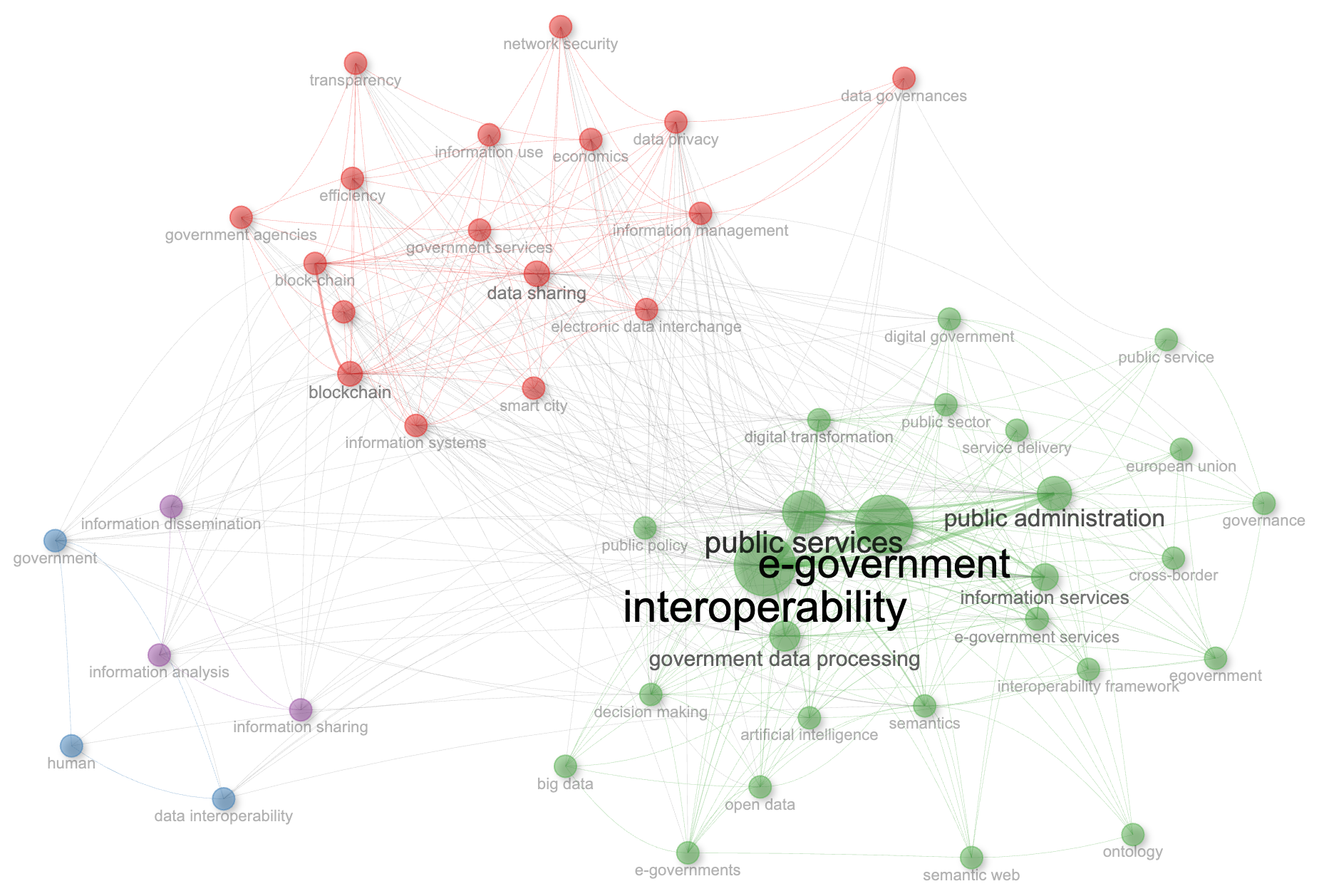
The co-occurrence network shows how the main keywords in the Scopus corpus are connected to each other. In this visualization, larger nodes represent terms that appear more frequently, while links indicate that two terms appear together within the same documents. The colors represent thematic clusters, or groups of concepts that tend to co-occur.
The most central concepts in the network are interoperability, e-government, public services, public administration, and government data processing. Their large size and dense connections show that they form the conceptual core of the corpus. This confirms that the literature is mainly concerned with how public-sector organizations use digital systems and data exchange mechanisms to improve service delivery and administrative coordination.
The green cluster, located around the center and right side of the network, represents the main digital government and public service delivery cluster. It includes terms such as interoperability, e-government, public services, public administration, government data processing, information services, digital government, public sector, service delivery, interoperability framework, semantic web, ontology, open data, artificial intelligence, and digital transformation. This cluster suggests that interoperability is not only treated as a technical matter, but as a key condition for modernizing public administration and enabling more integrated public services.
The red cluster, located toward the upper-left side of the network, is more strongly associated with data sharing, blockchain, trust, privacy, and information management. It includes terms such as data sharing, blockchain, electronic data interchange, data privacy, network security, transparency, efficiency, government agencies, government services, information management, and data governance. This cluster is especially important because it connects interoperability with questions of trust, verification, secure exchange, and institutional accountability.
A smaller peripheral group includes terms such as government, human, and data interoperability, while another group includes information sharing, information analysis, and information dissemination. These peripheral nodes suggest that the corpus also contains broader discussions on information flows, public communication, and data interpretation, but these themes are less central than the main interoperability and e-government clusters.
Interpretation for My Research
This network is highly relevant for my research because it shows that interoperability in digital government is not an isolated concept. It is connected to at least four major dimensions:
First, a service-delivery dimension.
Interoperability is strongly connected with e-government, public services, public administration, service delivery, and information services. This means that the literature sees interoperability as a necessary condition for improving how governments provide services to citizens, firms, and institutions.
Second, a data infrastructure dimension.
Terms such as government data processing, data sharing, electronic data interchange, semantic web, ontology, open data, and interoperability framework show that the field is deeply concerned with the infrastructures that allow public information to be structured, exchanged, and reused.
Third, a governance and trust dimension.
The presence of blockchain, data privacy, network security, transparency, efficiency, and data governance indicates that digital government interoperability also raises questions of institutional trust, authentication, verification, privacy protection, and accountability.
Fourth, an innovation dimension.
Terms such as artificial intelligence, digital transformation, smart city, big data, and decision making suggest that interoperability is increasingly linked to more advanced forms of data-driven public-sector innovation.
Relevance for a DPP-like Approach to Public Documents
For my proposed research on digital public documents in Mexico, this co-occurrence network provides strong conceptual support.
The network shows that the literature already connects interoperability, data sharing, government data processing, public administration, public services, data privacy, authentication, blockchain, and digital transformation. These are precisely the concepts needed to analyse official public documents as DPP-like digital objects.
A traditional public document, such as a permit, license, certificate, constancia, or administrative authorization, is often treated as a static file. However, from the perspective suggested by this network, a digital public document can be understood as a structured, verifiable, interoperable, and reusable data object. Its value does not come only from being digitized, but from being integrated into a broader institutional data infrastructure.
In this sense, a DPP-like public document would need:
- structured metadata;
- an issuing authority;
- verification mechanisms;
- access and privacy rules;
- semantic standards;
- interoperability with other government systems;
- clear institutional responsibilities;
- mechanisms for reuse across administrative procedures.
This interpretation connects very well with the idea of using an Institutional Analysis and Development framework. The co-occurrence network shows that the problem is not only technical. It involves rules, actors, information flows, governance structures, and institutional incentives.
Key Insight
The main insight from this figure is that the field has two strongly connected cores: one around e-government and public service delivery, and another around data sharing, trust, privacy, and governance. The research opportunity is located precisely at the intersection of these two cores.
That intersection is where digital public documents become analytically interesting. They are not just administrative outputs; they are potential public-sector data governance infrastructures.
Methodological Note
This figure should be interpreted as an exploratory map of the conceptual structure of the corpus. Some terms are influenced by the original search query, especially interoperability, e-government, public services, and public administration. However, the clustering of related terms such as blockchain, data privacy, data governance, semantic web, ontology, artificial intelligence, and digital transformation provides useful insight into the broader thematic organization of the field.
Thematic Map
Strategic Structure of the Research Field
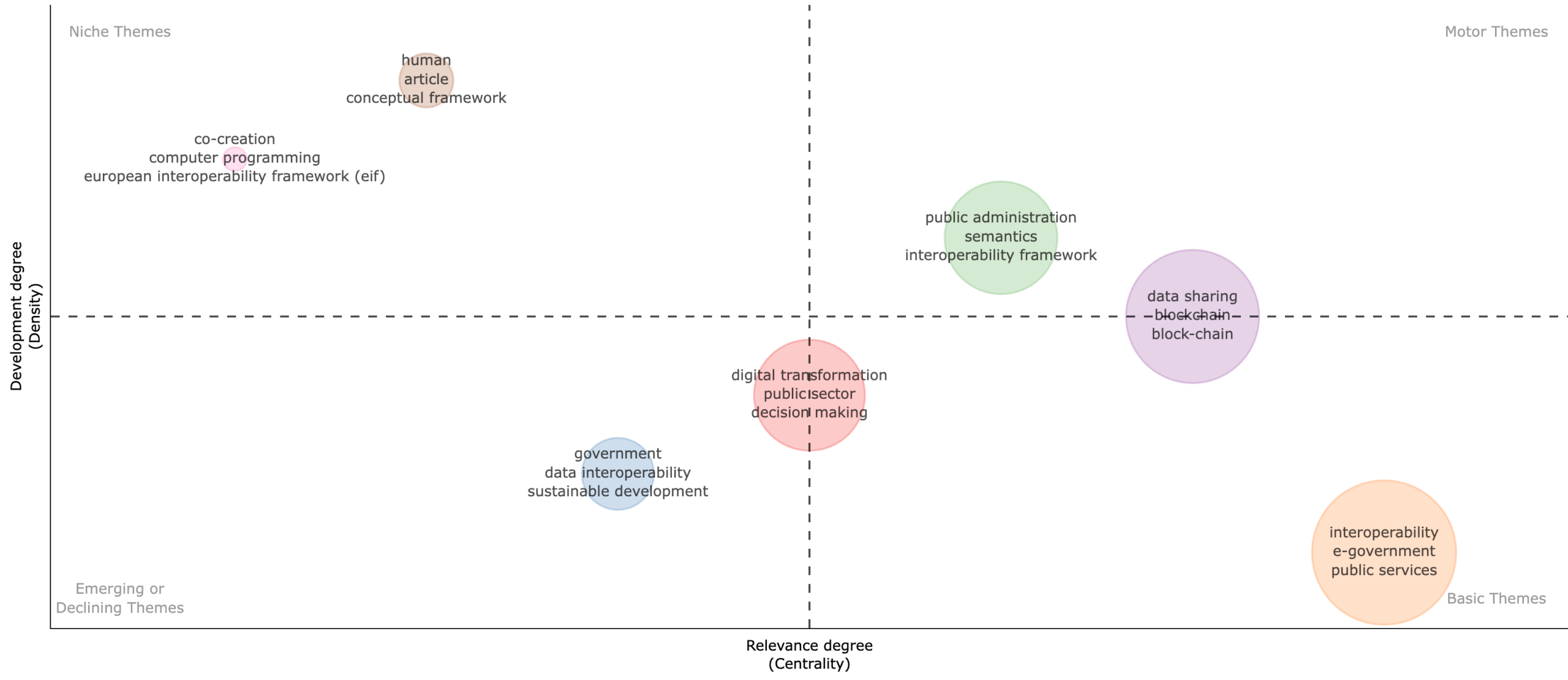
The thematic map shows the strategic position of the main keyword clusters in the Scopus corpus on interoperability, data sharing, digital government, public administration, and public service delivery.
In this figure, the horizontal axis represents centrality, or how relevant a theme is to the overall research field. The vertical axis represents density, or how internally developed and coherent the theme is. Based on these two dimensions, Bibliometrix classifies themes into four quadrants: motor themes, basic themes, niche themes, and emerging or declining themes.
Basic Themes: The Core Vocabulary of the Field
The largest cluster appears in the lower-right quadrant and includes interoperability, e-government, and public services. This is the most important basic theme in the corpus.
Its position means that these concepts are highly central to the field, but still broad and general. They provide the foundation for the whole research area. In other words, most of the literature is built around the relationship between digital government systems, interoperability, and the delivery of public services.
For my research, this confirms that interoperability is not a secondary technical issue. It is one of the basic concepts structuring the field. Any proposal for digital public documents in Mexico must therefore address interoperability as a foundational condition for administrative modernization and service integration.
Motor Themes: Highly Developed and Central Areas
The upper-right quadrant contains the motor themes of the corpus. These are themes that are both central to the field and internally well developed.
Two clusters stand out.
The first includes public administration, semantics, and interoperability framework. This suggests that one of the most mature areas of the literature connects public administration with semantic interoperability and formal interoperability frameworks. This is especially relevant because it shows that the field has moved beyond simple technical integration. It is now concerned with shared meanings, data standards, vocabularies, and institutional frameworks that allow public organizations to exchange information correctly.
The second motor theme includes data sharing, blockchain, and block-chain. This cluster shows that data sharing and trusted digital infrastructures are becoming highly developed research themes. The presence of blockchain reflects the growing interest in verification, traceability, data integrity, and secure exchange in digital government contexts. However, the separate appearance of “blockchain” and “block-chain” also suggests that future preprocessing should harmonize these terms.
Together, these motor themes show that the field is increasingly focused on two key questions:
how to create meaningful interoperability through semantic and institutional frameworks?, and how to ensure trustworthy data sharing through secure digital infrastructures?.
Emerging or Declining Themes
The lower-left quadrant contains themes with low centrality and low density. These may represent either emerging topics that have not yet fully developed or declining themes that are losing relevance.
One cluster includes government, data interoperability, and sustainable development. This suggests that the link between interoperability and sustainable development is present but still not central in this particular corpus. This is interesting because it could become a promising research bridge, especially if digital government infrastructures are connected to broader sustainability, circular economy, and public value agendas.
Another cluster, located near the center of the map, includes digital transformation, public sector, and decision making. Its position is especially interesting. It is not fully developed as a motor theme, but it is close to becoming more central. This suggests that digital transformation in the public sector is an important bridging theme that may continue gaining relevance in future research.
For my work, this is important because digital public documents can be positioned precisely within this emerging space: as instruments that connect interoperability, data governance, decision-making, and public-sector digital transformation.
Niche Themes: Specialized but Peripheral Topics
The upper-left quadrant contains niche themes. These themes are internally developed but less central to the overall corpus.
One small cluster includes human, article, and conceptual framework. This likely reflects a methodological or conceptual group of studies rather than a dominant substantive theme.
Another niche cluster includes co-creation, computer programming, and European Interoperability Framework (EIF). This is highly relevant but specialized. It suggests that some research connects interoperability with co-creation, software development, and European policy frameworks. However, its peripheral position means that these topics are not yet fully integrated into the main body of the corpus.
For my research, the presence of the European Interoperability Framework is important because it can provide a comparative reference for thinking about interoperability governance in Mexico. However, the thematic map suggests that EIF-related work should be used as a specialized reference rather than as the only conceptual foundation.
Interpretation for My Research
The thematic map supports a very clear interpretation: the field is structured around a broad foundation of interoperability, e-government, and public services, while its more developed research fronts focus on semantic interoperability frameworks, public administration, data sharing, and blockchain-based trust mechanisms.
This is highly relevant for developing a DPP-like approach to digital public documents in Mexico.
The figure suggests that digital public documents should be analysed through three connected layers:
- Basic service layer: Digital public documents are part of e-government and public service delivery.
- Interoperability and semantic layer: These documents require shared data models, vocabularies, metadata, and interoperability frameworks.
- Trust and governance layer: They also require mechanisms for authentication, verification, data sharing, privacy, and institutional accountability.
This reinforces the idea that public documents should not be treated as isolated digital files. They should be understood as structured, verifiable, interoperable, and reusable data objects embedded in a broader public-sector data governance infrastructure.
Relevance for a DPP-like Approach to Public Documents
The thematic map provides strong support for the analogy with Digital Product Passports.
A Digital Product Passport organizes product-related information so that it can be accessed, verified, exchanged, and reused across a value chain. Similarly, a digital public document could organize government-issued information so that it can be verified, exchanged, and reused across public agencies and administrative procedures.
The map shows that the core concepts needed for this approach are already present in the literature: interoperability, public services, public administration, semantic frameworks, data sharing, blockchain, digital transformation, and decision making.
For Mexico, this means that digital public documents could be studied as institutional data infrastructures. Their value would depend not only on digitization, QR codes, or electronic signatures, but also on semantic standards, interoperability rules, access rights, institutional responsibilities, and public value outcomes.
Key Insight
The key insight from this figure is that the field has a strong basic core but is evolving toward more sophisticated governance questions.
The basic core is:
interoperability + e-government + public services
The more advanced research front is:
public administration + semantic interoperability frameworks + data sharing + trusted digital infrastructures
This is precisely the intersection where a research agenda on DPP-like digital public documents can make a contribution.
Methodological Note
This thematic map should be interpreted as an exploratory strategic diagram. Some central terms, especially interoperability, e-government, and public services, are influenced by the original search query. However, the position of related clusters such as public administration–semantics–interoperability framework, data sharing–blockchain, and digital transformation–public sector–decision making provides valuable insight into the intellectual structure and future direction of the field.
Factorial Analysis
The Conceptual Positioning of the Main Terms
The factorial analysis maps the main keywords of the Scopus corpus according to their conceptual proximity. Terms that appear close to each other tend to be used in similar documentary contexts, while terms that appear far apart tend to represent different thematic orientations within the literature.
In this figure, the first dimension explains 33.69% of the variation, while the second dimension explains 16.02%. Together, both dimensions explain approximately 49.71% of the conceptual structure represented in the map. This means that the figure captures an important part of the thematic organization of the corpus, although it should still be interpreted as an exploratory visualization rather than a definitive classification.
Main Interpretation of the Map
The first dimension appears to separate two broad orientations in the literature.
On the left side, the terms are more strongly associated with data sharing, blockchain, information exchange, security, privacy, transparency, efficiency, and information systems. This side of the map reflects a more technical and trust-oriented stream of the literature. It focuses on how governments can exchange data securely, ensure integrity, improve transparency, and manage inter-organizational information flows.
On the right side, the terms are more closely related to interoperability, e-government, public administration, government data processing, e-government services, semantic web, semantics, interoperability frameworks, governance, and the European Union. This side reflects a more institutional and service-oriented stream. It is concerned with how digital government systems are organized, standardized, and integrated to improve public service delivery.
The second dimension also provides an interesting distinction. The upper part of the map includes terms such as network security, data privacy, transparency, efficiency, blockchain, public policy, government data processing, e-governments, and semantics. These terms point to formal, systemic, and infrastructural concerns: security, policy, data standards, and institutional reliability.
The lower part includes terms such as governance, digital transformation, service delivery, service industry, government, human, and information sharing. This area seems more related to implementation, organizational change, and the practical delivery of services.
Key Conceptual Groups
The map suggests four broad conceptual areas.
- Trust, security, and blockchain-oriented data sharing: The upper-left area contains blockchain, block-chain, network security, data privacy, transparency, efficiency, information systems, and data sharing. This group shows that one research stream connects public-sector data exchange with trust-building technologies and secure information management. This is relevant for digital public documents because official records require authenticity, verification, traceability, and protection against unauthorized modification.
- Institutional interoperability and public administration: The right side of the map contains interoperability, public administration, e-government, government data processing, e-government services, interoperability framework, semantic web, semantics, and European Union. This group is particularly important for my research because it shows that interoperability is not just a technical term. It is strongly connected to administrative modernization, semantic standards, public-sector frameworks, and institutional coordination.
- Digital transformation and service delivery: The lower-central/right area includes digital transformation, digital government, service delivery, governance, and service industry. These terms suggest an implementation-oriented stream focused on how public institutions transform their processes, services, and organizational models through digital technologies. This is important because a DPP-like model for public documents would not only require issuing digital files; it would require redesigning service delivery around reusable and verifiable data.
4. Information flows and public communication
The far-left area includes information dissemination, information analysis, information sharing, and government. These terms appear more peripheral, suggesting a broader but less central discussion about how governments distribute, analyse, and share information.
Interpretation for My Research
For my research on digital public documents in Mexico, this figure is especially helpful because it shows that the field is structured around two complementary logics.
The first logic is about trusted data exchange: data sharing, blockchain, privacy, security, transparency, and information systems.
The second logic is about institutional interoperability: public administration, e-government, interoperability frameworks, semantics, government data processing, and public service delivery.
A DPP-like approach to public documents sits precisely at the intersection of these two logics. Public documents such as permits, licenses, certificates, constancias, authorizations, and administrative resolutions need to be both:
- trusted and verifiable, because they carry legal and administrative authority; and
- interoperable and reusable, because they can reduce duplication and support integrated public services.
This supports the idea that digital public documents should not be treated as simple PDFs or isolated electronic records. They can be analysed as structured public-sector data objects embedded in institutional rules, semantic standards, verification mechanisms, access rights, and service-delivery processes.
Relevance for a DPP-like Framework
The factorial analysis strengthens the analogy with Digital Product Passports.
A Digital Product Passport is valuable because it structures product-related information so that it can be accessed, verified, exchanged, and reused across organizations. In a similar way, a digital public document could structure government-issued information so that it can be verified and reused across public agencies, administrative procedures, and levels of government.
The map shows that the required conceptual components are already present in the literature: interoperability, data sharing, government data processing, semantic web, interoperability frameworks, data privacy, network security, blockchain, transparency, governance, and digital transformation.
Key Insight
The main insight from this figure is that the research field is divided between a technical-trust axis and an institutional-service axis.
For my article, the research opportunity is to connect both axes through the concept of DPP-like digital public documents: official documents designed as interoperable, verifiable, machine-readable, reusable, and institutionally governed data objects.
Methodological Note
This factorial map should be interpreted as an exploratory conceptual structure analysis. The position of each term reflects its association with other terms in the corpus, not a causal relationship. For future preprocessing, it would be useful to harmonize keyword variants such as blockchain/block-chain, e-government/e-governments/egovernment, and data governance/data governances to obtain a cleaner conceptual structure.
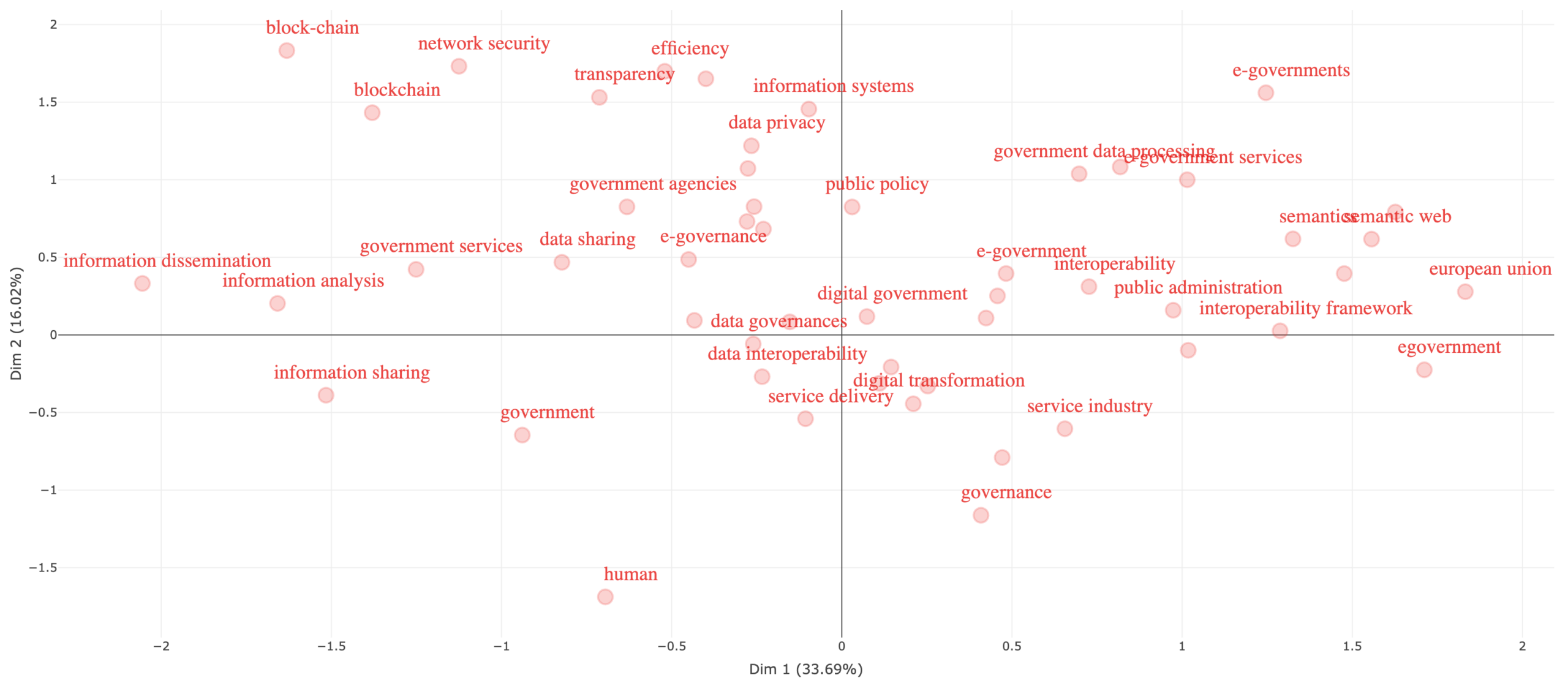
Co-citation Network
The Intellectual Architecture of the Field
The co-citation network shows which authors are frequently cited together within the Scopus corpus on interoperability, data sharing, digital government, public administration, and public service delivery. In this figure, larger nodes represent more influential cited authors, while the links show how often authors are cited together. The colors indicate intellectual clusters, or groups of references that tend to support similar research conversations.
The most central node in the network is Gil-Garcia J.R., whose work is strongly associated with digital government, smart government, inter-organizational information integration, public value, and the institutional challenges of data sharing in the public sector. His central position suggests that the corpus relies heavily on the idea that digital government is not only a technological transformation, but also an organizational and institutional transformation.
Another highly visible node is Charalabidis Y., connected to authors such as Kalogirou V., Lampathaki F., Sarantis D., and Loutsaris M.A. This cluster appears closely related to European digital government research, interoperability frameworks, public service modelling, open government data, semantic interoperability, and cross-border service integration.
A third important cluster includes Tambouris E. and Peristeras V., together with authors such as Zuiderwijk A., Van Noordt C., and Creswell J.W. This group is relevant because it connects e-government, open data, public-sector innovation, research methodology, and interoperability-oriented digital public services. The presence of Tambouris and Peristeras is especially important because both have contributed significantly to European e-government and interoperability research.
The orange cluster around Weerakkody V., Scholl H.J., Luna-Reyes L.F., Cresswell A.M., Wizeyimana J.D., and Margetts H. points toward another strong intellectual tradition: digital government adoption, public value, service transformation, and the organizational conditions required for successful e-government implementation. This cluster reinforces the idea that interoperability and digital service delivery are not only technical projects; they depend on institutional capacity, governance, administrative coordination, and public-sector reform.
The green cluster, including authors such as Brandsen T., Nabatchi T., Sørensen E., Bryson J.M., and Christensen T., appears to represent a public administration and governance tradition. These authors are commonly associated with co-production, public value, collaborative governance, public-sector innovation, and institutional design. Their presence is important because it shows that the corpus is not only rooted in information systems research, but also in public administration theory.
There are also smaller peripheral clusters. For example, the red cluster around Apostolou D. and Stojanovic L. may be related to semantic web, ontologies, and knowledge-management approaches in e-government. The brown cluster around Van Compernolle M., Verborgh R., and Bannister F. suggests a more specialized discussion linked to linked data, open data, and public-sector information infrastructures.
Interpretation for My Research
This figure is very useful because it confirms that the field is interdisciplinary. The literature on digital government interoperability is built from at least four intellectual traditions:
- Digital government and smart government: Represented by authors such as Gil-Garcia, Scholl, Luna-Reyes, Cresswell, Weerakkody, and Margetts. This tradition focuses on digital transformation, public value, organizational change, and the institutional capacity required to implement digital public services.
- European interoperability and public service modelling: Represented by Charalabidis, Tambouris, Peristeras, Kalogirou, Lampathaki, and Sarantis. This tradition is especially relevant for interoperability frameworks, semantic standards, open government data, and cross-border public services.
- Public administration, co-production, and governance: Represented by Brandsen, Nabatchi, Sørensen, Bryson, and Christensen. This tradition helps connect digital government with public value, institutional arrangements, collaborative governance, and citizen-oriented service delivery.
- Semantic web, linked data, and technical knowledge infrastructures: Represented by authors such as Apostolou, Stojanovic, Verborgh, and related nodes. This tradition supports the technical side of interoperability: ontologies, linked data, semantic integration, and machine-readable information.
Relevance for a DPP-like Approach to Public Documents
For my research on DPP-like digital public documents in Mexico, the co-citation network provides an important theoretical justification.
The figure shows that the field is not based on a single discipline. Instead, it combines:
- digital government studies;
- public administration theory;
- interoperability frameworks;
- semantic and technical infrastructures;
- open data and data sharing;
- public value and collaborative governance.
This is precisely the type of interdisciplinary foundation needed to study official public documents as structured, verifiable, interoperable, and reusable data objects.
A digital public document — such as a permit, license, certificate, constancia, authorization, or administrative resolution — is not only a technological artifact. It is also an institutional object. It is issued by an authority, governed by legal rules, used by citizens or firms, verified by other agencies, and reused across administrative procedures.
Therefore, a DPP-like framework for public documents should combine:
- interoperability and semantic standards, from the European digital government tradition;
- organizational and institutional analysis, from digital government and public administration research;
- trust, verification, and data governance, from the literature on information systems, open data, blockchain, and secure data exchange;
- public value and service delivery, from public administration and e-government studies.
Key Insight
The main insight from this co-citation network is that the intellectual opportunity for my research lies at the intersection of digital government interoperability, public administration governance, and semantic data infrastructures.
This supports the argument that digital public documents in Mexico should not be studied merely as electronic files or digitized PDFs. They can be conceptualized as public-sector data governance infrastructures, similar in logic to Digital Product Passports, but applied to government-issued documents and administrative procedures.
Methodological Note
This figure should be interpreted as an exploratory map of the intellectual structure of the corpus. Co-citation does not mean that the authors collaborated directly. It means that they are cited together by later documents. Therefore, the network helps identify shared intellectual foundations, research traditions, and theoretical communities within the field.
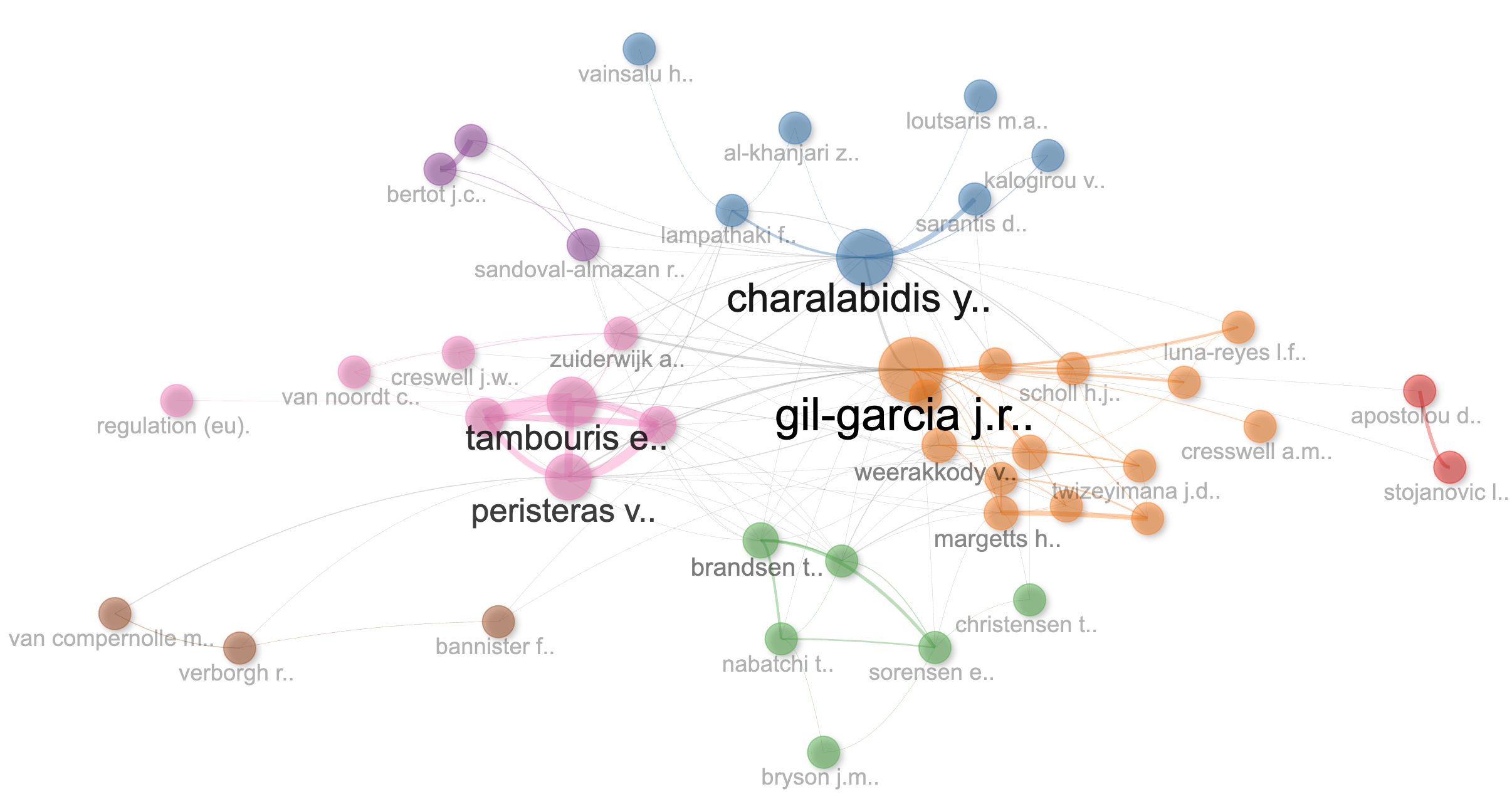
Collaboration Network
Research Communities Behind the Corpus
The collaboration network shows how authors in the Scopus corpus are connected through co-authorship. Unlike the co-citation network, which maps intellectual influence, this figure shows actual research collaboration patterns among authors working on interoperability, data sharing, digital government, public administration, and public service delivery.
In this visualization, larger nodes represent authors with stronger presence in the collaboration structure, while the links show co-authorship relationships. The colors indicate collaboration clusters, meaning groups of authors who tend to publish together.
Main Collaboration Clusters
The network reveals that the field is organized around several specialized research groups, rather than one single dominant global network.
One important cluster appears around Miguel Alvarez-Rodriguez, Victoria Kalogirou, and Yannis Charalabidis. This group seems connected to European research on digital government, interoperability, public services, semantic frameworks, and cross-border digital administration. The presence of authors such as Charalabidis and Kalogirou is especially relevant because their work is often associated with public-sector interoperability, open government data, and digital public service modelling.
Another central cluster includes Efthimios Tambouris, Vassilios Peristeras, Robert Krimmer, Ioannis Konstantinidis, and related collaborators. This cluster is highly relevant for the research topic because it connects e-government, interoperability, once-only principles, public service integration, and European digital government infrastructures. It appears as one of the most important collaboration communities in the corpus.
A third visible cluster is organized around Erik Mannens and Mathias Van Compernolle. This group seems more closely related to linked data, semantic technologies, and public-sector data infrastructures. Its position near the Tambouris–Peristeras cluster suggests a connection between semantic data technologies and digital government interoperability.
The network also shows a smaller but visible cluster around Omar El Beqqali and Barakat Oumkaltoum. This group appears to represent a more technical research stream focused on e-government architectures, data warehousing, business intelligence, cloud computing, and information systems for public services.
Several smaller peripheral clusters are also present. These include groups around authors such as Ordiyasa, Nugroho, Siapera, Prentza, Chenouni, Adadi, and others. Their peripheral position does not mean they are unimportant. Rather, it suggests that they publish within more localized or specialized collaboration groups that are less connected to the central European interoperability network.
Interpretation for My Research
This figure suggests that the research field is collaborative but fragmented. There are strong author communities, but they do not all form one fully integrated network. Instead, the corpus contains several research islands connected by thematic proximity but not always by direct co-authorship.
This is important because interoperability itself is a cross-boundary problem, yet the academic collaboration structure still appears divided into specialized communities:
- European digital government and interoperability frameworks;
- semantic web and linked data infrastructures;
- e-government systems and technical architectures;
- public-sector service delivery and administrative modernization;
- localized or country-specific digital government studies.
For my research, this confirms that a DPP-like approach to digital public documents in Mexico can draw from several communities at once. The topic is not only technical, nor only administrative. It sits at the intersection of:
- digital government,
- semantic interoperability,
- institutional governance,
- public service delivery, and
- trusted data exchange.
Relevance for a DPP-like Approach to Public Documents
The collaboration network reinforces the idea that public-sector interoperability is a collective research problem. No single author group dominates all dimensions of the field. Some communities focus on interoperability frameworks, others on semantic data infrastructures, others on e-government implementation, and others on technical information systems.
This is directly relevant for studying official public documents as DPP-like digital objects. A digital public document system would also require collaboration across multiple domains:
- public administration and legal authority;
- information systems and software architecture;
- semantic standards and data models;
- verification, authentication, and privacy;
- public service redesign;
- interagency coordination.
In this sense, the collaboration network mirrors the institutional challenge itself. Just as researchers work in specialized but connected clusters, government agencies also need to coordinate across specialized domains to make public documents interoperable, verifiable, and reusable.
Key Insight
The key insight from this figure is that the literature is structured around research communities, not isolated individuals. The most visible communities are linked to:
- European digital government,
- interoperability frameworks,
- semantic data infrastructures, and
- technical e-government systems.
For the article I am developing, this suggests that the Mexican case can be positioned as an opportunity to connect these research traditions into a single institutional framework for digital public document governance.
Methodological Note
This figure should be interpreted as a co-authorship map, not as a measure of theoretical influence. Authors who appear close together have collaborated directly or are part of connected collaboration groups. However, influential authors may appear less central if they publish with different teams or if their influence is captured more clearly through co-citation rather than co-authorship analysis.
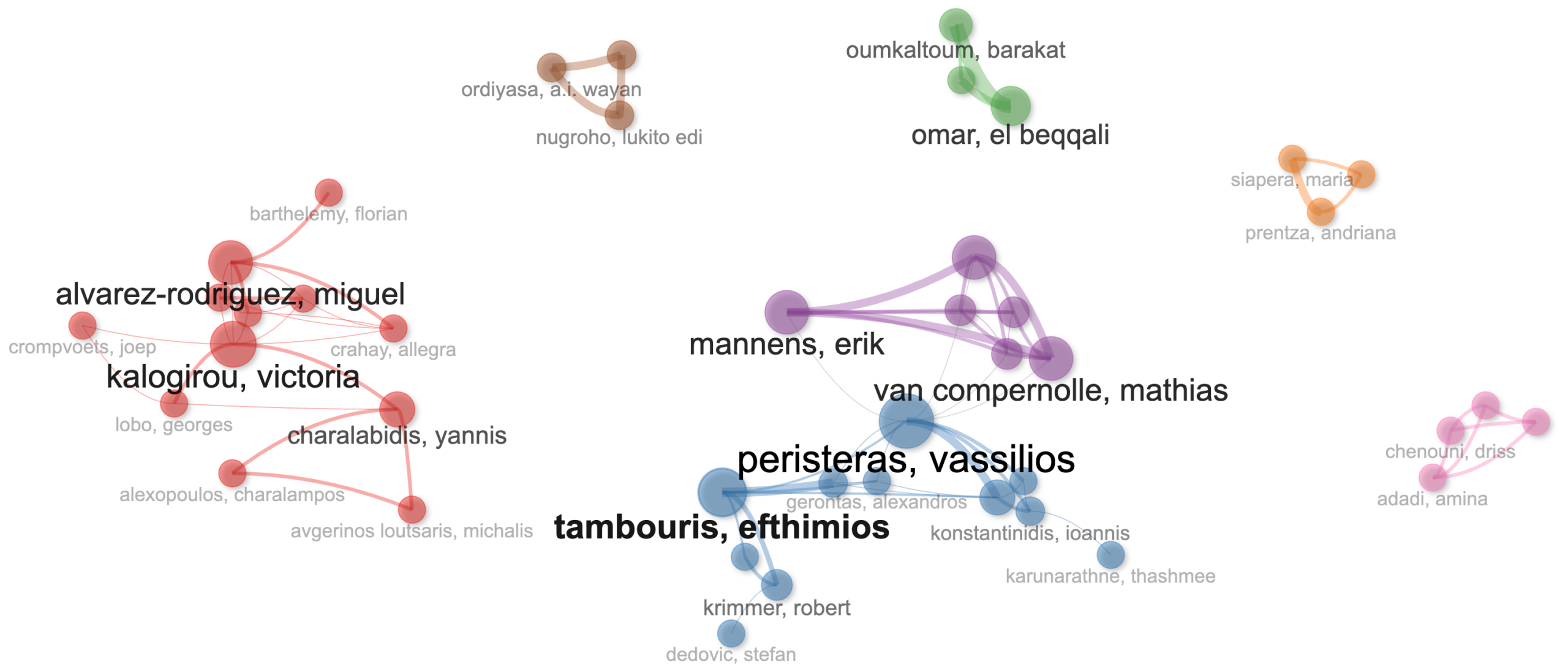
Countries’ Collaboration World Map
International Research Connections
The “Countries’ Collaboration World Map” shows the international co-authorship links within the Scopus corpus on interoperability, data sharing, information exchange, digital government, public administration, and public service delivery. In this visualization, countries are shaded according to their presence in the corpus, while the connecting lines represent international collaboration between authors affiliated with different countries.
The map confirms that this is a global research field, with contributions and collaborations across Europe, Asia, North America, Africa, Latin America, and Oceania. However, the collaboration structure is not evenly distributed. Some countries act as important bridges, while others appear mainly as domestic producers or as part of specific regional networks.
Main Collaboration Patterns
The strongest country-pair collaboration in the table is Belgium–Greece, with 5 joint publications. This is highly relevant because both countries are connected to European digital government, interoperability frameworks, semantic public services, and cross-border service delivery research. This reinforces the importance of the European research ecosystem in the development of interoperability and digital public service studies.
Two other strong links are China–United Kingdom and China–United States, with 4 collaborations each. This suggests that although China has a very strong domestic production base, part of its research is also connected to major Anglo-American academic networks.
The India–United States link, with 3 collaborations, and the USA–Australia link, also with 3 collaborations, show another important axis of international collaboration. These connections suggest that digital government, data sharing, and public service innovation are also being studied through transnational research networks involving large federal or multi-level governance systems.
Europe appears as the most interconnected regional space. Belgium, Greece, Estonia, Germany, Spain, Austria, the Netherlands, Luxembourg, Portugal, Italy, Sweden, France, and Cyprus form several overlapping collaboration links. This is not surprising, because interoperability is a central concern in the European digital government agenda, especially when public services must work across national borders, institutions, and administrative systems.
The map also shows broader South–South and cross-regional links, including collaborations involving Malaysia, Saudi Arabia, Bangladesh, Nigeria, Kenya, Oman, South Africa, Congo, Thailand, Peru, Ecuador, and Morocco. These links suggest that the field is expanding beyond the traditional European and North American centers of e-government research.
Interpretation for My Research
For my research, this map is important because it shows that digital government interoperability is not only a national technical challenge. It is also an international governance and knowledge-transfer issue.
The European collaboration network is especially relevant because many of the key ideas in the corpus — interoperability frameworks, semantic standards, once-only principles, public service modelling, and cross-border digital services — have been developed in contexts where governments must coordinate across institutional and national boundaries.
This is directly useful for thinking about digital public documents in Mexico. Although Mexico appears only through a limited collaboration link with Spain in this map, the topic itself has strong international relevance. Mexico can learn from these global discussions, especially from countries and regions that have worked on interoperability frameworks, digital identity, public-sector data exchange, and trusted digital documents.
Relevance for a DPP-like Approach to Public Documents
The collaboration map supports the idea that a DPP-like framework for public documents should not be developed in isolation. Just as Digital Product Passports require coordination across firms, regulators, platforms, and value-chain actors, digital public documents require coordination across government agencies, levels of government, legal frameworks, and technical systems.
The international collaboration patterns suggest that public-sector interoperability depends on shared knowledge across several domains:
- digital government and public administration;
- semantic interoperability and data standards;
- public service integration;
- digital identity and authentication;
- data privacy and cybersecurity;
- institutional governance and legal coordination.
For Mexico, this means that official documents such as permits, licenses, certificates, constancias, land-use authorizations, and administrative resolutions could be studied as part of a broader international research agenda on interoperable and verifiable public-sector data infrastructures.
Key Insight
The key insight from this figure is that the field has a strong European interoperability core, complemented by global collaboration links involving China, the United States, the United Kingdom, India, Australia, Saudi Arabia, Malaysia, and other countries.
For the article I am developing, this suggests that Mexico could be positioned as a valuable case for extending these debates into Latin America. A Mexican case study on digital public documents could connect local administrative challenges with international research on interoperability, data sharing, public service delivery, and institutional digital transformation.
Methodological Note
This map should be interpreted as a visualization of international co-authorship, not as a complete measure of policy influence or technological leadership. Some countries may have high publication output but limited international collaboration, while others may appear as bridges because they collaborate across several regions. The table of country-pair collaborations helps identify the strongest links, such as Belgium–Greece, China–United Kingdom, China–United States, India–United States, and USA–Australia.
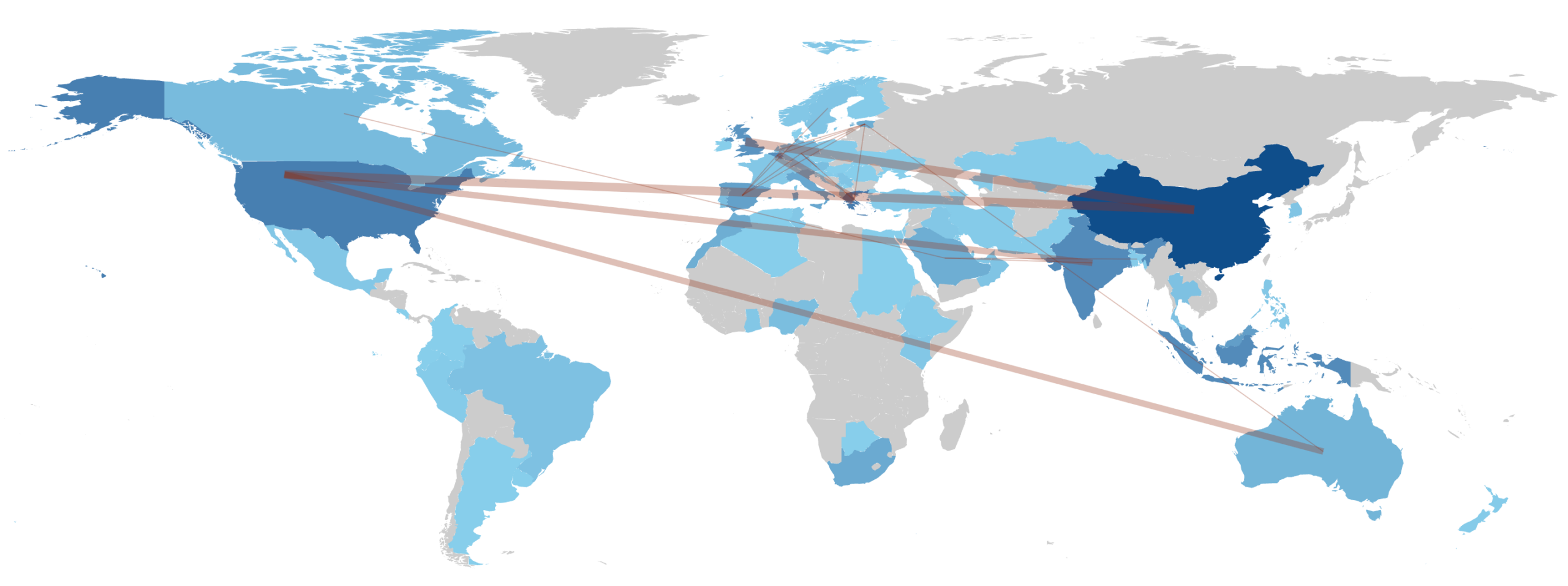
| AUSTRALIA | BANGLADESH | 1 |
| AUSTRALIA | PORTUGAL | 1 |
| AUSTRALIA | QATAR | 1 |
| AUSTRALIA | UNITED ARAB EMIRATES | 1 |
| BELGIUM | AUSTRIA | 1 |
| BELGIUM | ESTONIA | 2 |
| BELGIUM | GERMANY | 1 |
| BELGIUM | GREECE | 5 |
| BELGIUM | ISRAEL | 1 |
| BELGIUM | ITALY | 1 |
| BELGIUM | LUXEMBOURG | 2 |
| BELGIUM | NETHERLANDS | 1 |
| BELGIUM | PORTUGAL | 1 |
| BELGIUM | SPAIN | 2 |
| CANADA | AUSTRALIA | 1 |
| CANADA | BANGLADESH | 1 |
| CHINA | BANGLADESH | 1 |
| CHINA | CANADA | 1 |
| CHINA | GHANA | 1 |
| CHINA | KENYA | 1 |
| CHINA | MALAYSIA | 1 |
| CHINA | PAKISTAN | 1 |
| CHINA | SAUDI ARABIA | 1 |
| CHINA | UNITED KINGDOM | 4 |
| CHINA | USA | 4 |
| CROATIA | SLOVENIA | 1 |
| EGYPT | KUWAIT | 1 |
| ESTONIA | AUSTRALIA | 2 |
| ESTONIA | AUSTRIA | 1 |
| ESTONIA | CZECH REPUBLIC | 1 |
| ESTONIA | GERMANY | 2 |
| ESTONIA | NETHERLANDS | 2 |
| FRANCE | TUNISIA | 1 |
| GERMANY | AUSTRALIA | 1 |
| GERMANY | AUSTRIA | 2 |
| GERMANY | FRANCE | 1 |
| GREECE | AUSTRALIA | 1 |
| GREECE | CYPRUS | 1 |
| GREECE | ESTONIA | 2 |
| GREECE | GERMANY | 2 |
| GREECE | LUXEMBOURG | 1 |
| GREECE | SPAIN | 1 |
| GREECE | SWEDEN | 1 |
| GREECE | USA | 1 |
| INDIA | IRAQ | 1 |
| INDIA | ITALY | 1 |
| INDIA | MALAYSIA | 1 |
| INDIA | OMAN | 1 |
| INDIA | SAUDI ARABIA | 2 |
| INDIA | USA | 3 |
| ITALY | AUSTRALIA | 1 |
| ITALY | PORTUGAL | 1 |
| ITALY | SAUDI ARABIA | 1 |
| KAZAKHSTAN | DENMARK | 1 |
| KOREA | COSTA RICA | 1 |
| LUXEMBOURG | SERBIA | 1 |
| MALAYSIA | IRAQ | 1 |
| MALAYSIA | NIGERIA | 1 |
| MALAYSIA | PHILIPPINES | 1 |
| MALAYSIA | SAUDI ARABIA | 1 |
| MALAYSIA | UNITED ARAB EMIRATES | 1 |
| NORWAY | SWEDEN | 1 |
| OMAN | KENYA | 1 |
| PERU | ECUADOR | 1 |
| PORTUGAL | ISRAEL | 1 |
| SAUDI ARABIA | AUSTRALIA | 1 |
| SAUDI ARABIA | BANGLADESH | 2 |
| SAUDI ARABIA | CANADA | 2 |
| SAUDI ARABIA | SUDAN | 1 |
| SOUTH AFRICA | NIGERIA | 1 |
| SPAIN | AUSTRIA | 1 |
| SPAIN | CYPRUS | 1 |
| SPAIN | ESTONIA | 2 |
| SPAIN | FRANCE | 1 |
| SPAIN | GERMANY | 2 |
| SPAIN | ISRAEL | 1 |
| SPAIN | MEXICO | 1 |
| SPAIN | PORTUGAL | 1 |
| SPAIN | SWEDEN | 2 |
| SWEDEN | CYPRUS | 1 |
| SWITZERLAND | CONGO | 1 |
| THAILAND | CONGO | 1 |
| THAILAND | SWITZERLAND | 1 |
| UNITED KINGDOM | AUSTRALIA | 1 |
| UNITED KINGDOM | BANGLADESH | 1 |
| UNITED KINGDOM | BRAZIL | 1 |
| UNITED KINGDOM | CANADA | 1 |
| UNITED KINGDOM | GERMANY | 1 |
| UNITED KINGDOM | KENYA | 1 |
| UNITED KINGDOM | NEW ZEALAND | 1 |
| UNITED KINGDOM | NIGERIA | 1 |
| UNITED KINGDOM | OMAN | 1 |
| UNITED KINGDOM | PAKISTAN | 1 |
| UNITED KINGDOM | QATAR | 1 |
| UNITED KINGDOM | SAUDI ARABIA | 1 |
| UNITED KINGDOM | SOUTH AFRICA | 1 |
| UNITED KINGDOM | USA | 1 |
| USA | AUSTRALIA | 3 |
| USA | BANGLADESH | 1 |
| USA | CANADA | 1 |
| USA | CONGO | 1 |
| USA | ESTONIA | 1 |
| USA | ETHIOPIA | 1 |
| USA | GERMANY | 1 |
| USA | KENYA | 1 |
| USA | KOREA | 1 |
| USA | MOROCCO | 1 |
| USA | OMAN | 1 |
| USA | SAUDI ARABIA | 1 |
| USA | SWITZERLAND | 1 |
| USA | THAILAND | 1 |
| USA | UNITED ARAB EMIRATES | 1 |